

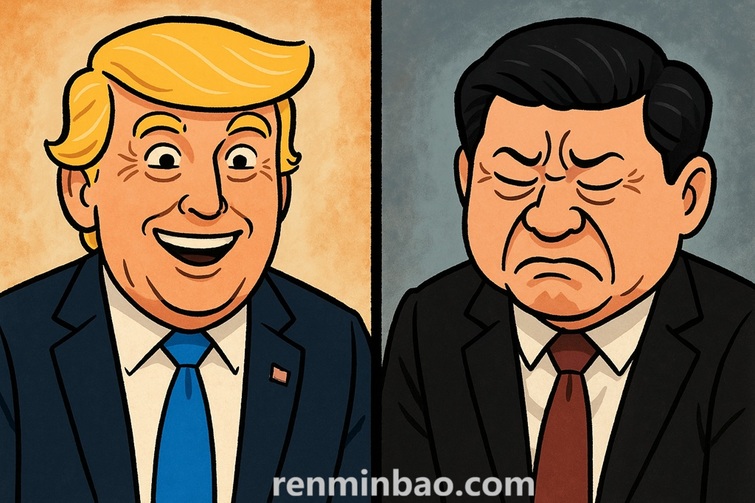
On September 19, 2025, during a phone call between Trump and Xi, Trump came away with a double win, while the CCP’s wolf warrior diplomacy was left deflated. (Image by People News)
[People News] U.S. President Trump is scheduled to meet with Chinese Communist Party (CCP) General Secretary Xi Jinping on September 24. On September 16, approximately 30 organizations advocating for human rights, democracy, and religious freedom worldwide issued an open letter to Xi Jinping, urging the CCP to immediately release political prisoners, human rights defenders, and individuals who have been arbitrarily detained due to the rights activities of their relatives. They also called for an end to transnational repression and judicial reform.
The open letter asserts: "There are widespread and systematic human rights violations in China (CCP), which contravene both domestic and international legal obligations. The extent and scale of arbitrary detentions occurring in various regions may constitute a crime against humanity," and, "We are equally concerned about your government (CCP) employing transnational repression and collective punishment to suppress free speech and restrict actions outside of China."
The letter highlights the CCP's repression of Tibetans, Uyghurs, and Hong Kong residents, as well as the targeting of activists including religious leaders, feminists, journalists, lawyers, and public health experts. It commends the efforts of the U.S. and other governments to investigate and prosecute the CCP's blatant legal violations, emphasizing that these human rights advocacy organizations will continue to document the CCP's abuses. The letter specifically references the CCP's newly enacted "National Unity and Progress Promotion Law."
The issuance of the open letter quickly generated significant public response. Many netizens expressed their support and condemned the Chinese Communist Party (CCP) for its long history of persecuting the Chinese people. They called for the release of several democratic figures who have been sentenced or are facing trial, including Li Zhiying, Huang Zhihao, and Qu Jinxin. Numerous signatories have reported experiencing harassment, stalking, or surveillance by CCP authorities or their agents while in the United States, and some activists residing in the U.S. have seen their families in China face retaliation from the CCP.
Reports indicate that just before Xi Jinping's visit to the U.S., several cases involving dissenters were being processed by the CCP. On September 16, the first national security law case in Macau was held, featuring a closed-door trial for former pro-democracy legislator Qu Jinxin, who is charged with 'subverting state power.' Qu, 68, was arrested last July after he publicly criticized the Macau authorities for their CCP-influenced governance and organized memorial events for several years following the 'June Fourth' incident. Under CCP regulations, the charge of 'subverting state power' can carry a maximum sentence of 10 to 25 years in prison.
Since Qu Jinxin's arrest, his family has been unable to reach him or secure a defense lawyer on his behalf.
Furthermore, the CCP's Ministry of Foreign Affairs has announced that it has requested the extradition of senior investigative journalist Bai Zhaodong, who fled to Thailand and is currently in detention there.
Bai Zhaodong, hailing from Yulin City in Shaanxi Province, has spent over 25 years in the Chinese news industry, working for various media outlets such as Northern Weekend and Caijing magazine, where he specialized in investigative journalism, particularly focusing on official corruption. While serving as an in-depth investigative reporter at Caijing, he published several significant exposés concerning Zhao Zhengyong, the then Secretary of the Shaanxi Provincial Committee of the Communist Party of China, highlighting the corruption and political-business interests during Zhao's tenure in Shaanxi. His reporting led to him facing criminal charges, questioning, and detention on six occasions. In November 2023, he fled China and arrived in Thailand in 2024.
In September 2024, the Yulin City Public Security Bureau issued an arrest warrant against him on fabricated charges of 'extortion'.
In March of this year, while preparing to travel to a third country, he was sentenced to two months in prison by the Thai government for violating immigration laws. On September 18 of this year, the Southern Criminal Court in Bangkok is set to publicly hear the appeal filed by Bai Zhaodong and his attorney regarding his detention at the Bangkok International Immigration Detention Center.
On the 16th, an open letter from 30 human rights advocacy organizations listed nearly dozens of individuals calling for Xi Jinping's release and requested that Xi publicly confirm before his arrival in the United States that the Communist Party of China will not engage in transnational repression or collective punishment against protests and resistance actions that may occur during his visit. If these demands are ignored, Xi Jinping's visit will likely exacerbate global public concern regarding the Communist Party of China's intentions on human rights issues.
The signatories of the open letter also expressed their willingness to meet directly with Xi Jinping during his visit if the opportunity arises.
According to reports, 29 individuals from various organizations advocating for human rights, democracy, and religious freedom signed this open letter. Notable signatories include Sophie Richardson from the China Human Rights Defenders Network, Olivia Enos from the Hudson Institute, Jamie Fly from Freedom House, Beh Lih Yi from the Committee to Protect Journalists, and Aleksandra Bielakowska from Reporters Without Borders, among others.
Around the time the open letter was issued, the U.S. Congress held a hearing urging the release of Jimmy Lai.
△





News magazine bootstrap themes!
I like this themes, fast loading and look profesional
Thank you Carlos!
You're welcome!
Please support me with give positive rating!
Yes Sure!