
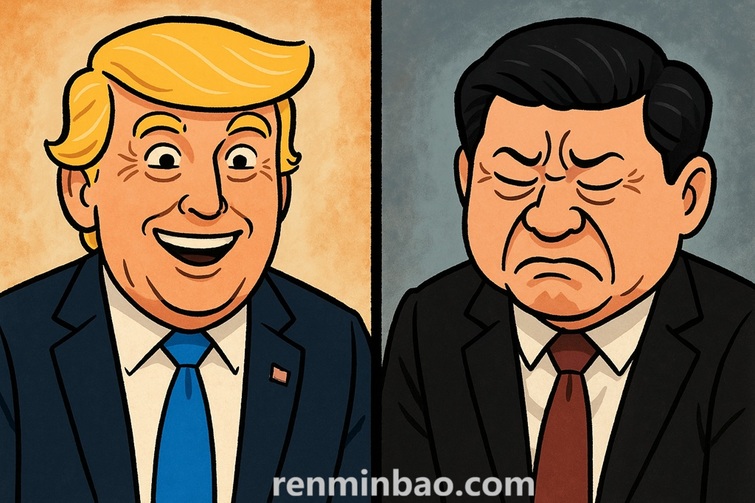
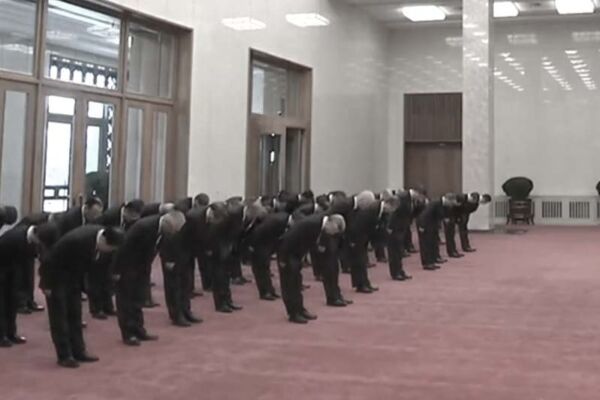
Thinking about taking action against Taiwan? Trump: You are free to think about it, but what are you actually going to do? (People News/AI-generated image)
[People News] On September 15, 2026, at the 13th Beijing Xiangshan Forum, former Chinese Ambassador to the U.S. Cui Tiankai stated, "National reunification, we will solve this problem once and for all," emphasizing that the Taiwan issue is the "red line within a red line" for the Chinese Communist Party (CCP). This assertive declaration did not incite panic within Taiwanese society; however, the timing of such strong remarks ahead of the Xi-Trump meeting suggests that the CCP has strategic calculations at play.
Official Stance: Taiwan Will Never Yield Under Pressure
In response to the CCP's "cultural warfare and military intimidation," the government of the Republic of China (Taiwan) has consistently asserted that the Republic of China (Taiwan) is a sovereign and independent nation, and that the two sides of the Taiwan Strait are not subordinate to one another, reflecting the true and objective reality of the Taiwan Strait. The CCP's unilateral characterization of the Taiwan issue as an "internal affair" or its arbitrary establishment of so-called "red lines" cannot alter the fact that Taiwan rejects the CCP's authoritarian governance. Officials have pointed out that Beijing's frequent use of unilateral coercive rhetoric, such as "once and for all" and "not ruling out the use of force," is the root cause of instability in the Taiwan Strait and the broader Indo-Pacific region. Taiwan will never yield under pressure, nor will it accept the CCP's proposed "one country, two systems" or any preconditions for unification.
Public Opinion: Behind "Once and for All" is the Elimination of Democracy
A significant number of Taiwanese netizens and public opinion generally perceive the term "once and for all" as laden with authoritarian and domineering connotations. Many have raised questions: "Does the so-called once and for all imply the erasure of Taiwan's democratic system? Or the elimination of the Taiwanese people's freedom to live as they choose?" Such sentiments have only intensified the Taiwanese public's aversion and wariness towards the CCP regime.
Some commentators and netizens have noted that the Chinese Communist Party (CCP) has been engaging in psychological warfare and military intimidation against Taiwan for a long time, using phrases like 'the earth shakes, and the mountains sway', 'the first battle is the last battle', and now 'one labor for all eternity'. Taiwanese society has developed a sense of 'immunity' and fatigue towards the wolf warrior rhetoric of such diplomats, and it is widely believed that this is more of a routine for Beijing's internal propaganda and its messaging to the United States in international forums, such as the Xiangshan Forum.
It is clear that Cui Tiankai's assertion of 'one labor for all eternity' has not succeeded in deterring Taiwan; rather, it has reinforced the consensus among the Taiwanese government and mainstream society that the future of Taiwan must be determined by the 23 million Taiwanese people themselves. Any imposed political framework or authoritarian attempts at unification will only serve to deepen the divide between the hearts of people on both sides of the Taiwan Strait.
In reality, the Taiwanese public has developed a strong 'psychological antibody' and desensitization to the extreme and hate-filled rhetoric from the CCP. Thus, the CCP's true ultimate goal may be to induce a psychological annihilation of the Taiwanese people, leading them to a state of 'spiritual paralysis' and 'self-abandonment'. In the realms of military and psychological warfare, inducing panic in the opponent can create chaos in the short term, but if this panic escalates excessively, it may instead provoke a sense of crisis and a united will to resist within Taiwanese society.
Notably, Cui Tiankai's decision to publicly make hardline statements like 'one labor for all eternity to resolve the Taiwan issue' just before the Xi-Trump meeting is not a random expression or mere emotional release; it is a carefully calculated 'preparation and chip shaping' within the CCP's diplomatic strategy towards Taiwan.
1. Fear of the United States avoiding the Taiwan issue.
The Chinese Communist Party (CCP) has consistently characterized the Taiwan issue as the 'first non-negotiable red line' in U.S.-China relations. However, the U.S. had previously sidestepped the Taiwan issue during high-level discussions at the Two Sessions. Consequently, ahead of the meeting between the U.S. and Chinese leaders, influential figures like Cui Tiankai, who is recognised as 'former Chinese ambassador to the U.S.' and 'senior U.S. expert,' have set the tone. The CCP believes this will allow them to elevate the priority of the 'Taiwan issue' at the summit, pressuring the U.S. delegation to prioritize the Taiwan Strait situation in their discussions. The CCP has signaled to the U.S. that 'Beijing has no room for compromise on the Taiwan issue,' attempting to compel the U.S. to make strategic concessions or publicly reaffirm its stance on other matters such as trade, technology controls, and sanctions (for instance, demanding the U.S. publicly reiterate its 'non-support for Taiwan independence').
Secondly, the CCP is executing a psychological warfare strategy of 'doubting the U.S.' to erode the confidence of Taiwan and its neighboring allies.
They are fostering a sense of anxiety amid the great power competition between the U.S. and China, suggesting that 'Taiwan could be traded at any moment.' This implies that the CCP is determined and has a timeline for resolving the issue, aiming to instill a psychological fear in Taiwanese society that 'the U.S. is unreliable' and 'the U.S. and China will ultimately reach a great power compromise,' thereby undermining Taiwan's internal resolve for defense.
Simultaneously, the CCP is testing whether U.S. officials or think tanks will respond with softened, retreated, or overly reactive statements upon hearing 'once and for all.' This will help assess the current strength of Washington's commitment to Taiwan Strait security and its political will. Furthermore, this strategy aims to project the CCP's image of 'holding the initiative and leadership' in managing U.S. and Taiwan-related affairs, signaling to the international community that Beijing will not alter its established strategic direction due to changes in U.S. political circumstances.
Three, Political Needs for Internal Communication and Propaganda
Within the political landscape of the Chinese Communist Party (CCP), the Ministry of Foreign Affairs plays a crucial role in fostering "internal consensus". Particularly ahead of high-level summits between China and the United States, the CCP must project a resolute stance of not conceding to the U.S., thereby crafting an image of a "strong nation" that aligns with domestic nationalist sentiments and the expectations of hawkish elements within the party.
By stressing the idea of a "one-time resolution", the CCP aims to signal internally that "the Taiwan issue will not be postponed indefinitely", thereby alleviating internal concerns regarding the government's pace of policy towards Taiwan.
Four, The Intention to Internationalize the Taiwan Issue
On the surface, the CCP has consistently asserted in its official diplomatic language that "the Taiwan issue is an internal matter of China and does not permit external interference", and it vehemently opposes the "internationalization" of the Taiwan Strait issue. However, in practice, the CCP's actions have paradoxically propelled the Taiwan issue to the forefront of global international security discussions. The CCP understands that Taiwan's geographical position is of critical strategic importance for international shipping and military operations, and destabilizing Taiwan could threaten the global shipping and supply chain "lifeline".
The Taiwan Strait is one of the busiest shipping routes in the world, accommodating nearly half of the world's container ships, while Taiwan is responsible for producing the vast majority of high-end semiconductor chips worldwide.
For Japan, the phrase 'If Taiwan has an issue, Japan has an issue' is more than just a slogan. If Taiwan were to fall under the control of the Chinese Communist Party (CCP), Japan's southwestern islands and southern energy supply lines would be directly exposed to the CCP's military might. This situation would also fundamentally alter the strategic balance in the Indo-Pacific region for Australia and the Philippines. Consequently, the CCP's military expansion has compelled countries such as Japan, South Korea, the Philippines, and Australia to form multilateral security alliances with the United States, including frameworks like AUKUS and the Japan-U.S.-Philippines mechanism.
In recent years, the CCP has frequently conducted military exercises around Taiwan, established no-fly zones, and even pursued policies aimed at 'internal sea' status in the Taiwan Strait, along with regular enforcement actions by maritime police. Such blockade threats pose a direct risk to global shipping security and supply chain stability, forcing nations like Japan, South Korea, and those in Europe and America—who heavily depend on the Taiwan Strait for shipping—to elevate the security of the Taiwan Strait to a critical 'national security issue.'
Strategic Backfire: The Outcome Beijing Most Dreads
While the CCP seeks to deter nations by escalating tensions in the Taiwan Strait, this strategy of 'reaching out to international high seas and global lifelines' has instead provoked a significant strategic backlash.
Today, 'peace in the Taiwan Strait' has emerged as an international consensus. From the G7 summit and trilateral discussions among the U.S., Japan, and South Korea, to statements from the EU and U.S.-Philippines cooperation, nearly all major international multilateral meetings now include the standard assertion that 'maintaining peace and stability in the Taiwan Strait is essential for global security and prosperity.'
The CCP believed that by instigating a crisis in the Taiwan Strait, it could force the international community to back down. However, the outcome has been that the world has become increasingly aware that safeguarding peace in the Taiwan Strait and ensuring freedom of navigation is, in fact, a means of protecting its own global interests.
In other words, the Chinese Communist Party has transformed the Taiwan issue into an international concern, resulting in Taiwan receiving greater protection from more countries.
(Originally published by People News)
△





News magazine bootstrap themes!
I like this themes, fast loading and look profesional
Thank you Carlos!
You're welcome!
Please support me with give positive rating!
Yes Sure!