
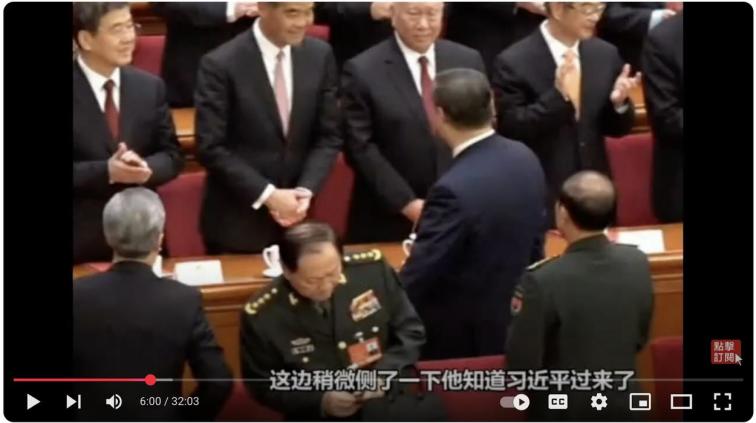
During the closing ceremony of the Two Sessions, video footage showed that as Xi Jinping was leaving, several Politburo members, including Vice Chairman of the Central Military Commission (CMC) He Weidong, turned around and stood by their seats to watch Xi depart. However, Zhang Youxia remained facing forward, not even glancing back as Xi walked past behind him. (Screenshot from video)
[People News] On September 21, following the conclusion of a Politburo meeting of the Chinese Communist Party (CCP), Zhang Youxia and Liu Zhenli were expelled from both the CCP and the military.
According to a report by Xinhua News Agency, with the approval of the CCP Central Committee and the Central Military Commission (CMC), the CMC’s Discipline Inspection Commission and Supervisory Commission have opened investigations into Zhang Youxia, a member of the CCP Politburo and Vice Chairman of the CMC, and Liu Zhenli, a member of the CMC and former Chief of the Joint Staff Department.
The report stated that on September 21, the CCP Politburo reviewed and approved the CMC’s “Report on the Investigation Results and Disciplinary Recommendations Regarding Zhang Youxia” and the “Report on the Investigation Results and Disciplinary Recommendations Regarding Liu Zhenli.”
This represents an extremely shocking earthquake at the top level of the CCP military. As a member of the CCP Politburo and the first Vice Chairman of the CMC, Zhang Youxia was not only the second-most powerful figure in the military after Xi Jinping, but also one of Xi’s most core allies within the military—a “princeling” with deep revolutionary ties, as their fathers, Zhang Zongxun and Xi Zhongxun, were life-and-death comrades in the Northwest Field Army. Meanwhile, Liu Zhenli, as Chief of the Joint Staff Department and a CMC member, was among the few high-ranking generals with actual combat experience.
The simultaneous downfall of these two central military figures is expected to have profound and dramatic impacts on both CCP politics and the military ecosystem.
“Even close confidants cannot be trusted”
The fall of Zhang Youxia and Liu Zhenli signals that the CCP’s recent wave of “anti-corruption” purges in the military has escalated—from the Rocket Force, the Equipment Development Department, and former defense ministers (Li Shangfu, Wei Fenghe), all the way to the core Politburo level and the top decision-making bodies of the CMC.
Zhang Youxia had long been viewed by outside observers as someone Xi Jinping would never move against within the military. The fact that even such a “trusted insider”—with impeccable revolutionary credentials and deep personal ties—has been purged suggests that Xi’s control over military power is facing a severe crisis of security and trust. At the peak of authoritarian power, no one is absolutely safe.
This move is likely to trigger massive shockwaves within the military and across the CCP leadership, creating an atmosphere of fear and insecurity. When even “absolute loyalty” cannot guarantee political safety, senior military officers and officials will become increasingly risk-averse, fostering formalism and passive compliance. Internal trust mechanisms may collapse entirely.
Factional purges and restructuring of the military command system
Liu Zhenli previously served as Army Commander and Chief of the Joint Staff, and, like Zhang Youxia, belonged to the traditional “Army faction” and represented experienced, battle-hardened leadership.
Both Zhang and Liu were among the few senior commanders with actual combat experience from the 1979 Sino-Vietnamese War. Their purge indicates that the influence of veteran soldiers and traditional army factions is being further uprooted.
The Joint Staff Department serves as the central hub for military operations, while the Vice Chairman of the CMC is a key conduit for military and political directives. Rapid turnover at the top levels of leadership will significantly weaken the continuity of combat readiness, the stability of military morale, and the effectiveness of central decision-making and execution.
News about Zhang Youxia first circulated online in mid-January this year, yet Xi delayed for months before officially announcing the decision to expel Zhang and Liu from both the Party and the military. This strategy—“trading time for space” and using a slow, grinding approach—offers a highly accurate reflection of the CCP’s methods of high-level political purges, particularly when targeting powerful figures within the military leadership.
Historically, authoritarian rulers have been most cautious when removing highly influential “second-in-command” figures within the military, fearing that sudden action could trigger chain reactions such as mutiny or internal coups. Xi Jinping’s adoption of a prolonged, gradual, and covert purge strategy demonstrates the calculated and ruthless nature of internal CCP power struggles.
Using delay to dissipate anger and political risk
Unlike figures such as Li Shangfu or officials from the Rocket Force, Zhang Youxia spent decades deeply embedded within the military, rising from grassroots Army ranks to Vice Chairman of the CMC. As one of the few “big brother” figures with real combat experience, he possessed extensive networks of loyal subordinates within the military, particularly in the Army and equipment systems.
If the authorities had immediately announced his expulsion and prosecution when news of his downfall first emerged, it could have triggered widespread panic within the military and even a collective backlash rooted in solidarity.
By employing a strategy of “leaking information first, handling the matter quietly, restricting movement, and maintaining surface-level stability,” the leadership ensured that officers at all levels, unable to ascertain the true situation at the top, would instinctively focus on self-preservation, observation, and mutual distrust. Once organizational cohesion within the military is fractured by suspicion and uncertainty, it becomes impossible to form any coordinated resistance.
“Quietly clipping Zhang’s wings to complete ‘de-Zhang Youxia-ization’”
During this period of delay, the authorities have actually been carrying out an extremely detailed 'military detoxification and blood replacement initiative' behind the scenes.
Xi Jinping and the CMC Discipline Inspection Commission would inevitably have used this time to secretly reassign, suspend, detain (under “shuanggui”), or investigate Zhang Youxia’s loyal subordinates and former confidants within the Joint Staff Department, the Equipment Development Department, the Army high command, and the various theater commands. At the same time, they would have conducted precise, targeted removals—“clipping his wings”—while replacing key positions (such as the Central Guard Bureau and core commanders across services) with cadres absolutely loyal to Xi personally, thereby reshaping and consolidating control over the military command chain.
This period was also used to connect all evidence involving Zhang Youxia in the equipment system and the Rocket Force corruption cases into a single, coherent chain—ensuring that the charges were “nailed down” with no room for reversal, and completely stripping him of legitimacy within the military on both political and moral grounds.
The most ruthless and cold-blooded calculus of power
Once Zhang Youxia’s influence within the military had been systematically stripped away, his loyalists eliminated, and all factions within the armed forces intimidated into declaring their distance from him, Zhang was transformed from a “highly threatening strongman” into a completely “isolated and powerless political outcast.”
At that point, the Politburo’s formal review and Xinhua’s high-profile announcement of his expulsion from the Party and the military were no longer a “high-stakes gamble that could explode at any moment,” but rather a “political declaration” whose outcome had already been sealed in secret. This not only demonstrated to the entire military the absolute authority of “those who obey me prosper, those who defy me perish,” but also signaled the complete end of the traditional old-guard generals and princeling factions within the armed forces.
Xi Jinping used “time” as a weapon to secretly complete a three-step process: “removing wings, breaking up factions, and restructuring command.” Only after gradually draining the “magma beneath the volcano” and exhausting the anger within the military did he reveal the final iron fist of enforcement. This outwardly calm “delay” masks what is in fact the most ruthless and cold-blooded exercise of power at the highest levels of the CCP.
The complete collapse of internal trust within the “Xi system”
In official CCP propaganda, military reforms and anti-corruption efforts since the 18th Party Congress were long declared to have achieved an “overwhelming victory.” Yet by 2026, the expulsion of a CMC Vice Chairman and a Chief of Staff for serious issues amounts to an implicit admission to the entire Party and nation that the past decade’s approach to military building and personnel selection has had major flaws.
When “anti-corruption” becomes an endless political purge, and when those personally promoted by the top leader repeatedly turn into “traitors and corrupt elements,” this process of self-negation continuously erodes the legitimacy and authority of the CCP’s top leadership.
The downfall of Zhang Youxia and Liu Zhenli is not a signal of political stabilization, but rather the ultimate manifestation of a complete breakdown of internal trust within an authoritarian system, plunging into a vicious cycle of suspicion. It marks the entry of CCP high-level politics into an extremely fragile and highly unpredictable deep-water zone.
What impact could the split with a core ally have on Xi’s health?
Will Zhang Youxia’s downfall further impact Xi Jinping’s health, which has long been rumored to be fragile? Historically, Lin Biao’s “betrayal” dealt a devastating blow to Mao Zedong’s health, nearly destroying it and leading to a rapid decline thereafter.
When the Lin Biao incident erupted in 1971, Mao Zedong suffered unprecedented psychological and emotional trauma. Mao had personally enshrined Lin Biao as his successor in the Party constitution. Lin’s alleged defection shattered Mao’s political myth of invincibility and symbolized the political collapse of the Cultural Revolution’s ideological framework. After the incident, Mao’s health deteriorated sharply, and he quickly descended into frailty and incapacity.
If one compares the psychological and health impacts of Zhang Youxia’s fall with Lin Biao’s “betrayal,” the blow to Xi Jinping may likewise produce a compounded effect in terms of intense psychological pressure and political paranoia.
The shattering of myth and the extremity of “political loneliness”
Lin Biao was Mao Zedong’s “closest comrade-in-arms,” while Zhang Youxia was one of the very few figures in Xi Jinping’s military circle who combined the trust labels of “princeling family ties,” “shared revolutionary lineage from the Northwest Field Army,” and “pillar of stability within the military.”
For over a decade, Xi entrusted military power to Zhang Youxia, relying on him to suppress other factions within the armed forces. If even someone as “deep-rooted and close as family” as Zhang proves problematic—whether due to policy disagreements, covert resistance, or perceived threats to power—the psychological blow to Xi Jinping would be immense. This would signal the ultimate collapse of Xi’s system of trust.
When even the last most trusted person is proven “unreliable,” what remains at the peak of power is extreme “political loneliness” and pervasive suspicion. Living in a constant state of high alert, distrusting everyone around—including guards, the military, and close associates, and seeing potential “Prigozhins” everywhere—becomes a chronic psychological stress condition. For an ageing leader rumored to suffer from serious illness, this is an extremely draining and toxic burden on health.
In medical and political psychology, intense emotional setbacks and prolonged high stress are key triggers for cardiovascular disease, immune system collapse, and mental exhaustion.
The purge of the First Vice Chairman of the CMC and the Chief of the Joint Staff affects the entire military command chain and the deployment of hundreds of thousands of troops. To prevent instability, the top leader must rapidly handle a vast number of highly sensitive personnel changes, investigations, and strategic arrangements. For an elderly leader in poor health, this represents an immense physical and mental strain.
After Lin Biao’s death in 1971, Mao Zedong developed severe cardiopulmonary conditions, including congestive heart failure and depression. For Xi Jinping—rumored to have cardiovascular issues—such a shock, stemming from the downfall of a personally cultivated “number two” figure in the military, could easily trigger sharp blood pressure fluctuations, acute cardiovascular events, or accelerate existing chronic conditions.
The Lin Biao incident devastated Mao’s health because it fundamentally shattered his confidence in his own power and historical role, causing irreversible psychological trauma.
For Xi Jinping, Zhang Youxia’s fall similarly represents a sudden earthquake of politics and trust. For a leader facing intense centralization of power, mounting geopolitical pressure, and rumored health concerns, such an environment—where “enemies seem to surround him on all sides”—is likely to further erode his health and accelerate both physical and mental decline.
Why did Xi and Zhang split?
The transformation of Xi Jinping and Zhang Youxia from “princeling allies and military partners” to open confrontation and total purge is not a случайный event, but rather an inevitable outcome of authoritarian concentration of power, combined with deep fractures between them over military development, power boundaries, and strategic decision-making.
As seen in historical parallels such as Mao Zedong and Lin Biao, or Stalin and Zhukov, when authoritarian leaders push power to its extreme, their closest aides often become their greatest threats. The reasons for their division are straightforward, mainly concentrated in the following four core areas:
Conflict of power: no tolerance for a ‘second sun’ in the military
Within the CCP’s military system, “the Party commands the gun” essentially means “the top leader alone commands the gun.” Zhang Youxia, as a princeling, with deep revolutionary family ties, and as one of the few senior commanders with real combat experience and extensive networks (especially in the Army and equipment systems), possessed influence that went far beyond that of typical political officers. His prestige—“merit overshadowing the ruler”—made it impossible for the top leader to rest easy.
For Xi Jinping, who seeks absolute centralized control, the military cannot accommodate another strong figure with prestige, factions, and real combat credentials. As purges swept through the Rocket Force and the Equipment Development Department, trails of corruption and factional ties inevitably pointed upward to Zhang Youxia. His very existence posed a latent threat to “absolute loyalty” and personal rule.
Divergence in military governance and warfighting doctrine
Xi and Zhang held fundamentally irreconcilable differences regarding how to build the military and prepare for war.
As a combat-experienced commander, Zhang understood the complexity of modern warfare, the real bottlenecks in military technology, and the actual risks of high-intensity conflict (such as a Taiwan Strait scenario or U.S. intervention). His approach emphasized pragmatism and objective constraints.
Xi Jinping, however, emphasized political control of the military, absolute obedience, and ideological directives, while setting ambitious readiness and victory targets. When professional military leaders like Zhang Youxia or Liu Zhenli raised concerns about operational risks, equipment limitations, or excessive political interference in training, they could easily be viewed by the top leadership as “lacking fighting spirit,” “passively resisting orders,” or even “politically disloyal.”
The expansion of accountability from equipment system corruption cases
The Equipment Development Department (formerly the General Armaments Department) was Zhang Youxia’s long-standing power base and one of the areas with the largest military expenditures and most concentrated利益 flows.
From the downfall of Li Shangfu (a former subordinate of Zhang) to the sweeping purge of Rocket Force leadership, numerous scandals involving procurement corruption, opaque operations, and even falsified equipment quality (such as missile fuel and silo cover issues) have been exposed.
Many of the implicated officials were personally promoted by Zhang or had long worked under him. For Xi Jinping, this suggests not only lax discipline but possibly that Zhang served as a “protective umbrella.” For Zhang, Xi’s relentless investigation into the equipment system and his former subordinates signaled an encroachment on his own political survival, destroying any remaining trust between them.
Strategic tensions over Taiwan and risk-taking
In great-power competition and the Taiwan Strait situation, a serious gap emerged between the top leadership and military commanders in strategic assessment.
Xi Jinping seeks to achieve “historic accomplishments” within his tenure and has imposed high demands on military readiness and deterrence.
However, veteran commanders like Zhang Youxia are acutely aware of the PLA’s lack of real combat testing, the destabilizing effects of ongoing purges on morale, and the actual odds in a conflict involving U.S. and Japanese intervention. When military leaders expressed caution or emphasized objective constraints regarding Taiwan-related risks, such “rational restraint” could be interpreted by an authoritarian leader as obstruction to political ambition.
Within the CCP’s authoritarian structure, there are no true “eternal allies,” only absolute hierarchical relationships. When Zhang Youxia’s military prestige, operational influence, and the corruption liabilities of the equipment system began to threaten Xi Jinping’s absolute power and sense of security, past personal ties dissolved in the face of political suspicion and survival imperatives.
(First published by People News) △




News magazine bootstrap themes!
I like this themes, fast loading and look profesional
Thank you Carlos!
You're welcome!
Please support me with give positive rating!
Yes Sure!