
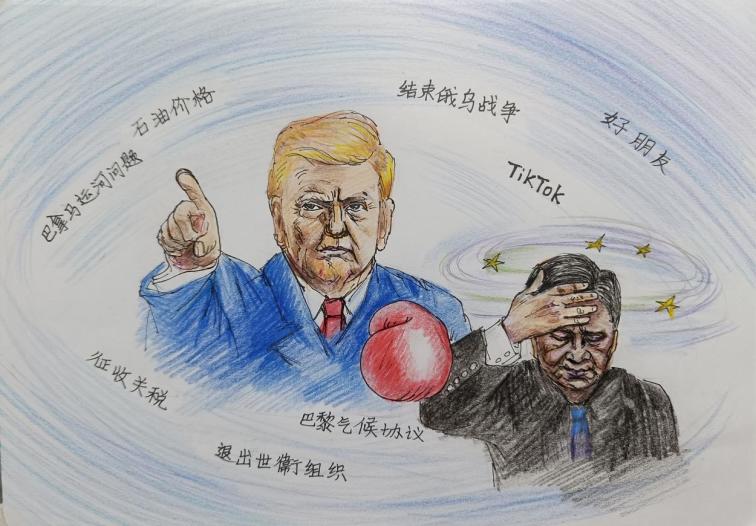
Trump's soft and hard tactics leave the CCP disoriented. (Image by Qing Yu / People News)
[People News] U.S. President Trump is set to meet with Chinese Communist Party leader Xi Jinping at the White House on September 24, where they will also hold a state dinner. In the lead-up to the summit, high-level negotiations between the U.S. and China commenced in New York, with the U.S. proposing the establishment of a new 'AI security notification mechanism' for the first time. This meeting, which addresses issues of technological security, regional stability, and the global economy, will not only assess the potential continuation of the economic and trade truce but also reflect the power dynamics within Zhongnanhai amid the internal political pressures faced by the Communist Party.
Experts interviewed suggest that this Trump-Xi summit at the White House is not a grand reconciliation that signifies a thaw in U.S.-China relations, but rather a highly tactical approach focused on 'risk management' and 'interest exchange.' The U.S. aims to sustain economic stability and momentum for the upcoming midterm elections, while Xi Jinping, facing intense internal political crises and widespread 'anti-Xi sentiment,' is looking to 'offer concessions' to the U.S. in exchange for diplomatic recognition and 'political endorsement' to mitigate internal power struggles in Zhongnanhai ahead of the Fifth Plenary Session.
Bessent's New York Negotiations Set the Stage for the Trump-Xi White House Summit
According to The Dajiyuan, on September 20, U.S. Treasury Secretary Scott Bessent and Trade Representative Jamieson Greer engaged in all-day discussions with Chinese Vice Premier He Lifeng (Hé Lìfēng) at JPMorgan's headquarters in New York, laying the groundwork for the upcoming Trump-Xi summit at the White House.
During the negotiations in New York, the U.S. and China reached an agreement to implement the dialogue mechanism known as the 'Board of Trade,' which was established in May. This mechanism aims to screen non-strategic and non-sensitive goods for reciprocal tariff reductions. China intends to lower tariffs on consumer goods and low-tech products, while the U.S. will make reciprocal adjustments on energy, agricultural products, and medical equipment; however, the specific list of goods has not yet been released.
As the U.S.-China trade truce agreement approaches its expiration on November 10, both parties are discussing mutual tariff reductions on approximately $30 billion worth of goods. Beisen Te confirmed in a September 21 interview with CNBC that discussions regarding the truce agreement have taken place, but no explicit commitment to extend the deadline has been made.
Nevertheless, the negotiations are still hindered by several unresolved issues, including China's previous commitment to purchase $17 billion worth of U.S. agricultural products (including 25 million tons of soybeans) and the promise to buy over 200 Boeing aircraft, which have not progressed significantly. Additionally, Beijing's earlier commitment to relax restrictions on the export of critical minerals has also not been fulfilled.
In this round of negotiations in New York, the U.S. introduced a proposal for a new 'U.S.-China AI Security Notification Mechanism,' focusing on national security-level notifications of AI emergencies. This proposal was submitted as a decision reference for the upcoming White House summit.
Beisen Te further indicated that the U.S. and China are expected to meet again in Shenzhen in about two months to formalize the AI dialogue mechanism and establish an 'incident hotline' to address risks associated with uncontrolled AI agents, non-state actors, and cyber threats in real-time.
Beisent reiterated that AI developers must take responsibility for the consequences of their technology, using the incident where Hugging Face was attacked by AI agents as an example. He pointed out that the responsibility lies with the management of OpenAI, not the tool itself.
Despite the frequent diplomatic activities, experts have generally tempered their expectations for the summit to yield a breakthrough structural agreement. U.S. Secretary of State Marco Rubio and Trade Representative Katherine Tai have both stressed that long-term differences exist between the U.S. and China, with the primary goal of the summit being to 'maintain stability in U.S.-China relations' and manage these differences to prevent them from escalating.
According to a report by Reuters, Trump is also expected to announce a meeting with Xi Jinping at the APEC summit in Shenzhen in November and the G20 summit in Miami in December.
Political maneuvering ahead of the CCP's Fifth Plenary Session
Chinese affairs expert Wang He stated in an interview with The Dajiyuan that the Washington summit has significant implications for the governance of both leaders and their domestic political standing. For the U.S., the midterm elections in November are approaching, and economic performance and stock market trends are crucial for the Republican Party to maintain a majority in Congress. For the Chinese Communist Party, the upcoming 'Fifth Plenary Session' and next year's '21st National Congress' involve important personnel adjustments and power restructuring.
Wang He emphasized that Xi Jinping's decision to visit the U.S. just before the Fifth Plenary Session indicates that he is prioritizing diplomatic achievements as a key focus of governance, aiming to 'prevent anti-Xi forces from collaborating with the Trump administration both domestically and internationally to pressure Xi Jinping.'
Wang He believes that Xi Jinping urgently requires the U.S. to grant him 'face' by delaying tariffs and postponing arms sales to Taiwan, in order to create some political leeway domestically.
Political commentator Chen Pokong openly told The Dajiyuan that Xi Jinping's primary demand at this White House summit is to secure U.S. endorsement of his 'authority.' He noted that there is significant resentment within the Chinese Communist Party (CCP) and the military due to ongoing purges, with 'hatred for Xi' becoming a unifying sentiment.
Chen analyzed that Xi Jinping is in dire need of extraordinary treatment from Trump—such as a White House state dinner, a 21-gun salute, a military honor guard, and even Trump personally greeting him at Joint Base Andrews. This would serve as propaganda capital domestically, helping to craft an image of 'equal standing' with the U.S. and a successful diplomatic strategy, which would in turn suppress dissent within the party and reinforce the legitimacy of his lifelong rule.
Chen Pokong emphasized that to gain U.S. recognition and endorsement of his authority, Xi Jinping must 'bring out the beef' at the negotiating table, ensuring that the U.S. receives tangible economic benefits.
'Rare earth chips' versus technology controls
Regarding bargaining chips, both Wang He and Chen Pokong concur that 'rare earths' are currently the only countermeasure available to the CCP. Approximately 70% to 80% of the global rare earth supply chain and production remains under CCP control, posing a threat to U.S. advanced weaponry and high-tech industries.
However, Chen Pokong pointed out that the effectiveness of the rare earth strategy is only temporary. As the U.S. establishes domestic rare earth companies and signs development agreements with Denmark and Greenland, while excluding Chinese and Russian involvement, Washington is gradually dismantling the Chinese resource blockade.
In contrast, the U.S. has concentrated its stringent measures against the Chinese Communist Party (CCP) on high-tech warfare and geopolitical economic sanctions.
While the U.S. and China have begun discussions on AI security risks, the U.S. has not eased its core technology embargo. U.S. Trade Representative Katherine Tai has clearly stated that export controls on AI chips and semiconductor equipment are not part of the current negotiations regarding the AI framework. Similarly, U.S. Secretary of Commerce Howard Lutnick has confirmed that relaxing export controls is not on the negotiation agenda.
Wang He argues that the high-tech crackdown and warfare imposed by the U.S. on the CCP continue to be Xi Jinping's "greatest vulnerability".
On the geopolitical front, the U.S. House of Representatives recently passed a bill that authorizes imposing tariffs of up to 100% on countries that purchase significant amounts of Russian energy. Furthermore, the U.S. has demanded that Beijing cut its financial and oil connections with Iran and support the reopening of the Strait of Hormuz, which have become crucial leverage for the U.S. to compel Beijing to make concessions.
Current Situation and Security Line in the Taiwan Strait
Earlier, the Trump administration delayed a military sales plan to Taiwan worth approximately $14 billion, prompting speculation about whether the U.S. would use arms sales as a bargaining chip in negotiations with China. In this context, Secretary of State Marco Rubio reaffirmed that the U.S. opposes any unilateral changes to the status quo in the Taiwan Strait and firmly rejects any attempts to alter Taiwan's status through coercion or intimidation.
Chen Pokuang analyzed that the White House's public agenda does not prioritize the Taiwan issue as a key negotiation topic, with the U.S. stance being to 'maintain the status quo.' The Chinese side's main request is simply to ensure that the U.S. does not unexpectedly announce arms sales to Taiwan during Xi Jinping's visit, in order to avoid a repeat of the 2017 Mar-a-Lago summit, when the U.S. military launched a surprise attack with 59 missiles on the Syrian Assad regime, which put Xi Jinping in a difficult position.
A report from the Asia Society's China Analysis Center, released ahead of the Xi-Trump summit on September 18, indicated that Xi Jinping desires a meticulously timed visit, maintaining an equal status with Trump, and that there should be no risk of embarrassment. The report also noted that Chinese officials are concerned about the uncertainties surrounding the U.S. preparations for the summit.
Furthermore, Chen Pokuang added that Taiwan conducted a joint live-fire exercise combining attack drones and traditional missiles on the eve of the summit, and Taiwan (TSMC) holds over 90% of the irreplaceable position in the global advanced chip manufacturing sector, underscoring Taiwan's significant role as a strategic barrier in the U.S.-China competition.
Commercial Diplomacy and Humanitarian Issues
In terms of commercial diplomacy, while executives from Chinese electric vehicle and advanced manufacturing companies such as BYD, CATL, Guoxuan High-tech, and Xiaomi are expected to attend the White House state dinner, Reuters reported that the originally planned commercial roundtable meeting by the Chinese side has been canceled. This suggests that the symbolic importance of the business delegation far outweighs any actual investment agreements, and these companies continue to face stringent scrutiny from the U.S. regarding trade and national security.
Regarding humanitarian and human rights issues, Trump has publicly announced that he will address the matter of American citizens detained by the Chinese Communist Party during his meeting with Xi Jinping. He has also expressed concern over the release of Hong Kong pro-democracy activist Li Zhiying. △





News magazine bootstrap themes!
I like this themes, fast loading and look profesional
Thank you Carlos!
You're welcome!
Please support me with give positive rating!
Yes Sure!