
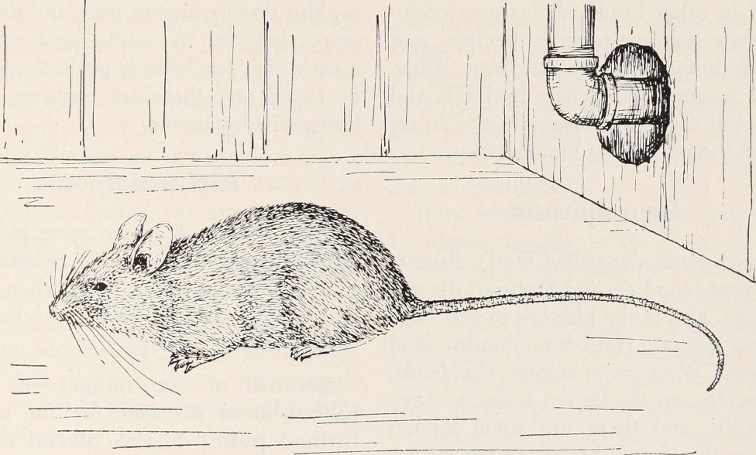
Illustrations of a roof rat and a house mouse from the 1948 publication Control of Rats and Mice by Tracy I. (Internet Archive Book Images, No restrictions, via Wikimedia Commons)
[People News] An employee at the Anti-Plague Research Institute in Irkutsk, Siberia, Russia, has died from severe pneumonia, raising concerns about pneumonic plague and potential laboratory infections. The Disease Control Center in Suifenhe City, which borders Russia, announced that local authorities are actively promoting epidemic prevention through WeChat public accounts, distributing informational flyers, and conducting health education lectures.
According to Radio Free Asia, a staff member from the Suifenhe Disease Control Center was interviewed on Thursday (the 8th) and, when asked about the incident in Russia and local epidemic prevention measures, stated: "We promote every day through WeChat public accounts, and in our front square, we distribute flyers and hold health knowledge lectures. However, our higher authorities have not provided us with specific measures, but there are precautions in place against the plague."
On Thursday, Radio Free Asia attempted to contact the Suifenhe port office to inquire about any new entry quarantine measures, but the call went unanswered.
Port Hotels Welcoming Russian Travelers
Suifenhe serves as a significant port for personnel exchanges between China and Russia. A staff member at the Jia Shang Travel Maxim Building informed Radio Free Asia: "We interact with Russians daily; our hotel has a particularly high number of Russian guests. If you are concerned about the plague, then you should avoid staying here."
A staff member at the Huirun International Hotel remarked: "There are relatively few Russians staying here because the rooms are quite expensive. Russians typically opt for accommodations on the street where the prices are lower, around a hundred yuan, but you can be assured that the number of Russians staying here is very low, and sometimes there are none at all."
This incident has ignited discussions on Chinese social media platforms. Under topics like 'Russian Plague Incident' on Weibo, some users have urged the Russian authorities to provide more information, expressing hope that the pneumonia death of unknown cause is merely an isolated case. Other users noted that the Russian side has yet to confirm the presence of the plague, and the testing methods and results for the deceased have not been disclosed.
The death of the research institute employee has raised significant concerns.
The deceased, 28-year-old Daliya Xipilova, was reported to have been hospitalized on September 29 due to severe pneumonia. Despite receiving ventilator support, she passed away on October 2. The specific pathogen responsible for her pneumonia remains unidentified. The research institute is involved in studying dangerous infectious diseases, including the plague.
On October 7, World Health Organization (WHO) Director-General Tedros Adhanom Ghebreyesus announced that the Russian authorities convened a meeting on October 2 in response to a local resident suspected of being infected with a dangerous infectious disease. The WHO requested additional information from Russia on October 3, citing the International Health Regulations. In a response on October 6, the Russian side stated that there had been no reported cases of plague in Irkutsk Oblast recently, and approximately 200 individuals who had contact with the suspected case had been quarantined.
Following this, the Russian health regulatory agency reported that no cases of plague were found among the contacts and that preventive measures are being gradually lifted. However, the exact cause of the deceased's pneumonia has yet to be clarified. Kremlin spokesperson Dmitry Peskov addressed the news of a second suspected case on October 7, asserting that most media reports are 'false information' and emphasized that the statements from the Russian health regulatory agency should be regarded as authoritative.
Currently, the World Health Organization (WHO) is in the process of verifying reports regarding a second employee who has developed pneumonia of unknown origin, but has not confirmed the death of this individual. U.S. Secretary of State Marco Rubio has publicly urged Russia to provide more information, while Trump has indicated his willingness to discuss the issue with Putin and offer assistance.
Previously, China and Russia conducted an epidemic prevention drill.
According to the Fuyuan City Media Center, from August 24 to 27, a joint emergency drill for cross-border infectious disease outbreaks between China and Russia took place in Fuyuan City, Heilongjiang Province. The drill included scenarios for the importation of plague and cross-border joint responses. Sergey Barakhonov, the director of the Irkutsk Anti-Plague Research Institute, also attended the event and delivered a speech.
In an interview with Radio Free Asia, Mr. Dong, a scholar from Northeast China, expressed his concerns regarding the lack of transparency in Russian information: "Russia's political opacity is not much better than that of China. This incident could potentially lead to a significant disaster for the world, given the many factors involved. The main concern is that in today's society, biochemical weapons are becoming increasingly sophisticated, and many viruses appear mysteriously."
Mr. Dong noted that if the outbreak is due to the original plague, it is not particularly alarming: "However, if it is a genetically modified virus, that would be very concerning. This would be akin to a biochemical weapon. Whether it is intentionally released or accidentally developed, it is frightening and exhibits the characteristics of a biochemical weapon."
Mr. Zhou, a former scholar at the Henan Disease Prevention and Control Center, mentioned in an interview that while he was in Wuhan in September 2019, he saw reports of local airports conducting drills for the prevention of the novel coronavirus: "I happened to be in Wuhan, and the airport was conducting related drills, but as a member of the public, I didn't pay much attention. However, two months later, the outbreak occurred. This time, the Russian pneumonic plague bears a striking resemblance to that situation."
Mr. Zhou (Zhou Xiansheng) noted that for more than a century, large-scale outbreaks of plague have been largely under control. However, recent reports indicate that personnel involved in research on pneumonic plague have died, and the threat posed by this situation is significantly greater than that of naturally occurring plague.
He raised concerns about the possibility of human involvement in the incident: "If we were to assess whether this is man-made or naturally occurring, we would certainly lean towards believing it is man-made, wouldn’t we? The evidence of human involvement is too substantial, too substantial; at the very least, the situation raises serious doubts."
Pneumonic plague can lead to rapid death following its onset.
Plague is a bacterial infectious disease caused by Yersinia pestis, which can be transmitted through infected flea bites, contact with infected tissues, and other means. Pneumonic plague, in particular, can spread between individuals through respiratory droplets from infected patients. The World Health Organization indicates that the incubation period for pneumonic plague can be as short as approximately 24 hours. If untreated, it can result in death within 18 to 24 hours after symptoms appear, but prompt administration of effective antibiotics can be life-saving.
△









News magazine bootstrap themes!
I like this themes, fast loading and look profesional
Thank you Carlos!
You're welcome!
Please support me with give positive rating!
Yes Sure!