
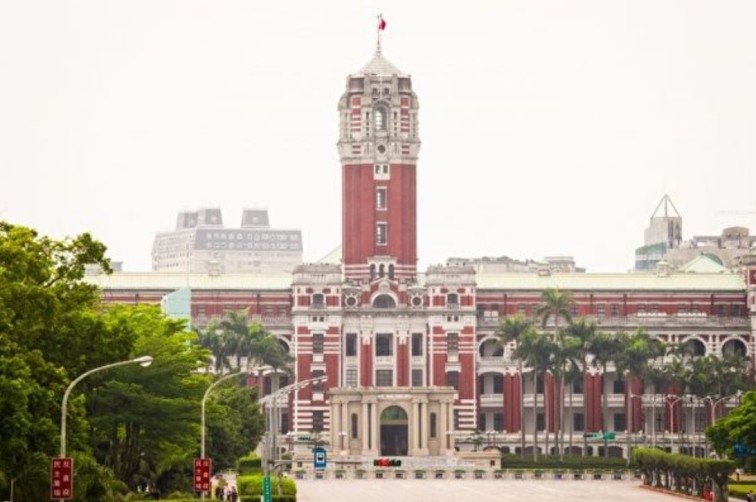
Taiwan Presidential Office. (Chen Bozhou / Dajiyuan)
[People News] Taiwanese television host Cai Kangyong recently attended a campaign event for Shen Boyang, the Democratic Progressive Party's (DPP) candidate for Taipei mayor. Following his appearance, he was subjected to three consecutive days of online attacks from Chinese netizens. This incident has ignited a backlash among Taiwanese citizens regarding China's democratic literacy, the so-called 'giant baby mentality,' and cross-border repression. In response, Taiwanese officials have pledged to actively amend laws to counter these actions.
Voice of America reports that Cai Kangyong's online harassment is merely the latest instance of the CCP's cross-border repression against Taiwan. Concurrently, the FBI has indicated that Lai Ching-te, Taiwan's President, has had his eldest son, Lai Ting, monitored by a Chinese woman suspected of acting as an unregistered agent for the CCP in the United States. Analysts suggest that these events underscore the CCP's anxiety in creating external adversaries to foster internal nationalism, thereby reinforcing the legitimacy of its regime.
Cai Kangyong Faces Online Attacks and Corporate Boycotts.
On Sunday (October 4), Cai Kangyong made a low-profile appearance at the establishment meeting of Shen Boyang's Taipei campaign headquarters. Before departing, he expressed that he was there to 'listen to opinions from all sides' and hoped to 'have the opportunity to meet with every candidate.' However, once this news reached China, it quickly led to skepticism among Chinese netizens regarding his support for 'Taiwan independence hardliners.'
Shen Boyang has been designated by the Mainland's Taiwan Affairs Office as a 'Taiwan independence hardliner' and is currently under investigation by the CCP's public security authorities, making Cai Kangyong's presence particularly significant.
Despite Cai Kangyong's agent later confirming that he was preparing to interview the candidates for the Taipei mayoral election from the two major parties, this did not prevent Chinese netizens from launching attacks against him. Some even harshly labeled him as a 'homosexual + Taiwan independence artist.' For three consecutive days, various negative topics surged to the top of Weibo's trending list, including #Cai Kangyong account cleared and unfollowed# and #Cai Kangyong multiple works taken down#, which garnered over 53 million and 37 million views, respectively.
Chinese companies have also joined the boycott, with leading automotive brand issuing a statement to cut ties with Cai Kangyong, and the fashion magazine 'Harper's Bazaar' removing the promotional cover story from its September issue. Following this, his podcast dialogue video 'New Life PLUS' was also taken down.
Taiwanese citizens show support for Cai Kangyong: 'There is no need to report or apologize to anyone.'
However, aside from a few politicians from the blue camp who echoed the Chinese Communist Party's narrative, Cai Kangyong's support within Taiwan has remained largely unaffected.
The general public continues to express positive sentiments towards him. For example, Kaohsiung resident Chen Yimin commented on Facebook (FB) that Cai Kangyong is a Taiwanese citizen with the right to participate in any activity, stating, 'He does not need to report or apologize to anyone!'
Taipei voter Peng Xiaomei also commented on Facebook: 'Regardless of who Brother Kangyong votes for... whether he votes for Jiang (Wan'an) or Shen (Boyang), it is his own judgment and choice.'
Current Taipei Mayor Jiang Wan'an from the Kuomintang publicly stated on Monday (October 5) that he respects Cai Kangyong's freedom of choice and 'does not agree with intervening or influencing anyone's freedom of choice through interests or any form.' He also invited Cai Kangyong to attend his campaign event and arranged a seat in the rock zone.
According to Taiwanese media, Shen Boyang addressed the online boycott of Cai Kangyong by mainland Chinese netizens during an event on Sunday night. He remarked that it is indeed unfortunate, as Cai Kangyong has expressed a genuine interest in hearing a variety of different voices.
Shen Boyang stated, "In a democratic society, this is how it works. He comes here not to shout along with us; he is here to see what this person is saying. Then he may also want to hear what another person has to say."
He further noted that if such actions are only occurring in a democratic society, "I believe for us, it should be quite ordinary."
Cai Kangyong has not directly addressed the controversy, but he has made two posts on Facebook. One post expressed gratitude to Jiang Wan'an for the invitation and assured that he would "gladly attend to observe and learn... and dress as much as possible in line with the host's desired style to help create the party atmosphere." The other post featured a thought-provoking image of his print titled "Everything is Just a Process."
Voice of America reached out via email to invite Cai Kangyong for an interview, but no response had been received by the time of publication.
Huang Yihau: The CCP exhibits a "giant baby mentality."
Cai Kangyong's experience of online harassment and boycott from the CCP is merely the latest instance of the CCP's cross-border suppression against Taiwan. According to statistics released by Taiwan's Mainland Affairs Council on Monday, the number of individuals subjected to cross-border suppression by the CCP has reached at least 126 people and 140 instances, with targets including not only government officials and political figures but also specific individuals. For instance, comedian Huang Yihau and Guan Jianzhong, the head of Lion Film and Television Cultural Company, which introduced the film "State-Owned Organs," have both been victims.
At the end of last year, Huang Yihau garnered positive feedback for his jokes that mocked Xi Jinping, the leader of the Chinese Communist Party. In late May this year, he scheduled another special performance, but prior to the show, the venue was vandalized with white paint and feces by 35-year-old Guo Weihao as a warning. Following an investigation by law enforcement, two suspects were indicted in late September on charges of intimidation and vandalism, including Liu Shengjie, who was accused of inciting criminal activity in Taiwan. However, the identity of the Chinese national behind the cross-border violent intimidation remains unknown.
In an interview with Voice of America regarding the violent attack, Huang Yihau expressed his surprise, stating that he believed he was "too low-profile to be targeted." However, after experiencing the incident firsthand, he gained a profound understanding of the differences in democracy, freedom, and the rule of law across the Taiwan Strait. Although he had previously faced censorship in 2018 when he went to China for development due to involvement in sensitive topics, he realized that China was not a suitable democratic society for his career and decided to abandon the Chinese market.
He remarked, "I think the CCP, or rather, the Communist Party's mindset is quite infantile. The entire world must revolve around it; it wants something and must obtain it. If it doesn't get what it wants, it starts to cry and throw a tantrum."
Huang Yihau also sarcastically noted that if one must refer to someone as 'dad' to earn money, then the CCP should call U.S. President Trump 'dad' if it wants to profit from the United States.
He further addressed the pro-CCP 'little pinks': "If you love China so much, you should just stay in China and not come out. The Communist Party hopes you won't venture out to see the outside world; you should just live well within the walls."
Guan Jianzhong: From Fear to Withstanding Pressure
Guan Jianzhong is yet another victim of the Chinese Communist Party's cross-border repression. Since he brought the film "State-Owned Organs" to Taiwan in 2024, he has been inundated with threatening images featuring guns, knives, and bullets, as well as letters threatening to plant bombs. Recently, someone even impersonated him to threaten others over the phone, leaving him exhausted as he rushed to the police station to clarify the situation.
In an interview with Voice of America, Guan Jianzhong confessed that he was once so terrified that he contemplated halting the film's screening by the end of October that year, particularly as 80% of theaters were influenced by the chilling effect of the CCP's cross-border suppression and refused to show the film, which addresses the CCP's live organ harvesting from Chinese citizens, including a testimony from an 18-year-old PLA soldier.
However, he stated that it was precisely the CCP's relentless persecution that fueled his anger and led him to refuse to back down, as he continued to "advocate for freedom of speech in theaters," ultimately realizing that he was capable of withstanding pressure.
Guan Jianzhong remarked: "No one is an outsider. Peace has never meant silence; silence only breeds infinite fear."
He earnestly called on all theaters in Taiwan to join his movement, questioning: "The CCP is killing people, and when I stand up to speak, I am rejected by the normal mechanisms of society? Are you (the theaters) executing orders from a foreign government, or do you wish to uphold a virtuous democratic system?"
He also urged all audiences in Taiwan to support "State-Owned Organs," to bravely enter theaters, and to demonstrate the Taiwanese people's resolve to resist intimidation.
Taiwan's Mainland Affairs Council: Will actively pursue legal amendments to counteract.
In relation to the incident involving Cai Kangyong, Qiu Chui-zheng, the head of Taiwan's Mainland Affairs Council, remarked on Tuesday (October 6) that this incident underscores the stark contrast between Taiwan's free democratic society and the authoritarian regime of the Chinese Communist Party (CCP). He urged the CCP to refrain from interfering in Taiwan's elections and cautioned Taiwanese artists pursuing opportunities in China about the potential risks of having 'different positions and zero interests.'
Additionally, regarding the illegal surveillance of Lai Ching-te's (Lai Qingde) son, Lai Ting, and his family by CCP agents in Los Angeles, Qiu Chui-zheng condemned the CCP's cross-border repression. He announced that the Taiwanese government will implement a set of guidelines aimed at helping citizens understand the nature and tactics of the CCP's cross-border pressure, as well as the support available when confronting CCP suppression.
Qiu Chui-zheng further stated that Taiwan has already established mechanisms to prevent and counter the CCP's cross-border repression. However, recognizing the shortcomings in the rule of law, the government will actively amend the Anti-Infiltration Law and other relevant laws to enhance these measures.
On Tuesday, the Mainland Affairs Council also released a statement commending Taiwanese law enforcement for their diligent investigation into the assault of Japanese senior media figure Akio Yaita by members of a Hong Kong gang in July. The Taichung District Prosecutor's Office has filed charges against a suspect named Liao and is pursuing the remaining four accomplices.
The statement from the Mainland Affairs Council indicated that the defendants in this case received foreign funding, which not only harmed specific victims but also 'utilized violence to suppress speech, thereby infringing upon Taiwan's democratic system and social order.'
The CCP is leveraging nationalism to reinforce its power.
In light of the CCP's escalating cross-border repression, Huang Zhao-nian, an associate professor at National Chengchi University's Institute of National Development, analyzed that the underlying structural reason is that 'the legitimacy logic of the CCP's authoritarian rule is facing significant challenges.'
He stated that prior to the 2010s, China's economic growth was still remarkable, and the populace was generally optimistic. This economic growth helped to legitimize the rule of the Communist Party of China (CPC). However, over the past decade, the pace of China's economic growth has gradually slowed, and the transformation and upgrading of industries have proven challenging. Notably, in recent years, the youth unemployment rate has remained persistently high, leading the CPC to adopt a more aggressive stance internationally. This includes the so-called 'wolf warrior' diplomacy towards the world and a hardline approach against Taiwan in military, diplomatic, and economic matters, all aimed at fostering internal nationalism and patriotism to reinforce its legitimacy in power.
Huang Zhaonian told Voice of America, "These are all assertive external actions that create an external enemy, which can help consolidate nationalism and patriotism internally... thereby strengthening the regime's legitimacy."
He noted that the CPC's cross-border suppression is also a form of assertive action, employing methods such as judicial repression upon entering the CPC's jurisdiction or the long-arm jurisdiction of transnational extradition, as well as economic coercion or inducement against artists like Cai Kangyong. This also includes direct violent intimidation against opposition figures such as Shibata Akio, Huang Yihau, and Guan Jianzhong.
Regarding the judicial repression within China and the long-arm jurisdiction abroad, Huang Zhaonian remarked that the Taiwanese government can only morally persuade its citizens and expose the risks of traveling to China, or call on the international community to reassess judicial agreements with the CPC.
Concerning the direct violence against opposition figures, he urged the Taiwanese government to not only strengthen the rule of law but also to establish an incentive mechanism for whistleblowers, allowing for the exposure of covert networks of local collaborators who are bought and directed by the CPC, thus aiding in investigations and legal accountability. △






News magazine bootstrap themes!
I like this themes, fast loading and look profesional
Thank you Carlos!
You're welcome!
Please support me with give positive rating!
Yes Sure!