
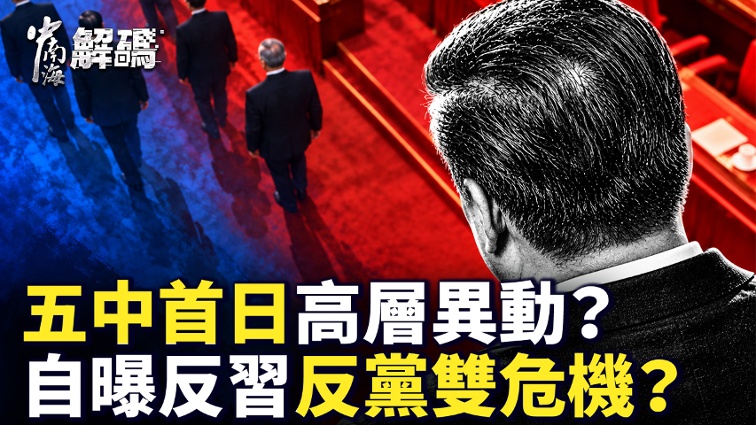
The first day of the Fifth Plenary Session sends a significant signal: Zhongnanhai is rallying anti-Xi and anti-Party forces (video)
[People News] On October 26, the Fifth Plenary Session of the Communist Party of China officially commenced!
However, the opening announcement from Xinhua News Agency was surprisingly brief, consisting of only a few lines! It did not disclose the number of attendees or provide a complete list. The news broadcast also failed to show any footage. Whether Hu Chunhua, who has been rumoured to be involved in controversies, actually attended remains unclear!
The Central Military Commission, which originally had seven members, now has only two remaining! Even more shocking is that out of the 44 military central committee members elected in 2022, research institutions report that 42 have been purged or have vanished from public view! So, will Xi Jinping appoint new members to the Central Military Commission during this Fifth Plenary Session? Will Li Qiang assume the role of vice chairman of the Military Commission?
Even more astonishing is the speculation that Xi Jinping might restore the title of 'Party Chairman' from the Mao Zedong era! Does this imply that the power dynamics at the 21st National Congress in 2027 will undergo significant changes? Will all the rumours about potential successors be rewritten?
However, on the very day of the Fifth Plenary Session's opening, the party media outlet 'People's Daily' published two significant articles, discussing topics ranging from Mao Zedong to Xi Jinping, and from stringent anti-corruption measures to the long-term governance of the Communist Party of China. While these articles appear to emphasise Xi Jinping's authority, could they also reveal a major crisis facing the Communist Party—internal dissent not only against Xi but against the Party itself?
Hello, dear viewers, welcome to 'Decoding Zhongnanhai.' I am Sun Ning.
Where Exactly Is Hu Chunhua as the Fifth Plenum Opens?
On the morning of October 26, the Fifth Plenum of the 20th Central Committee of the Chinese Communist Party (CCP) officially opened in Beijing.
At 12:02 p.m., Xinhua News Agency released a statement announcing that Xi Jinping had delivered a work report to the plenum on behalf of the Political Bureau of the Central Committee and explained a draft decision on consistently advancing full and rigorous Party self-governance.
Beyond that, there was almost no substantive information. The actual number of attendees was not disclosed, no complete attendance list was released, and no details were provided about personnel arrangements within the Central Military Commission.
Closed-door meetings of the CCP Central Committee have always been standard practice, and brief opening announcements are nothing unusual in themselves. This time, however, what has attracted the most attention from outside observers is precisely the names that have not been made public.
One of those names is Hu Chunhua, once regarded as a potential successor to the generation after Hu Jintao, but later sidelined as a political heir.
On October 22, Hu Chunhua, the current vice chairman of the National Committee of the Chinese People's Political Consultative Conference (CPPCC), did not attend a ceremony held in Beijing to commemorate the 90th anniversary of the Red Army's victory in the Long March.
Following his absence, reports emerged claiming that Hu Chunhua had been placed under control and that even his family members had become unreachable. Other rumours suggested that he had not been arrested but was instead under the protection of military figures. Some also speculated that the situation might be connected to a power struggle among senior leaders on the eve of the Fifth Plenum.
On October 25, The Dajiyuan published another exclusive report. Citing an insider within the CCP who used the pseudonym “Huai Ming,” the report said that Hu Chunhua had missed the Long March commemoration because of health reasons. The source also claimed that Hu's family members had not gone missing and that he had recently seen Hu Chunhua's son at a social event involving horse racing.
Independent commentator Cai Shenkun has also expressed reservations about rumours that Hu Chunhua had been arrested. He believes that Hu has long since left the Politburo and may not pose a direct threat to Xi Jinping's current power arrangements. His absence from a single event, he argues, is not enough to conclude that something has happened to him.
However, none of the above reports or claims can currently be independently verified.
In fact, the question of Hu Chunhua is merely one small part of the much larger personnel uncertainty surrounding the Fifth Plenum. The CCP's senior leadership faces an even more startling question: the military.
The Military Commission has dwindled from seven members to just two!
Are 42 military central committee members facing issues?
Does anyone recall the composition of the Central Military Commission following the 20th National Congress of the Communist Party of China in 2022?
At that time, there were seven members in total. Xi Jinping served as the chairman of the Military Commission, supported by two vice-chairmen and other members. However, just a few years later, as we approach the Fifth Plenary Session, only Xi Jinping and Zhang Shengmin remain as members of the Central Military Commission.
And that’s not the whole story.
On October 23, the Brookings Institution in the United States reported that among the 44 military personnel who joined the Central Committee of the Communist Party in 2022, after a series of dismissals and expulsions, only 17 still nominally hold Central Committee positions.
Of these 17 individuals, only Dong Jun and Zhang Shengmin have had any notable public activities in recent months.
Consider this: a nation's highest military leadership body once had seven members, and now only two are left. Many military central committee members have lost their positions or have not been seen in public for an extended period. What does this signify?
Xi Jinping has been in power for several years, yet there are severe corruption and discipline issues within the military's upper ranks. What has gone wrong? More critically, some of the generals who have been purged were promoted during Xi Jinping's administration. If even those senior generals promoted under his leadership cannot be trusted long-term, how can the next generation of generals build trust?
The Fifth Plenary Session serves as a crucial opportunity for the Central Committee to make adjustments to the personnel of the Central Military Commission. The question on everyone's mind is whether Xi Jinping will appoint new members to the Military Commission during this meeting. There is significant interest in the potential successor, Li Qiang. If he indeed joins the Military Commission and takes on the role of Vice Chairman, his position as a successor would be nearly assured.
If there are adjustments to the Military Commission, who will be the newly elected members? This session provides an important lens through which to observe the shifts in the power dynamics of the Communist Party of China for the next generation.
Is Xi Jinping set to restore the title of Party Chairman?
On the eve of the Fifth Plenary Session, the Financial Times published a report on October 24 that posed a compelling question: Could Xi Jinping reinstate the 'Party Chairman' position from the Mao Zedong era?
The report references an analysis by Christopher Nye, a researcher at the Jamestown Foundation in the United States, suggesting that if this Fifth Plenary Session officially grants Xi Jinping the title of 'Leader', then the 21st National Congress of the Communist Party of China in 2027 might see the revival of the 'Party Chairman' role.
However, restoring the Party Chairman system could have implications beyond just Xi Jinping's title; it could reshape the entire power structure of the 21st National Congress!
Historically, during the Mao Zedong era, the highest leadership position in the Central Committee was that of Party Chairman. Following Mao's death, both Hua Guofeng and Hu Yaobang held this title. It wasn't until the 12th National Congress of the Communist Party of China in 1982 that the party constitution was amended to abolish the position of Chairman of the Central Committee, replacing it with that of General Secretary.
Currently, if Xi Jinping reinstates the party chairmanship system, it would indicate that the Chinese Communist Party (CCP) may once again revise its highest power structure.
This raises several questions. If Xi Jinping serves as the party chairman, who will take on the role of general secretary? If Li Qiang or another individual becomes general secretary, will they genuinely assume the highest power, or will they merely handle routine party affairs? Additionally, who will hold the positions of chairman of the Central Military Commission and president of the country?
If these roles are occupied by different individuals, how will power be allocated? This situation provides a new perspective on the recent succession rumours. The core issue is not merely who holds the title of the highest position, but rather who possesses the ultimate decision-making authority.
If Xi Jinping is the party chairman while another person serves as general secretary, and Xi Jinping also retains the chairmanship of the Central Military Commission, then the emergence of a new general secretary does not necessarily imply that Xi Jinping has genuinely relinquished the highest power.
On the other hand, if the general secretary also wields military power and significant authority over personnel decisions, that could represent a meaningful transfer of power. Therefore, in the future, assessing who the successor is should not be based solely on titles; it is crucial to understand how party power, military power, and organisational personnel authority are structured.
Moreover, the Financial Times report noted that some analysts believe the chances of reinstating the party chairmanship are low. Therefore, whether the Fifth Plenary Session will introduce new political titles and whether the 21st National Congress will actually adjust the highest leadership positions still awaits official confirmation.
However, while the outside world is fervently discussing whether Xi Jinping is following in Mao Zedong's footsteps, the People's Daily published two significant articles on October 26. At first glance, these articles emphasise Xi Jinping's so-called core position, the stringent anti-corruption campaign, and the necessity for the Communist Party of China (CPC) to maintain long-term governance.
However, the CPC often vocalises its deficiencies, and these two articles may actually expose a more alarming concern: the CPC's greatest fear may not only be whether Xi Jinping can continue to hold power, but whether the very foundation of its rule is starting to waver!
This could be the major crisis that the Fifth Plenary Session truly needs to address. Let’s now examine the political signals revealed by these two articles that are worth noting.
Two Significant Articles: From Mao Zedong to Xi Jinping
On the opening day of the Fifth Plenary Session, October 26, the People's Daily published two noteworthy articles.
The first article, which appeared on the front page, was signed by 'Ren Zhongping' and titled 'Continuously Advancing Comprehensive Strict Governance of the Party on the New Journey'. 'Ren Zhongping' is a collective pseudonym used for important political commentary in the People's Daily.
This article begins by referencing the Long March from 90 years ago, particularly highlighting the historical significance of the Zunyi Conference in establishing Mao Zedong's leadership. It then transitions to Xi Jinping, emphasising the importance of maintaining his core position and the comprehensive strict governance of the Party.
The second article, authored by Wang Feng, is titled 'Scientifically Understanding the Great Achievements and Important Insights of Comprehensive Strict Governance of the Party in the New Era'. Although this article appears on page 9, it is positioned alongside the article by 'Ren Zhongping' and is featured on the homepage of People’s Daily Online.
The article highlights Xi Jinping's political authority, the comprehensive leadership of the Communist Party of China (CPC), the stringent anti-corruption campaign, and the consolidation of the CPC's long-term ruling status.
It is important to note that while the two articles have different emphases, they consistently underscore a few key points: Xi Jinping's core position, political loyalty, the high-pressure anti-corruption approach, and the CPC's enduring governance.
Additionally, the timing of their publication on the opening day of the Fifth Plenary Session is particularly significant. On the surface, this serves as a declaration of Xi Jinping's authority and reinforces the CPC's leadership role. However, from another perspective, the repeated emphasis on these political demands raises an important question: what is causing unease among the highest ranks of the CPC?
Next, we will examine the military's purges, succession uncertainties, and the current realities in China to uncover the significant political crises that may be concealed behind these two articles.
Do these two major articles reveal two critical crises within the CPC?
These two articles from the People's Daily appear to stress Xi Jinping's core status and the necessity for the CPC to maintain long-term governance. However, this perspective also raises two highly sensitive questions.
First, is Xi Jinping's personal authority facing opposition within the party?
In recent years, Xi Jinping has been actively purging the military, even removing Central Military Commission Vice Chairman Zhang Youxia. The Central Military Commission, which originally had seven members, now has only two remaining. Each of these purged generals had their own subordinates, colleagues, and networks. The broader the scope of the purges, the more individuals are affected. Even if no one dares to voice their opposition openly, could it be that there are no feelings of discontent, with individuals feeling anger but unable to express it?
The absence of some military veterans from public footage during the commemorative conference for the 90th anniversary of the Long March raises questions: Are they unwilling to cooperate, or are they facing restrictions? This remains unconfirmed.
These uncertainties lead to a critical question: While Xi Jinping can exert control over the military through purges, can he genuinely eliminate dissent against him?
Consequently, the People's Daily's repeated emphasis on Xi Jinping's core status during the Fifth Plenary Session is particularly significant. It likely indicates that Xi Jinping's core position is being challenged.
Now, let’s examine the second question: Have anti-party forces begun to emerge within the Chinese Communist Party (CCP)?
This issue is more serious than mere opposition to Xi. Opposition to Xi pertains to dissent against him personally, while anti-party sentiment questions the entire ruling system of the CCP.
The two articles not only advocate for the preservation of Xi Jinping's authority but also stress the CCP's leadership and its long-term governance. Why is there such a pronounced emphasis on the necessity of the CCP's prolonged rule at this pivotal moment of the Fifth Plenary Session?
Does this suggest that within the CCP, the dissent is not limited to individuals opposing Xi, but that there may be broader doubts about the entire ruling system, potentially leading to the emergence of anti-party forces?
Particularly in light of economic challenges, youth unemployment, local fiscal pressures, and the ongoing purges of high-ranking military officials, could this situation escalate into questioning the highest leader or even the entire political system?
Thus, at this Fifth Plenary Session, the CCP may be confronting two distinct levels of political crises: one targeting Xi Jinping personally, and the other challenging the very foundation of the CCP's rule.
The Central Military Commission is facing a personnel shortage and can make new appointments; if succession plans are unclear, positions can be adjusted. However, can purges truly eliminate opposition? Can political propaganda restore trust? Can the Fifth Plenary Session address these fundamental issues?
This may represent the most significant crisis currently highlighted by the two articles published in the People's Daily on the day of the Fifth Plenary Session.
Can the Fifth Plenary Session resolve the crisis?
The Fifth Plenary Session has begun, but the real uncertainties may still lie ahead.
Did Hu Chunhua attend or not? Will the Central Military Commission bring in new members? Is Xi Jinping genuinely planning to restore the position of Party Chairman and reorganise the power dynamics for the 21st National Congress?
Even more concerning than these personnel matters is whether two distinct factions of opposition have emerged within the Communist Party: one opposing Xi Jinping, and another that has begun to question the Communist Party's ruling status?
If such a crisis truly exists, relying solely on purging officials and stressing political loyalty is unlikely to provide a fundamental solution. Dear viewers, what are your thoughts? We invite you to share your opinions in the comments section, and please subscribe to our channel and share this episode. Thank you for watching 'Decoding Zhongnanhai.' I am Sun Ning, and we will see you in the next episode. △





News magazine bootstrap themes!
I like this themes, fast loading and look profesional
Thank you Carlos!
You're welcome!
Please support me with give positive rating!
Yes Sure!