
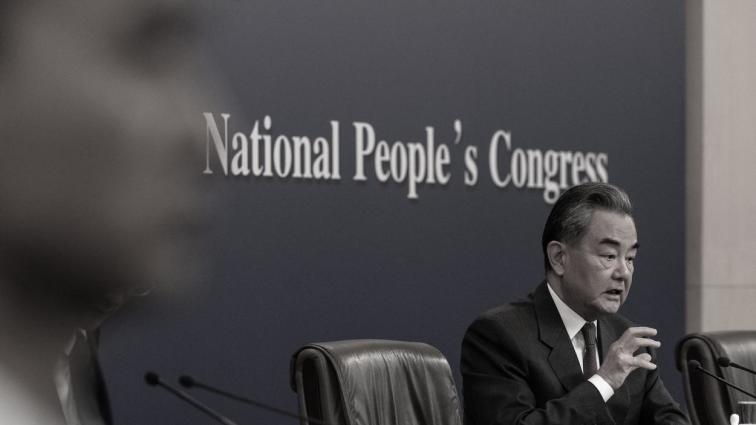
Image: Chinese Foreign Minister Wang Yi. (Photo by Kevin Frayer/Getty Images)
[People News] Over a week after the conclusion of the 20th Central Committee's Fifth Plenary Session of the Communist Party of China, alongside statements from senior officials and various ministries, the military's response has also been delivered as expected.
On the afternoon of November 6, the spokesperson for the Ministry of National Defence addressed reporters at a regular press conference, discussing how the entire military would study and implement the 'Decision' approved by the plenary session. The statement was divided into two parts. In the first part, Xi Jinping's name was notably absent; instead, it was asserted that the entire military 'firmly expresses the need to unify thoughts and actions with the spirit of the plenary session.'
In the second part, besides the standard remark that 'learning and implementing the spirit of the plenary session is a significant political task for the entire party, the nation, and the military both now and in the future,' it was also emphasised that there is a need to study Xi Jinping's thoughts on party building and military strengthening, 'deeply advancing the comprehensive strict governance of the party and the military, and continuously promoting political military building.' However, references to the 'two establishments,' 'four consciousnesses,' 'four confidences,' and 'two safeguards'—collectively known as '2442'—have completely vanished, mirroring the communiqué from the plenary session.
Additionally, phrases such as 'unite around the Party Central Committee with Xi Jinping at its core' and 'implement the responsibility system of the Chairman of the Military Commission' were also missing.
This raises the question: how did the spokesperson for the Ministry of National Defence articulate similar issues at the regular press conferences following the Fourth Plenary Session in October 2025 and the Third Plenary Session in July 2024?
During the 2025 press conference, the spokesperson did not mention Xi in the first paragraph. In the second paragraph, they stated, "The entire military will earnestly study and implement the spirit of Chairman Xi's important speech, deeply learn and comprehend the spirit of the plenary session, unify thoughts and actions with the decisions and deployments of the Party Central Committee, the Central Military Commission, and Chairman Xi, and unite more closely around the Party Central Committee with Xi Jinping at its core," followed by references to "two four four two" and the "responsibility system of the Chairman of the Military Commission."
At the 2024 press conference, the spokesperson noted in the first paragraph, "The plenary session listened to and discussed the work report presented by Chairman Xi on behalf of the Central Political Bureau," and in the final paragraph stated, "The entire military will earnestly study and implement the spirit of Chairman Xi's important speech, deeply learn and comprehend the spirit of the plenary session, and effectively unify thoughts and actions with the decisions and deployments of the Party Central Committee and Chairman Xi, uniting more closely around the Party Central Committee with Xi Jinping at its core," followed by similar references to "two four four two" and the "responsibility system of the Chairman of the Military Commission."
When comparing the statements made by the Ministry of Defence spokesperson after the Third and Fourth Plenary Sessions, it is clear that the statement following the Fifth Plenary Session significantly diminishes Xi's standing within the military.
1. The name of the report presenter is omitted, indicating that Xi is not mentioned.
2. The phrase "The entire military will earnestly study and implement the spirit of Chairman Xi's important speech" is excluded, and the previous wording "unifying thoughts and actions with the decisions and deployments of the Party Central Committee, the Central Military Commission, and Chairman Xi" has been altered to "unifying thoughts and actions with the spirit of the plenary session."
3. The phrase "Xi Jinping at the core" is absent.
4. The references to "two four four two" and the "responsibility system of the Chairman of the Military Commission" are also omitted.
The military's approach to learning from the decisions and spirit of the Fifth Plenary Session is so apparent that even the observant can see through it. If Xi Jinping continues to hold military power, would he really choose to weaken himself in this manner?
On the same day, November 6, Wang Yi, a member of the Political Bureau of the Communist Party of China and the Foreign Minister, published an article titled "Central and State Organs Must Walk the First Array." This article is yet another interpretation of the Fifth Plenary Session by a senior Communist Party official, following those by Wang Huning, Cai Qi, and Li Xi, as is customary for state media.
In this article, which is filled with clichés and empty phrases, Wang Yi begins by discussing the importance of party building within state organs. He describes it as a "political requirement to uphold and strengthen the centralised and unified leadership of the Party Central Committee," and he quotes relevant speeches by Xi, suggesting that Xi shares this view.
However, Wang Yi emphasises the need to "maintain the authority of the Party Central Committee, which is determined by one person and finalised by one hammer through practical actions... to ensure that the centralised and unified leadership of the Party Central Committee is implemented and reflected in... all fields and aspects, ensuring that the Party Central Committee always oversees the overall situation and coordinates all parties." The phrase "determined by one person" clearly refers to Xi Jinping; does this indicate that Xi still retains the decision-making power of "finalised by one hammer"?
Additionally, the article emphasises the need to 'align with the Party Central Committee led by Xi Jinping, implementing his important instructions and directives with the highest standards, strictest requirements, and best quality.' It also states the importance of 'clearly upholding and strengthening the centralised and unified leadership of the Party Central Committee, improving the mechanisms for implementing major decisions and deployments from the Party Central Committee, promptly reporting significant matters to the Party Central Committee, and ensuring that important proposals are first aligned with the Party Central Committee.' Furthermore, it insists on 'resolutely responding to the Party Central Committee's advocacy, strictly adhering to the Party Central Committee's decisions, and firmly avoiding actions prohibited by the Party Central Committee,' alongside the commitment to 'always be loyal to the core, support the core, safeguard the core, and defend the core.'
Wang Yi's article gives the impression that while it is essential to express loyalty to the 'Party Central Committee' and follow its directives, there is also a strong emphasis on loyalty to Xi, highlighting the need to 'be loyal, support, safeguard, and defend' him. Has Wang Yi demonstrated this during the plenary session as well?
Wang Yi's stance is a classic example of a fence-sitter. Along with the defence spokesperson's omission of the phrase 'two four four two,' it indirectly supports the author's earlier assessment that Xi's power has indeed been weakened. Influential figures within the Party who can diminish his authority do not wish for him to continue in office. However, in order to protect the Party and maintain their own power, Xi Jinping and these individuals are still engaging in mutual compromises to sustain a certain balance. Yet, this fragile equilibrium is unlikely to last long.
(First published by People News) △






News magazine bootstrap themes!
I like this themes, fast loading and look profesional
Thank you Carlos!
You're welcome!
Please support me with give positive rating!
Yes Sure!