
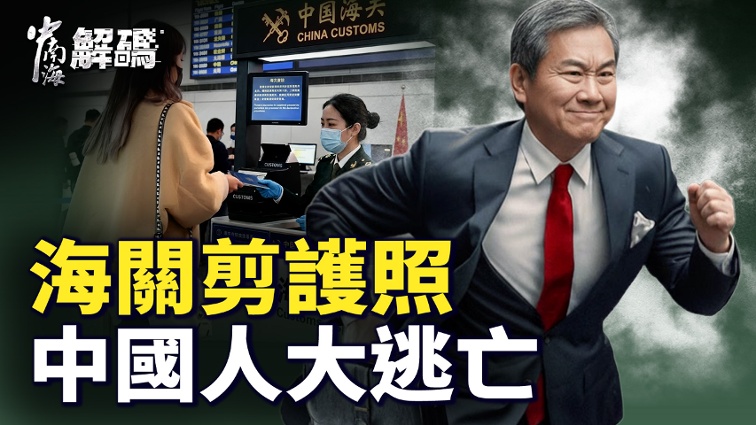
The wealthy, professors, and doctors are all on the run; passports have become state-owned assets (video)
[People News] Recently, the State Administration of Taxation of the Chinese Communist Party (CCP) revealed through Xinhua News Agency that since the CCP announced a 20% personal income tax on offshore trusts and income in late July, over 160 billion yuan in personal income tax has been reported during the 90-day tax payment transition period. In October alone, tax revenue exceeded 120 billion yuan, which has nearly increased the national personal income tax revenue for that month by 90%.
In light of the substantial tax collected by the CCP in such a short time, foreign media have labelled it as the CCP's 'most radical tax collection.' However, the CCP's official media, Xinhua News Agency, characterised it as 'stable and orderly.' Additionally, the CCP has indicated that the next phase of the tax collection initiative will involve intensified verification and inspection.
How will this verification and inspection be carried out? For ultra-wealthy individuals, the CCP plans to compile a list for investigation based on the Hurun Wealth List and publicly available corporate data. For entrepreneurs operating abroad, relevant provincial tax authorities will form working groups specifically tasked with gathering and organising information related to offshore trusts. What gives the CCP such confidence? It stems from the digital fences that the CCP has already established for all Chinese citizens. With the aid of artificial intelligence and big data, the chances of evading scrutiny are extremely low.
The CCP has also asserted that the collection of overseas trust income 'is not about robbing the rich, but about collecting old debts.' So, how far back do these old debts go? The official directive requires the collection of overseas income from 2022 to 2024, and it has warned that anyone who deliberately conceals this information will face severe penalties in addition to back taxes.
In recent years, private enterprises have been teetering on the brink of collapse due to the relentless crackdown by the Chinese Communist Party (CCP). This includes 'offshore fishing' targeting high-quality companies from other provinces, 'coastal fishing' involving a '30-year retrospective investigation' of local businesses, the criminalisation of debt aimed at specific targets, and 'selective law enforcement'. Additionally, over 20 provinces have established 'police-tax composite operation centers', causing significant distress for many companies and merchants.
In the first half of 2026 alone, annual reports from listed companies revealed that more than 100 firms were required to pay back taxes and late fees, totalling approximately 7.7 billion yuan. This amount surpasses the total taxes publicly recovered by Xi Jinping since he took office in 2012 over the past 14 years, highlighting the CCP's aggressive tax recovery efforts against enterprises.
Furthermore, the CCP's pursuit of personal overseas income is also accelerating. From January to May 2016, the cumulative tax payments for residents' overseas income reached 13 billion yuan.
On one hand, the CCP promotes an 'economic optimism' narrative while simultaneously preparing for a crackdown; on the other hand, wealthy individuals in China find themselves with no means of escape.
This scenario bears resemblance to the industrial and commercial reforms that occurred after the CCP came to power.
Following the establishment of the CCP, a series of movements were initiated. In early 1952, after the 'Sufan' and 'Sanfan' movements, the CCP launched the 'Wufan' movement targeting private industrial and commercial operators. This included campaigns against 'bribery, tax evasion, theft of state property, use of substandard materials, and theft of state economic intelligence'. Notably, the 'anti-tax evasion' campaign demanded the repayment of 'historical tax evasion amounts', even tracing back to the Republic of China or earlier periods. The resulting tax liabilities were so enormous that capitalists could not afford to pay them, even if they lost everything.
The cadres utilised the struggle techniques from land reform against the capitalists, inciting workers to denounce them. During the denouncement meetings, capitalists were forced to kneel on small stools or bend over for long periods. They were not allowed to return home; some were tied up, others confined to toilets, and some even slept on the office floor for several consecutive days, enduring severe torment and humiliation.
Many individuals could not bear the pressure of exorbitant taxes and the prolonged torment of being monitored and denounced. The suicide rate was particularly high; in Beijing, after the ice on Kunming Lake melted in spring, over a dozen bodies were found in a corner of the lake. Police across various regions patrolled parks to prevent people from hanging themselves from trees.
According to statistics from the Chinese Communist Party itself, 644 people committed suicide in Shanghai within two months, averaging more than 10 per day. Furthermore, even if capitalists in Shanghai chose to commit suicide, they could not jump into the Huangpu River, as the CCP would claim they had fled to Hong Kong, and their families would still be required to pay taxes. Consequently, jumping from buildings became their desperate first choice, allowing CCP cadres to see the bodies and be somewhat reassured.
At that time, Shanghai Mayor Chen Yi would casually inquire each evening while holding a cup of tea, 'How many paratroopers have we had today?' referring to the number of capitalists who had jumped to their deaths that day.
Ultimately, according to the proportions set by Mao Zedong, about 5% of capitalists in the cities were classified as the most 'reactionary' and faced severe punishment as a warning to others. Among them, 1% were executed, 1% were sentenced to life labour reform, and another 2-3% received prison sentences of 10 years or more.
The majority of capitalists classified as 'law-abiding' and 'semi-law-abiding' were also subjected to fines and penalties. At that time, a queue stretching 1.5 kilometres formed outside the People's Bank of Shanghai for the payment of fines. By the conclusion of the 'Five Anti' movement in October 1952, the Communist Party had 'recovered' taxes and fines totalling over 300,000 billion old currency, which was more than half of the military expenses incurred by the Communist Party during the Korean War.
Consequently, when the large-scale public-private partnership movement commenced in early 1956, private business owners were notably proactive. After enduring the Communist Party's brutal campaigns, some were left terrified, believing that the Party's word was law; others discovered that surrendering their businesses would elevate them to 'hero' status, liberating them from their previous roles as adversaries of the Party, and thus they willingly engaged; while some genuinely wished to distance themselves from the 'capitalist' label and expressed great enthusiasm.
As a result, on February 24, 1956, the Central Committee of the Communist Party passed a resolution aimed at transforming 'capitalist industry and commerce.' By the end of March, an astonishing 99% of private factories and 85% of private businesses had completed the public-private partnership process. By the end of 1956, the state-owned economy accounted for 93% of national income, with private industrial enterprises nearly disappearing. Everyone became part of state-owned enterprises, relying on the Communist Party for their livelihoods, and the conditions for workers who had been exploited by the Party deteriorated further.
From the industrial and commercial reforms and public-private partnerships following the establishment of the Communist Party to the recent appropriation of private enterprises in China, it is clear that the Communist Party's unscrupulous tactics of extortion, over-exploitation, and short-sighted profit-taking have not changed in over seventy years.
Simultaneously, the Chinese Communist Party (CCP) asserts that the 160 billion yuan collected in tax payments from overseas trusts will ultimately be allocated to public services such as education, social security, and county-level healthcare. It appears that the CCP's efforts to tax the wealthy are framed as a means to enhance people's livelihoods and promote 'common prosperity' for all. The CCP seems to be reviving the old tactic of pitting farmers against landlords and workers against capitalists.
Nevertheless, the CCP has been targeting private enterprises for several years, and the visible reality is a soaring unemployment rate, graduates entering the job market only to face unemployment, a flexible workforce exceeding 300 million, a decline in overall social consumption, and an economic downturn. In this context, who can still have faith in 'common prosperity'? It is clear to everyone that this is merely a cover for the CCP's communist ideology.
(First published by the People News) △





News magazine bootstrap themes!
I like this themes, fast loading and look profesional
Thank you Carlos!
You're welcome!
Please support me with give positive rating!
Yes Sure!