
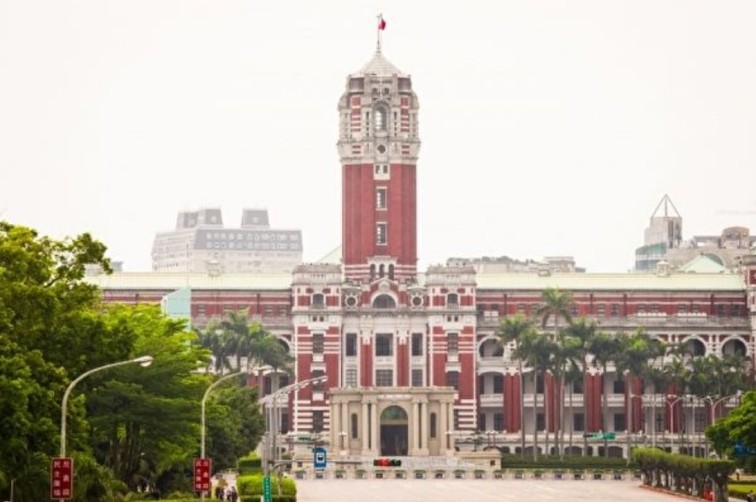
Taiwan Presidential Office. (Chen Bozhou / Dajiyuan)
[People News] November 12, 2026, marks the 160th anniversary of Sun Yat-sen's birth, which the Republic of China designates as "Father of the Nation's Birthday Commemoration Day." This day was previously a public holiday but has now been reclassified as a day of "commemoration only, no holiday." This year, the Republic of China did not hold any official commemorative ceremonies for this occasion. Instead, various civic groups, hometown associations, and cultural exchange centres organised commemorative gatherings, academic forums, or historical lectures.
In stark contrast, the Chinese Communist Party (CCP) has initiated a series of high-profile activities. They assert that Sun Yat-sen is a great pioneer of China's democratic revolution and emphasise the need to learn from his valuable spirit to inspire all Chinese people, both at home and abroad, to strive for modernisation with Chinese characteristics, national rejuvenation, and united efforts. They also touched upon issues of inheritance.
This has led to astonishment among overseas media, with outlets such as Voice of America, Radio France Internationale, and some Taiwanese media expressing concerns that the CCP is attempting to manipulate cross-strait narratives, using Sun Yat-sen's name to conduct united front tactics against the Chinese community and to unify Taiwan. What remains unclear to many is the CCP's connection to the democratic revolution. The CCP's brutal dictatorship and authoritarianism rank among the highest globally. Since the 1920s, they have disrupted the Kuomintang, employing tactics of both attachment and division in their struggles, whether in personnel or organisation, all adhering to the highest commands. How can they shamelessly discuss Sun Yat-sen's democratic revolution?
What does Sun Yat-sen's vision of democracy entail? At its core are the Three Principles of the People: nationalism, democracy, and people's livelihood. On July 15, 1916, Sun Yat-sen attended a tea gathering for Guangdong representatives in Shanghai, where he delivered a speech on the realisation of civil rights. In this speech, he outlined the principle of civil rights, which encompasses four powers: the right to vote, the right to recall, the right to initiate legislation, and the right to referendum. The principle of people's livelihood emphasises social equity and proposes policies such as 'equalisation of land rights' to address the widening gap between the rich and the poor and alleviate the struggles of the populace.
These concepts of civil rights and people's livelihood embody Sun Yat-sen's belief in the inherent goodness of human nature and his nostalgic moral ideals. The Three Principles of the People are enshrined as the first article of the Constitution of the Republic of China and are also part of the curriculum in high schools and universities. Does the Chinese Communist Party dare to teach the Three Principles of the People in schools? The wealth gap in mainland China is arguably among the largest in the world, with many party officials amassing great wealth while 800 million people live in poverty. Reports of unemployed migrants starving or freezing to death in cities frequently circulate online, with some even becoming organ donors for party officials. What right does the Communist Party have to claim that the people are the masters of their own affairs?
The Communist Party distorts history in its commemorative speeches. The Republic of China asserts that to honour Sun Yat-sen, one must acknowledge the enduring reality of the Republic of China he founded and respect Taiwan's lifestyle of freedom and democracy.
What political parties did Sun Yat-sen establish? What nation did he create?
In the late Qing Dynasty and early Republic of China, in 1905, Sun Yat-sen founded the Tongmenghui (Chinese Revolutionary Alliance) in Tokyo, Japan, where he was appointed as its leader and established the political agenda of 'expelling the Tartars, restoring China, establishing the Republic, and equalising land rights.'
On October 10, 1911, the Xinhai Revolution, led by Sun Yat-sen and others, began in Wuchang, sparking responses from various provinces. On December 29, Sun Yat-sen was elected as the provisional president of the Republic of China by representatives from seventeen provinces in Nanjing. He announced his inauguration on January 1, 1912 (the first year of the Republic) in Nanjing, establishing the provisional government of the Republic of China and implementing the 'Five Races Under One Union,' with the temporary constitution embodying republican principles. On February 12, 1912, the last emperor of the Qing Dynasty, Puyi (Xuantong Emperor), abdicated, marking the end of the Qing Dynasty. In August, the Tongmenghui (Chinese United League) was reorganised into the Kuomintang (Nationalist Party), with Sun Yat-sen elected as its chairman.
At that time, it is worth noting that the Communist International's Far East branch (the Chinese Communist Party) was nonexistent; even the Communist International itself was not established until March 1919. In 1921, the Chinese Communist Party emerged as a branch of European Marxism-Leninism in China, beginning to align itself with the Kuomintang to gain strength. From that point on, it continuously caused turmoil within the Republic through robbery, violence, and deception, undermining the Republic, disrupting social order, and attacking China's natural and moral culture, positioning itself against the Chinese nation. In Sun Yat-sen's words, the Chinese Communist Party represents those to be 'expelled from barbarian rule and restore China.'
What is the essence of Sun Yat-sen's thought? His ideology is deeply rooted in traditional Chinese culture while also embracing aspects of Western modern civilisation. He admired Confucian ideals such as 'the world as a commonwealth' and 'a world of great harmony,' while also drawing inspiration from Western democratic politics. He prioritised the public good over personal power, embodying humility and a spirit of altruism.
The Chinese Communist Party (CCP) asserts that it is advancing modernisation in a distinctly Chinese manner... Indeed, anything labelled as Chinese style or characteristic by the CCP seems to be subject to manipulation without restraint. In reality, the so-called Chinese characteristic style serves merely as a facade for deception, fundamentally reflecting the CCP's own practices. The Three Anti Campaign, the Five Anti Campaign, the Anti-Rightist Movement, the Cultural Revolution, the Tiananmen Square crackdown, the 1999 persecution of Falun Gong, and the misinformation surrounding SARS and COVID-19—aren't these all examples of a Chinese style?
Regarding 'national rejuvenation,' Taiwan's economic growth and social prosperity, its social order and moral values, as well as its elections and human rights—these truly represent the brilliance of Chinese civilisation. In 1949, the CCP appropriated the name of the Republic of China, positioning itself against China, the people, and the republic, and declared itself the People's Republic of China. Consequently, during Chiang Kai-shek's era, the Republic of China did not acknowledge this and referred to the mainland as a temporarily occupied disaster zone by the Communist bandits, a territory to be reclaimed. While the current Republic of China government has recognised Beijing, it has become evident that the more they compromise, the more aggressive the CCP has become, conducting military exercises over the years to signal a potential military assault.
Analysts suggest that the CCP's series of events commemorating the 160th anniversary of Sun Yat-sen's birth is intended to leverage his reputation to unify the Chinese people both domestically and internationally for the CCP's continued existence and to undermine China. There are concerns that as the divide in historical understanding grows, the grand narrative of Chinese history represented by Sun Yat-sen may be exploited by the CCP to further divide the Taiwanese populace.
In an interview with Voice of America, Wu Se-zhi, an assistant professor at the General Education Centre of National Taiwan Ocean University in Taipei, remarked that Beijing is trying to confine the historical status of the Republic of China to a transitional phase within the revolutionary process. This move aims to establish the Chinese Communist Party's exclusive authority to interpret modern Chinese history and to broaden the political space for its unification efforts towards Taiwan.
△




News magazine bootstrap themes!
I like this themes, fast loading and look profesional
Thank you Carlos!
You're welcome!
Please support me with give positive rating!
Yes Sure!