
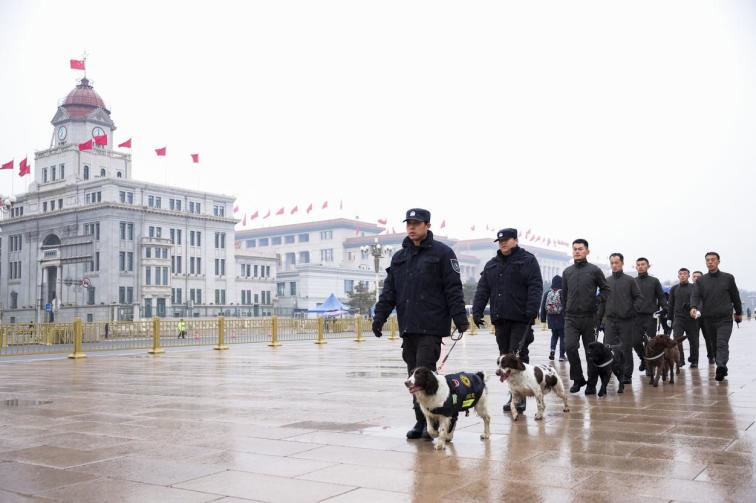
File photo: Plainclothes security personnel walk outside the Great Hall of the People during the opening ceremony of the National People's Congress in Beijing, China, on March 5, 2024. (Photo by Lintao Zhang/Getty Images)
[People News] As the Asia-Pacific Economic Cooperation (APEC) Leaders' Meeting kicks off in Shenzhen, China, a stark geopolitical transaction is taking place on the sidelines. Papua New Guinea Prime Minister James Marape confirmed to Chinese Communist Party leader Xi Jinping that the Taiwan representative office in his country has been closed, admitting that this decision was 'not easy' and that he is facing domestic challenges. Analysts note that Beijing has consistently required countries to first demonstrate their 'political loyalty' by severing ties with Taiwan before discussing economic benefits. However, historical lessons from several African nations that abandoned Taiwan only to encounter debt and unfulfilled promises suggest that this 'Faustian bargain' made for short-term gains could lead to unpredictable political and economic repercussions for Papua New Guinea.
An Unequal Political Performance
According to a Reuters report, during his meeting with Xi Jinping in Shenzhen on the 17th, Prime Minister James Marape of Papua New Guinea (PNG) voluntarily brought up his government's efforts to shut down Taiwan's representative office, candidly admitting that "it was not easy" and acknowledging that he had "faced domestic challenges." Marape not only defended his actions by declaring that "China respects Papua New Guinea's sovereignty, and we must fully respect China's sovereignty as well," but also echoed Beijing's rhetoric by proclaiming that "when China prospers, we all prosper together." In response, Xi immediately expressed his appreciation and praised Papua New Guinea for firmly adhering to the "One China" principle.
Looking back at the sequence of events, Papua New Guinea briefly established diplomatic relations with Taiwan in 1999 before switching recognition to Beijing. Nevertheless, the two sides maintained substantive exchanges through representative offices for many years. It was not until July this year that PNG's Foreign Ministry unilaterally announced the immediate closure of Taiwan's representative office and demanded that its personnel leave the country within a specified period. On November 6, Taiwan's Ministry of Foreign Affairs announced that it would proactively withdraw its mission, completely terminate technical cooperation and assistance programs with Papua New Guinea, and suspend purchases of liquefied natural gas (LNG) from the country. The U.S. Department of State expressed concern in a statement, describing the move as yet another example of Beijing's intimidation of Taiwan and its supporters around the world, undermining the sovereign right of countries to decide independently whether to cooperate with Taiwan.
Analysts argue that when a national leader must publicly "take credit" for his efforts and air his grievances in front of another country's head of state during a diplomatic meeting, it reveals that the relationship is not founded on equal and mutually beneficial cooperation, but rather on a fragile foundation of unilateral pressure and transactional exchanges. Beijing's approach to diplomacy has long followed a consistent pattern: first pressure the other party into abandoning its principles and presenting a political "pledge of allegiance," and only then allow it to sit at the negotiating table and share in the economic benefits.
The Calculations of Votes and Money: Why Would Democratically Elected Leaders Be Willing to Mortgage Their Principles?
In response to questions about why democratically elected leaders would willingly act against democratic principles and public sentiment, political observers point out that in developing countries such as Papua New Guinea, where infrastructure is inadequate and poverty rates are high, elections are often governed by the practical logic of "interest distribution":
Trading "Visible Roads and Bridges" for Immediate Electoral Support: Compared with abstract diplomatic principles, such as maintaining Taiwan's representative office, the loans and infrastructure commitments offered by Beijing can produce visible results within an incumbent's term in office. Leaders can quickly hold ribbon-cutting ceremonies and showcase these projects as political achievements, making them easier to convert into tangible votes ahead of elections.
Tribal Factions and the Mindset of "Political Discounting": Elections in Papua New Guinea are heavily dependent on local tribal power brokers and candidates' financial resources. Chinese funding can be directed toward the interests of politicians' constituencies. Furthermore, with elected politicians generally serving terms of only three to five years, many adopt a short-sighted mentality of "short-term benefits for me, long-term debts for the nation," leaving the next administration to deal with the consequences of debt burdens and compromised sovereignty.
Africa's Cautionary Tales: Empty Promises and a Wave of Regret
However, the price of entering into this kind of deal with Beijing—akin to "selling one's soul to the devil"—can be extremely high. Over the past two decades, several African countries that severed diplomatic ties with Taiwan and switched recognition to Beijing have come to regret their decisions after experiencing broken aid promises, mounting debt burdens, and deteriorating living conditions for ordinary citizens:
| Country | Year Diplomatic Ties with Taiwan Were Severed | Reality After Switching Recognition to Beijing and Signs of "Regret" |
|---|---|---|
| Malawi | 2008 | The US$6 billion in aid reportedly promised by Beijing was slow to materialise. Meanwhile, large numbers of Chinese businesses entered the country and competed with local retailers. In a public interview in 2010, then-President Bingu wa Mutharika reportedly admitted that severing ties with Taiwan had been "a mistake." |
| The Gambia | 2013 | After unilaterally severing ties with Taiwan, the country was temporarily sidelined by Beijing. The loss of Taiwan's extensive agricultural and medical assistance contributed to stagnation in people's livelihoods. The government reportedly made repeated attempts through unofficial channels to express "regret and a desire to resume diplomatic relations" with Taiwan, but these overtures were politely declined. |
| São Tomé and Príncipe | 2016 | After demanding an enormous financial package and being turned down, the country switched recognition to Beijing. This led to the withdrawal of Taiwan's malaria-control medical team and a rapid deterioration in public health conditions. Meanwhile, progress on Beijing's promised infrastructure projects, including a deep-water port, was slow, prompting widespread public criticism. |
| Burkina Faso | 2018 | Switching recognition to Beijing did not usher in an economic boom. Instead, the country became mired in severe terrorist attacks and political instability, while Chinese-funded projects ground to a halt. Local intellectuals subsequently reflected that abandoning Taiwan's practical assistance in exchange for political promises that failed to materialise had ultimately proved not worthwhile. |
| Liberia / Chad | 2003 / 2006 | Chinese investment in iron ore mining and oil extraction triggered serious environmental pollution, labour disputes, and substantial debt burdens. Political circles and the media in both countries have repeatedly seen calls for reflection, including expressions of nostalgia for Taiwan's practical assistance and criticism of excessive dependence on major powers. |
Looking at the historical trajectories of these countries, Taiwan has offered "teaching people how to fish" through agricultural, medical, and grassroots technical assistance. Although relatively modest in scale, such programs have directly benefited ordinary people. Beijing, by contrast, has offered infrastructure packages worth billions of dollars, often accompanied by high-interest loans, Chinese companies monopolising construction contracts, resource exploitation, and even unfulfilled promises.
Today, Marape's admission in front of Xi Jinping that he has "faced domestic challenges" suggests that growing public concern over debt traps and the surrender of national sovereignty has also emerged across Pacific island nations in recent years. Papua New Guinea's decision to bow to Beijing in pursuit of immediate economic incentives raises the question of whether the country will follow the same path as several African nations. Its future choices are now under close scrutiny from both the international community and its domestic electorate.
△





News magazine bootstrap themes!
I like this themes, fast loading and look profesional
Thank you Carlos!
You're welcome!
Please support me with give positive rating!
Yes Sure!