
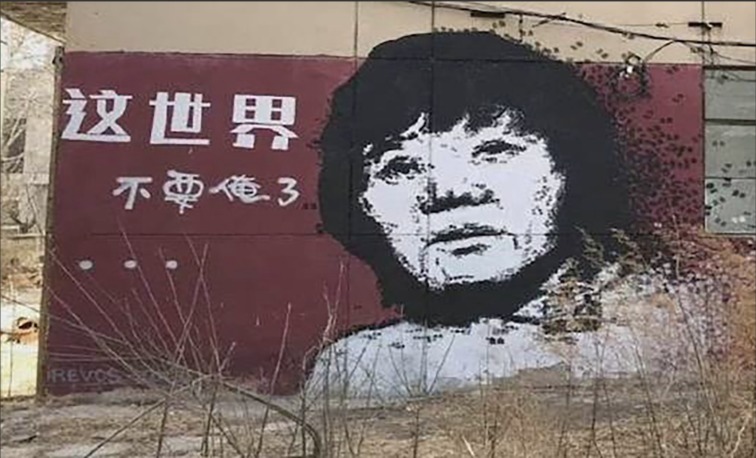
The “Chained Woman” incident in Xuzhou, Jiangsu Province, happened several years ago, yet behind the authorities’ high-profile campaign against human trafficking, the woman at the centre of the case was forcibly isolated, and her current situation remains unknown. (Online screenshot)
[People News] On October 9, a spokesperson for the Chinese Communist Party’s Ministry of Foreign Affairs announced that the Global Women’s Summit would be held in Beijing from October 13 to 14, with Xi Jinping attending the opening ceremony and delivering the keynote speech. What is surprising is that this will be the second time this summit has been convened.
The summit was originally initiated by Xi Jinping and the CCP. In September 2015, during his only appearance at the United Nations General Debate, Xi hosted the first Global Women’s Summit at the UN headquarters in New York. There, he proposed four initiatives to promote the synchronised development of women and the economy and society. He also donated US$10 million to UN Women to support the implementation of the Beijing Declaration and Platform for Action, and pledged to launch 100 maternal and child health projects and 100 “Happy Campus Projects.”
In addition, Xi promised to invite 30,000 women from developing countries to China for training and to train 100,000 female technical personnel in those countries. Indeed, this was quite a grand gesture from Xi.
In 2020, Xi delivered a video address at the UN meeting commemorating the 25th anniversary of the Beijing World Conference on Women, where he proposed holding another summit in 2025.
This upcoming summit, therefore, will likely serve as Xi’s final major international appearance before the CCP’s upcoming Fourth Plenary Session, which will determine his political future.
The author believes that whether this appearance is meant to build momentum or not, it will not affect the plenary session’s agenda.
As for the content of Xi’s speech, one can already guess—it will be filled with pleasant-sounding rhetoric. And, just like the first summit, he will likely make generous donations at the expense of the Chinese people, providing aid to other countries while ignoring the harsh realities faced by many women and children in China, who still struggle to afford medical care, attend school, or escape abuse and mistreatment.
Let us first take a look at Xi Jinping’s remarks at the first Global Women’s Summit in September 2015. Xi said that “women are creators of both material and spiritual civilisation, and are an important force driving social development and progress.” He declared that “the environment for women’s survival and development has been continuously improved.” However, he also acknowledged that “in the face of rampant terrorism and violence, women have suffered greatly. Even today, various forms of discrimination against women still exist, and incidents of abuse and even torture of women continue to occur.”
To address this, one of Xi’s proposed solutions was to “actively safeguard women’s rights and interests.” He stated, “Women’s rights are fundamental human rights. We must incorporate the protection of women’s rights into our legal and regulatory systems, elevate it to a matter of national will, and internalise it as a social code of conduct.” He further emphasised that China must “guarantee basic medical and health services for women, with special attention to the needs of rural women, women with disabilities, migrant women, middle-aged and elderly women, and women from ethnic minorities,” and that “every woman and child should bask in the sunshine of happiness and peace.”
After reviewing the global situation, Xi then turned to the Chinese Communist Party’s policies toward women, stating that “in the Chinese people’s pursuit of a better life, every woman has the opportunity to shine in her life and realise her dreams.” He also pledged that “China will continue to actively implement the fundamental national policy of gender equality, supporting women in achieving success in their careers and fulfilling their personal aspirations.”
His words sounded impressive, even inspiring — enough to make many Chinese nationalists and “little pinks” burst into songs of praise. Yet the 2022 Xuzhou “Chained Woman” trafficking case, which shocked both China and the world, and the Tangshan barbecue restaurant attack, in which four women were brutally beaten and abused, mercilessly tore through Xi’s pretty rhetoric. One cannot help but ask: Were those women basking in the sunshine of happiness and peace? Where, in their lives, was the chance to shine or to realise their dreams?
It is clear that when it came to these two public outrage cases, the top leadership in Zhongnanhai was not blind to what was happening — they knew full well that pulling one thread would unravel the whole fabric. Therefore, they allowed local officials to offer up scapegoats and close the cases hastily. No matter how eloquently Xi Jinping speaks, there is no doubt that he does not care about the lives or deaths of the four women in Tangshan or the “chained woman” in Xuzhou. If he truly cared, he would have slammed his hand on the table, brought the real culprits to justice, and genuinely protected women’s rights.
In reality, the trafficking of women and children in China has never ceased. The horrific scenes described in the 1988 investigative report Black Whirlpool still exist in some parts of China today.
That book documented a major national case of mass abduction and trafficking of women that occurred years ago in Xuzhou: “A total of 101 women were kidnapped and sold by this criminal gang, of whom 11 were raped or gang-raped. The youngest victim was only 13 years old. The vast majority were unmarried young women — farmers, cadres, unemployed youth, and even women with mental illnesses...”
The report also included chilling statistics about women from other provinces who had been deceived, abducted, and sold into Jiangsu Province’s Xuzhou region — and these were only the most conservative estimates: Since 1986, Tongshan County, 12,000; Suining County, 8,700; Pixian County, 9,400; Fengxian County, 8,100; Peixian County, 5,300; Xinyi County, 4,600. “These are horrifying numbers — numbers written in blood and tears.”
Indeed, they are horrifying. How many “chained women” were among them? Were they ever rescued? Tens of thousands of women trafficked to Xuzhou, raped, abused — the thought itself is terrifying. And that horror still exists today. The “chained woman” was merely one of countless victims.
Ask yourself — if there were media oversight and independent civic voices, would trafficking in Xuzhou be so rampant? Would the true attackers in Tangshan still walk free, while victims are denied justice?
The root cause of all this lies in the CCP’s one-party authoritarian system. Under this regime, officials mouth empty slogans about protecting women, while in reality enriching themselves and harming the people.
Therefore — no matter how beautiful Xi’s or the CCP’s words sound — the Chinese people must recognise this truth: Only by breaking away from the CCP — this demonic system — and letting the people truly govern themselves, can Chinese men and women live in genuine peace and happiness.
(First published by People News) △




News magazine bootstrap themes!
I like this themes, fast loading and look profesional
Thank you Carlos!
You're welcome!
Please support me with give positive rating!
Yes Sure!