
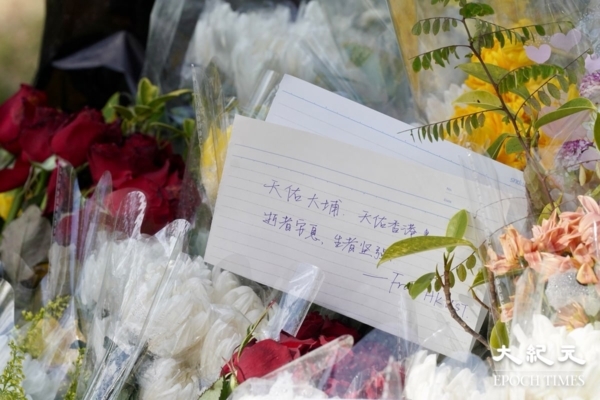
On November 29, 2025, citizens gathered near the fire scene to mourn. (Yu Gang / The Dajiyuan)
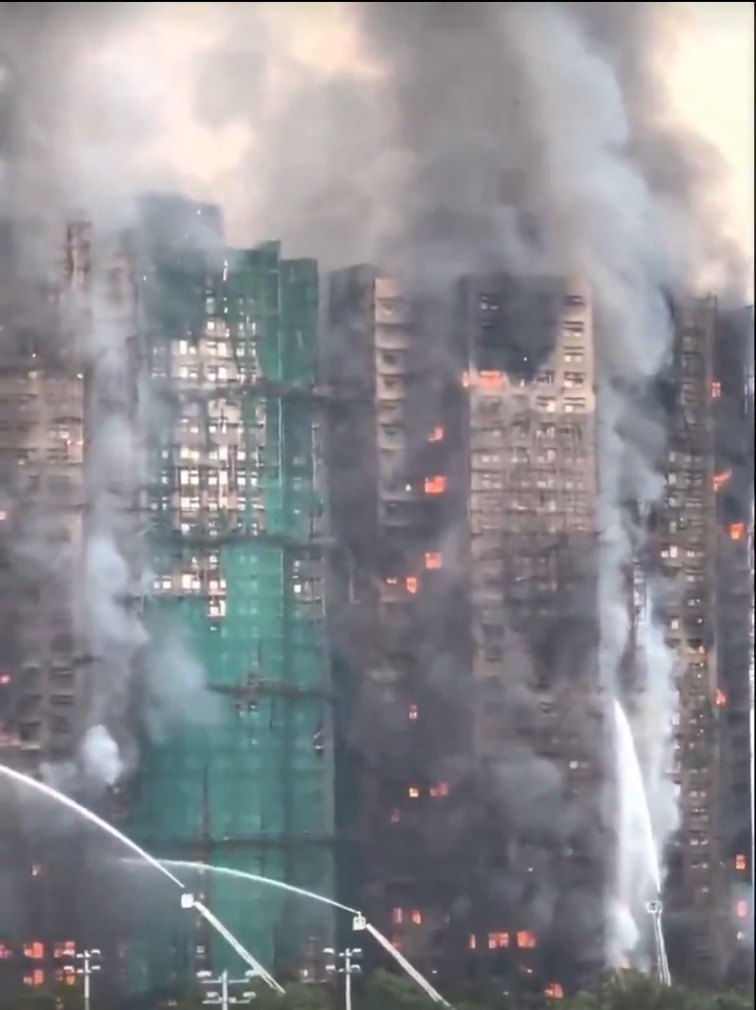
[People News] A level five fire broke out at Hong Fu Court in Tai Po, New Territories, Hong Kong, on November 26. As of this report, at least 146 people have died, 79 have been injured, and over 200 are still missing. Many Hong Kong residents, both locally and abroad, are calling for the Hong Kong government to establish an 'independent investigation committee.' However, the government has not only failed to initiate any independent inquiry but has also arrested the organiser of the petition for an investigation into the fire on charges of 'inciting rebellion.'
The fire at Hong Fu Court has uncovered more troubling details. Analysts suggest that the incident highlights the collapse of Hong Kong's overall system, with a tragedy that could have been prevented occurring due to the government's disregard for public complaints. As a result of the government's evasion of responsibility, even the middle class and moderate members of the establishment in Hong Kong have begun to express their views.
According to a report by Agence France-Presse, seven out of the eight buildings in Hong Fu Court were destroyed, nearly 2,000 households were engulfed in flames, and the confirmed death toll from this most severe residential fire in Hong Kong's history has risen to 146. This weekend, thousands of citizens brought their families to Hong Fu Court to pay their respects to the victims, with the line of mourners stretching for hundreds of meters.
A whistleblower sent 80 warning letters before the fire, but the Hong Kong government ignored them.
In relation to the deadliest fire in Hong Kong in at least 63 years, the Hong Kong government announced on November 28 that the latest investigation revealed that the protective net on the lower floors was the first to catch fire, and the polystyrene boards sealing the building's windows caused the flames to spread rapidly, eventually igniting other buildings. Furthermore, the bamboo scaffolding caught fire, and the burnt bamboo fell, igniting additional protective nets, which led to a complete loss of control over the fire.
Hong Kong Chief Executive Lee Ka-chao (Li Jiachao) informed the media that the government will conduct a thorough inspection of all bamboo scaffolding across the city, and officials will discuss the possibility of switching to metal scaffolding.
However, the Hong Kong government has attributed the cause of the disaster to the bamboo scaffolding, which has faced widespread scepticism, as the use of bamboo scaffolding is a construction method with a history of over a century in Hong Kong.
Civil structural engineering expert Zhu Xueye, based in the United States, told The Dajiyuan that from a structural perspective, the simultaneous burning of several buildings indicates that the materials used in the scaffolding nets lack fire resistance.
Zhu Xueye emphasised that fire prevention is a crucial aspect of high-rise buildings. Once a fire breaks out in a high-rise, the strong winds at high altitudes make it nearly impossible to contain the flames above a certain height; it relies on materials to resist the spread of the fire, meaning that flame-retardant materials are essential to provide firefighters with enough time to extinguish the blaze. Otherwise, a gust of wind can quickly carry the flames to the rooftop, making rescue efforts futile.
As early as when renovations began at Hongfu Garden in 2024, a whistleblower reported to the Hong Kong Labour Department that the protective net used in the renovation was not compliant with flame-retardant standards. However, the Labour Department dismissed the complaint, citing 'no welding work being conducted' and 'the fire risk being relatively low,' and did not issue a work stoppage order.
Pan Zhuohong, a construction engineering expert and chairman of the China Science and Technology Monitoring, revealed in an interview with Liang Zhen, the host of the YouTube political program "Zhen Talk," that he had sent at least 80 letters last May to various major departments, including the Hong Kong Housing Authority, the Labour Department, the Buildings Department, and the Independent Review Committee of the Housing Bureau. In these letters, he warned that the renovation contractors for several buildings, including Hong Fu Court, were suspected of using flammable scaffolding nets, but his warnings went unheeded.
Reports indicate that the contractor in question, "Hongye Construction Engineering Co., Ltd.," has a history of multiple fines related to engineering or scaffolding lawsuits. Additionally, some netizens have disclosed that Hongye's maintenance project charges amount to an astonishing HKD 330 million, which is HKD 150 million higher than its competitors during the bidding process.
Liang Zhen told The Dajiyuan that with few new buildings being constructed in Hong Kong, "major renovations" have become a lucrative business with substantial profits. The exorbitant price of HKD 330 million for the maintenance of eight buildings was awarded to a company with a notorious reputation, which is both the worst and the most expensive, suggesting that there are likely many irregularities at play.
In light of the recent major fire, the Hong Kong Buildings Department ordered a temporary halt to work on 30 private building projects on the 29th, 28 of which are contracted to Hongye Construction.
According to Hong Kong law, private buildings that are 30 years old or older must undergo inspections under the "Mandatory Building Inspection Scheme" (commonly referred to as "major renovations") after receiving notification from the Buildings Department.
Hongye Construction has also been linked to pro-communist parties in Hong Kong.
Comprehensive reports from Hong Kong media indicate that Huang Bijiao, a member of the pro-Beijing 'Democratic Alliance for the Betterment and Progress of Hong Kong', served as an advisor to the Hongfu Court during the approval process for a HKD 330 million renovation project and the selection of contractors. When residents expressed safety concerns about the project, she commented on social media: 'The major renovation work is currently in full swing, and we must unite to stabilise the estate for the successful completion of the major renovation.'
Following the tragic fire at Hongfu Court, she faced severe public backlash. On Saturday (28th), Huang Bijiao responded that she was not aware of the latest progress on the major renovation project, stating, 'This area’s district councillor is not under my coverage.'
In response to the Hong Kong government's failure to launch any independent investigation and the arrest of individuals who initiated a petition for such an investigation, Liang Zhen from Hong Kong questioned why the government has not pursued the matter further, suggesting that vested interests are at play. She noted that Hongye Construction Company is closely linked to the 'Democratic Alliance for the Betterment and Progress of Hong Kong,' which is the largest pro-Communist Party organisation in Hong Kong.
Liang Zhen added that beyond political parties, the Chinese Communist Party has numerous organisations in Hong Kong, including satellite organisations like owners' incorporated associations, which have significant interests involved.
Middle Class Begins to Speak Out
Currently living in Taiwan, Hong Kong artist Huang Guocai told The Dajiyuan that the entire incident reveals the collapse of Hong Kong's overall system, leaving the public with no means to voice their complaints. Under the governance of the Hong Kong Communist Party, the system has completely crumbled, and online reports are disregarded.
Huang Guocai remarked that in the past, when there was still a fourth estate in Hong Kong, the public could approach the media to file complaints and expose issues, but now most media outlets in Hong Kong are under the control of the Hong Kong Communist Party.
Former Hong Kong Observatory Director Lin Chao-ying raised concerns in a Facebook post, stating: "The flammable surrounding nets and foam are clearly the material culprits; why is the focus of scrutiny instead on the relatively less flammable bamboo?" He criticised the disappearance of accountability regarding the 'people' and 'system' that should be responsible for the disaster.
Wang Xiangwei, the former editor-in-chief of the Hong Kong South China Morning Post and currently an associate professor in the journalism department at Hong Kong Baptist University, told foreign media: "The larger issue is: In light of this tragic fire, should senior officials not take full responsibility?"
Former Hong Kong Financial Secretary Tsang Chun-wah expressed on social media on Sunday (30th) that we should not rush to "sentence the bamboo shed to death"; it would be unfortunate to ban its use without proper investigation. He suggested examining human factors, such as whether smoking or the use of substandard materials contributed to the incident, and proposed methods for improvement and regulation. He also raised concerns about the high cost of metal scaffolding, questioning whether the general public could afford a complete replacement of bamboo sheds during major renovations.
In response, senior current affairs commentator Sang Pu noted that many moderate voices in Hong Kong are beginning to emerge. This includes Tsang Chun-wah's comments on Facebook, which indicate a reluctance to shift blame onto the bamboo, suggesting a divergence from the views of officials like Chen Guoji (the Chief Secretary) and Li Jiachao. These moderate middle-class individuals are gradually starting to speak out.
Liang Zhen remarked, "Every Hong Kong resident knows the truth; the bamboo scaffolding is certainly not the main culprit. He simply wants to express that we see Anthony Wong, Janice Yan, and other celebrities. Some stars have even taken to the streets to volunteer. She believes that Hong Kong residents must be thinking that this is their home, and regardless of political stance, anyone could be burned alive; everyone could be a victim."
Hong Fu Court Fire: Hong Kong Residents to Launch Global Blame Petition
Following a devastating 43-hour fire on the 26th, thousands of residents of Hong Fu Court have been left homeless. Many people have donated supplies, and numerous volunteers have come forward to assist. However, reports have emerged of conflicts between these volunteers and the "Care Team" set up by the Hong Kong government. On the 29th, the pro-Communist Party newspaper, Wen Wei Po, published an article claiming that police suspected that "black violence" and "yellow people" had infiltrated the disaster relief efforts.
The terms "black violence" and "yellow people" were used by pro-China media to describe protesters during the 2019 anti-extradition movement in Hong Kong.
According to the Hong Kong media outlet Independent Media, citizens, including Minerva Chan, launched a petition on Change.org on the 28th titled "Thorough Investigation of the Tai Po Hong Fu Court Fire," outlining four key demands: ongoing support for affected residents and ensuring proper resettlement; the establishment of an independent investigation committee to thoroughly examine potential conflicts of interest; a re-evaluation of the engineering oversight system to avoid superficial resolutions; and a commitment to hold government officials accountable for regulatory failures. By 7 PM on the 29th, over ten thousand signatures had been collected for the petition.
However, one of the petition initiators, 24-year-old university student Miles Kwan, was arrested by the Hong Kong police on the 29th on charges of inciting rebellion, and the petition website was subsequently taken down.
On the same day, the National Security Office stationed in Hong Kong released a statement claiming that during the disaster period, there were "anti-China and chaotic Hong Kong elements" inciting public resentment against the government, and they would "not hesitate to take strong legal action against those who use disasters to create chaos in Hong Kong".
In response, Liang Zhen remarked that the Hong Kong government is employing violence as a means of maintaining stability, which is a typical approach of the Chinese Communist Party (CCP). Following the Urumqi fire in 2022, the White Paper Revolution erupted in Shanghai. The situation in Hong Kong is even more difficult than that of Urumqi and is even more absurd. Thus, the CCP is particularly fearful of a White Paper Revolution occurring in Hong Kong, as this is their greatest concern.
Liang Zhen further asserted that the public has lost trust in the government, and the Hong Kong government has effectively declared bankruptcy in terms of credibility.
Sang Pu, chairman of the Taiwan-Hong Kong Association, also noted that in Hong Kong, public opinion has not been completely suppressed or extinguished; rather, it is growing stronger. Currently, not only pro-democracy advocates demanding democratic reforms but also localist individuals and even some moderate establishment figures from the light blue camp are feeling a sense of urgency, questioning, "Why is this government so quick to shirk its responsibilities?"
He added that there will be a series of global petition actions to support the four fundamental demands of this 24-year-old young man from Hong Kong.
Sang Pu stated that this sentiment will resonate globally. In the coming week or two, Hong Kong residents will gather in Taiwan, the United States, Canada, and the United Kingdom to demand accountability. They will hold prayer meetings in remembrance, set up 'Lennon Walls' (walls displaying slogans and messages against the extradition bill), and participate in discussions focused on accountability.
(Dajiyaun) △




News magazine bootstrap themes!
I like this themes, fast loading and look profesional
Thank you Carlos!
You're welcome!
Please support me with give positive rating!
Yes Sure!