
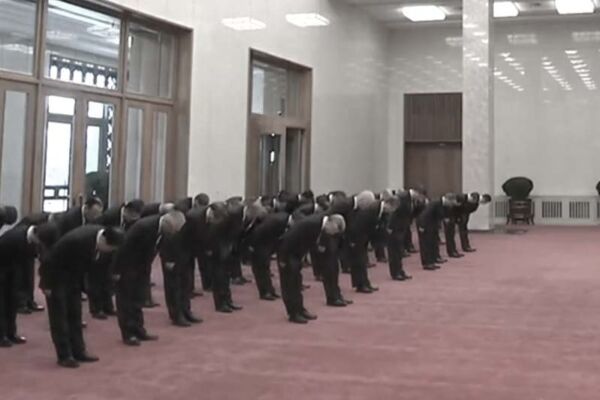
On December 26, 2023, members of the CCP Politburo Standing Committee and senior officials in Beijing bowing to the statue of Mao Zedong. Screenshot from a video.
[People News] Recently, the Chinese Communist Party (CCP) has once again stirred up a wave of anti-Japanese fervor, with an extremely high-pitched tone. The CCP’s central Party newspaper, People’s Daily, has listed “nine major crimes” against Japanese Prime Minister Sanae Takaichi and has already adopted a posture suggesting that nothing short of forcing Takaichi out of office will suffice. CCP fighter jets have even used radar to lock onto Japanese aircraft—just one step short of actually opening fire.
For Japan, which has grown accustomed to the CCP launching an anti-Japanese campaign every so often, the reaction has been relatively calm and restrained.
Recently, however, a routine move by the Japanese government brought to mind a striking contrast with the CCP, which is currently making such a high-profile show of anti-Japanese sentiment.
On December 5, Japanese Prime Minister Sanae Takaichi and 18 cabinet members publicly disclosed their own assets as well as those of their family members. Among them, Takaichi’s total assets amounted to 32.06 million yen (about 1.5 million yuan), noticeably lower than those of several core cabinet members.
Ranked first was Defense Minister Shinjiro Koizumi. His total assets amounted to 272.48 million yen (about 13 million yuan). All of Koizumi’s assets are registered under the name of his wife, Kristine Takigawa, including 70 million yen in government bonds, 77.64 million yen in corporate bonds, and 124.84 million yen in other marketable securities. He also declared ownership of 700 shares of Tokyo Metro stock.
Ranked second was Foreign Minister Toshimitsu Motegi. His total assets totaled 193.97 million yen (about 10 million yuan), including 178.94 million yen in marketable securities, real estate in Ashikaga City, Tochigi Prefecture worth 15.03 million yen, as well as a total of 243,300 shares in five companies that he holds.
Ranked third was Minister of Internal Affairs and Communications Yoshimasa Hayashi. His total assets amounted to 150.88 million yen (about 7 million yuan), including 137.88 million yen in real estate, 13 million yen in deposits and other assets, as well as golf club memberships and stocks that he owns.
Do Xi Jinping and the other six members of the CCP Politburo Standing Committee dare to publicly and openly disclose their own assets and those of their families?
The answer is: they do not dare.
Not only do Xi Jinping and the other six Politburo Standing Committee members not dare to openly disclose their own and their families’ assets, even the amounts embezzled by senior military corruption figures already investigated by Xi’s authorities are not dared to be made public.
In January 2013, Xi launched the anti-corruption “tiger-hunting” campaign at the Second Plenary Session of the 18th Central Commission for Discipline Inspection. During Xi’s first and second terms, more than 170 generals were investigated. These included former Politburo member and Vice Chairman of the Central Military Commission Xu Caihou; former Politburo member and Vice Chairman of the Central Military Commission Guo Boxiong; former member of the Central Military Commission and Director of the Political Work Department Zhang Yang; and former member of the Central Military Commission and Chief of the Joint Staff Department Fang Fenghui, among others.
How much did Xu Caihou embezzle? The CCP’s wording was: “the amount was extremely huge.”
How much did Guo Boxiong embezzle? The CCP’s wording was: “the amount was extremely huge.”
How much did Zhang Yang embezzle? The CCP’s wording was: “the amount was extremely huge.”
How much did Fang Fenghui embezzle? The CCP’s wording was: “the amount was extremely huge.”
…
Exactly how huge are these “extremely huge amounts”? All CCP Party media, including China Central Television, People’s Daily, PLA Daily, Qiushi magazine, and so on and so forth, have uniformly refrained from reporting on this in any high-profile way, collectively pretending to be deaf and mute.
After Xi secured a “third consecutive term” at the CCP’s 20th National Congress in 2022, and as the Rocket Force major case broke out, the CCP military launched wave after wave of purges. Another batch of full generals, lieutenant generals, and major generals were investigated. These included former Politburo member and Vice Chairman of the Central Military Commission He Weidong; former member of the Central Military Commission and Director of the Political Work Department Miao Hua; former member of the Central Military Commission, State Councilor, and Minister of National Defense Li Shangfu; and former member of the Central Military Commission, State Councilor, and Minister of National Defense Wei Fenghe, among others.
How much did He Weidong embezzle? The CCP’s wording was: “the amount was extremely huge.”
How much did Miao Hua embezzle? The CCP’s wording was: “the amount was extremely huge.”
How much did Li Shangfu embezzle? The CCP’s wording was: “the amount was extremely huge.”
How much did Wei Fenghe embezzle? The CCP’s wording was: “the amount was extremely huge.”
…
Exactly how huge are these “extremely huge amounts”? All CCP Party media, including China Central Television, People’s Daily, PLA Daily, Qiushi magazine, and so on and so forth, have uniformly refrained from reporting on this in any high-profile way, collectively pretending to be deaf and mute.
Why is it that Japanese Prime Minister Sanae Takaichi and her cabinet members—whom the CCP describes as “heinously criminal”—dare to openly and straightforwardly take the lead in disclosing their own and their families’ assets, while the CCP, which claims to represent “justice and conscience,” does not even dare to disclose the amounts embezzled by military corruption figures who have already been investigated?
Why is it that Japanese Prime Minister Sanae Takaichi and her cabinet members—whom the CCP fiercely criticizes for “hijacking public opinion,” “inciting emotions,” and “deceiving and harming” the Japanese people—dare to openly and straightforwardly take the lead in disclosing their own and their families’ assets, while the CCP, which endlessly proclaims that it “serves the people wholeheartedly,” does not even dare to disclose the amounts embezzled by military corruption figures who have already been investigated?
Why is it that Japanese Prime Minister Sanae Takaichi and her cabinet members—whom the CCP harshly condemns as “going against the tide” and as “unreliable and untrustworthy”—dare to openly and straightforwardly take the lead in disclosing their own and their families’ assets, while the CCP, which claims to have “confidence in its path, theory, and system,” does not even dare to disclose the amounts embezzled by military corruption figures who have already been investigated?
The answer is very simple: the CCP has neither “confidence in its path,” nor “confidence in its theory,” nor “confidence in its system.” The CCP is fundamentally not a party that “serves the people wholeheartedly,” but a party that “serves the renminbi wholeheartedly,” a party that is terrified of the people knowing the truth. The CCP is fundamentally not a party that represents “justice and conscience,” but a party that relies on “falsehood, evil, and struggle” to deceive the world, fish in troubled waters, and commit every kind of wrongdoing.
Former Singapore Prime Minister Lee Kuan Yew once said: “If a country has not established a system for public disclosure of officials’ assets, then that country’s anti-corruption efforts can only be flowers in a mirror and the moon reflected in water.”
According to World Bank statistics, by 2016, 153 countries and regions around the world had established systems for officials to declare and publicly disclose their assets.
Does the CCP know about asset declaration and disclosure systems? It has long known about them. As early as the CCP’s “Two Sessions” in 1988, some deputies to the National People’s Congress proposed legislative motions regarding officials’ asset declaration. In 1994, the Standing Committee of the Eighth National People’s Congress officially included the Asset Declaration Law in its legislative plan. Yet to this day—more than thirty years later—the CCP has still not promulgated a law on officials’ asset declaration and public disclosure.
On December 22, 2019, Peking University professor Zheng Yefu published an article titled “Asset Disclosure, Please Start with the Standing Committee”, in which he noted that asset declaration and disclosure systems are “fair, peaceful, low-cost, non-ideological, and have been adopted even by countries that do not follow Western traditions.”
Professor Zheng suggested: “Let the seven Standing Committee members take the lead in publicly disclosing their assets. I have heard many times: to forge iron, one must be strong oneself. Taking the lead in asset disclosure is a good way to prove one’s own innocence and to set an example for officialdom. If this is done, there will be no fear that asset declaration and disclosure cannot be implemented.”
Six years have passed since Professor Zheng Yefu put forward this proposal, yet Xi Jinping and the other six members of the CCP Politburo Standing Committee have all turned a blind eye and a deaf ear.
Why do Xi Jinping and the other six Standing Committee members resolutely refuse to take the lead in disclosing their assets?
The fundamental reason is this: today’s CCP has become the most corrupt party in the world. High officials engage in grand corruption, lower officials engage in smaller corruption—and even lower officials often engage in major corruption. Almost no official is free from corruption.
After ten years of Xi’s anti-corruption “tiger-hunting,” He Weidong—personally, exceptionally, and rapidly promoted and heavily reused by Xi as a CCP Politburo member and Vice Chairman of the Central Military Commission—was in office for only a little over two years before becoming “suspected of serious duty-related crimes, involving extremely huge amounts, with extremely serious nature and extremely vile impact.” How much more so for other CCP officials?
The CCP’s high-profile anti-Japanese campaigns are nothing more than acting. Their real purpose is to cover up the severe economic crisis, social crisis, and political crisis that the CCP is facing.
Today, I read an article titled “This Is Not a Crisis but Death!” The article states: “A housing market collapse, high unemployment, shrinking consumption, declining corporate profits, and massive closures of factories and shops—these phenomena are described as an economic crisis or a great depression. Economic crises and depressions eventually end. Japan’s ‘lost thirty years’ still managed to climb out from the bottom. But China’s situation is different. It is not an economic crisis but a systemic collapse—not merely a great depression but an overall march toward death.”
The CCP is facing a crisis of party extinction. This is the most severe reality confronting the CCP.
If the CCP were to make public how much the seriously corrupt military figures have embezzled, what if the military were to rise up in rebellion?
If the CCP’s seven Standing Committee members were to take the lead in disclosing their assets, wouldn’t that cost them their lives?
— The Dajiyuan
△







News magazine bootstrap themes!
I like this themes, fast loading and look profesional
Thank you Carlos!
You're welcome!
Please support me with give positive rating!
Yes Sure!