

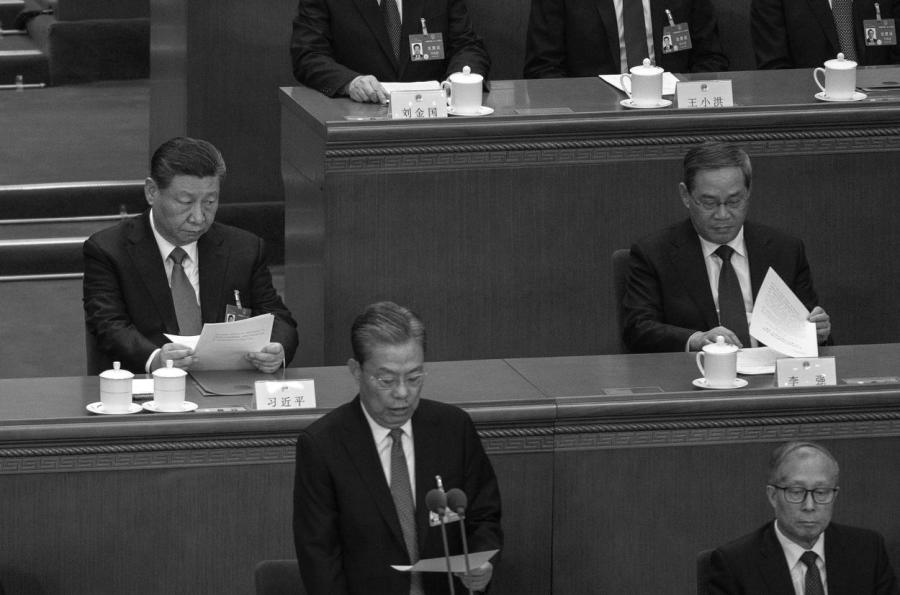
Image: During the March 2024 Two Sessions, Xi Jinping was photographed by foreign media in the Great Hall of the People with an expression of extreme pain while drinking tea. (Illustration by Qing Yu/People News)
[People News] According to commentator Lao Deng, it is rumoured that during this year's Two Sessions, Xi Jinping experienced another stroke due to anxiety and irritability. Fortunately, timely medical intervention prevented any serious consequences. How credible is this information? It remains unverified at this time.
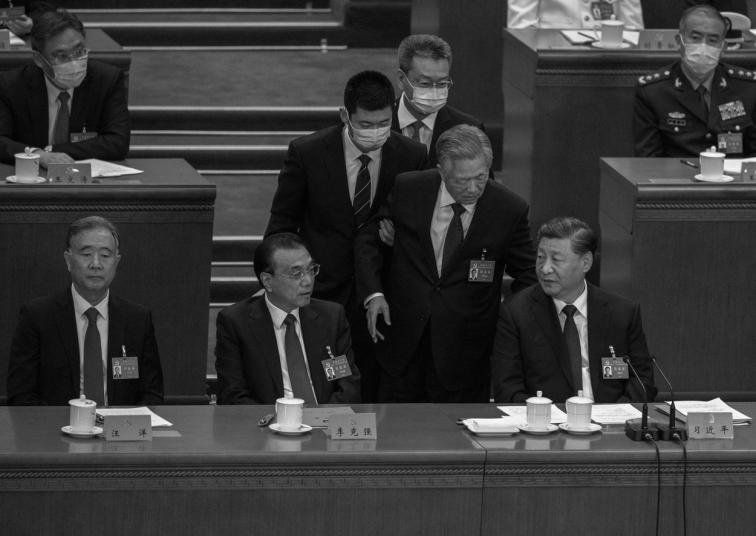
However, multiple videos from CCTV and the Chinese Communist Party's online media reveal that Xi Jinping often appeared quite fatigued during this year's Two Sessions, occasionally showing a dark complexion. At the closing meeting of the National People's Congress (NPC) and the Chinese People's Political Consultative Conference (CPPCC), the six prominent figures sitting next to him had only one water cup in front of them, while he had two. This could suggest that one of the cups was for medication, indicating he needed to take medicine promptly to avoid sudden health issues.
Another detail suggests that Xi Jinping was not in a good mood during the Two Sessions. This does not necessarily stem from concerns about being harmed due to the arrests of many high-ranking officials, but is likely related to his health. What detail is this? During the Two Sessions, there was an occasion when Wang Huning handed him a note. After briefly looking at it, he spoke a few words to Wang while looking down, and when he returned the note to Wang, his head and arm slightly trembled.
We do not know the contents of the note, but it is clear that his behaviour at that moment was unrelated to the method of passing the note or its content, nor was it connected to his attitude towards Wang, as he maintained a normal expression while speaking to Wang. This indicates that the issue must be related to his health.
In theory, given the advanced communication methods available today, if the leaders of the Communist Party of China (CPC) have something to convey, they could simply set their mobile phones to silent mode and send text messages or make phone calls. Why resort to secretly passing messages like they are sending coded signals, and even require assistance from camera personnel to relay messages to those in the back row? This behaviour seems rather odd.
Historically, the practice of CPC leaders passing secret messages through notes has deep roots as far back as the 1950s and 1960s; the upper echelons of the CPC often communicated covertly through notes to undermine political rivals. For instance, during the Anti-Rightist Movement, Kang Sheng aimed to discredit Peng Dehuai and Xi Zhongxun by writing notes to Mao Zedong at meetings, claiming that using literary works to oppose the party was a new tactic. Even earlier, during the conflict between the Republic of China and the CPC, underground organisations within the CPC favoured using notes with coded messages for communication.
Thus, the fact that the CPC's upper leadership continues to use this method suggests they are quite accustomed to it, having a strong familiarity with the tactics employed by the Red Guards. Consequently, any physical tremors observed can only be interpreted as health-related.
Furthermore, on March 7, CPC leader Xi Jinping attended a meeting with military and armed police delegations. CCTV footage indicated that Xi Jinping's movements appeared somewhat unusual; he walked with a slight shoulder tilt, which likely also pertained to health issues.
Notably, at this meeting with military and armed police delegations, only four active-duty generals and two retired generals were present.
The representatives who did not attend the event included Li Fengbiao, political commissar of the Western Theater Command and a representative of the National People's Congress, Xu Xueqiang, director of the Equipment Development Department of the Central Military Commission, Chen Hui, political commissar of the Army, Chang Dingqiu, commander of the Air Force, Guo Puxiao, political commissar of the Air Force, He Ping, former political commissar of the Eastern Theater Command, Yuan Yubai, former commander of the Southern Theater Command, and Wang Jianwu, former political commissar of the Southern Theater Command.
Analysts believe that this further confirms that these eight generals have encountered serious issues, putting their qualifications as representatives of the National People's Congress (NPC) in jeopardy.
On March 11, the BBC reported that during this year's Two Sessions of the Chinese Communist Party (CCP), the total number of representatives from the military and armed police delegation to the NPC has decreased from the initial 281 to 243, a reduction of 38. Additionally, not all of the registered 243 representatives were present; some are still cooperating with investigations and, while they have not yet been stripped of their qualifications, are unable to attend.
The report indicates that the 'presence' and 'absence' showcased at this year's Two Sessions have illustrated the latest developments in China's secretive political landscape over the past year. For example, the attendance figures from the military delegation and the diminished presence of generals at the venue provide a clear insight into the significant reshuffling of the military's high command structure due to the intense anti-corruption campaign.
A report released by the International Institute for Strategic Studies (IISS) on the eve of the CCP's Two Sessions noted that the high-pressure anti-corruption measures within the military have created serious gaps in the command structure, which could significantly hinder the rapid modernisation of the CCP's military readiness.
Political commentator Yuan Bin wrote in The Epoch Times on March 1, stating that despite Xi Jinping's extensive purges, he remains increasingly uneasy rather than reassured. It appears that Xi Jinping has only one path left, which is to carry the revolution through to its conclusion.
(Originally published by People News)
△





News magazine bootstrap themes!
I like this themes, fast loading and look profesional
Thank you Carlos!
You're welcome!
Please support me with give positive rating!
Yes Sure!