
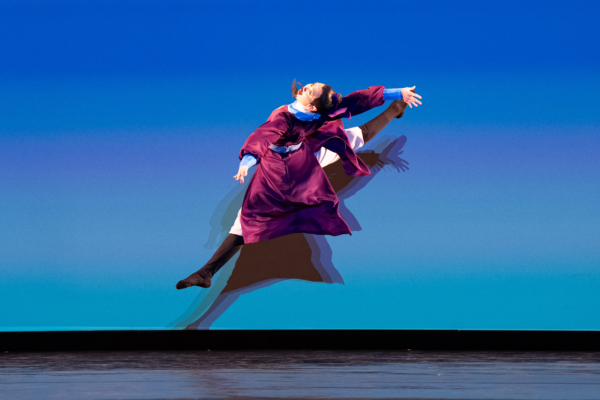
In September 2025, the 11th NTD International Classical Chinese Dance Competition was held at the Sugar Loaf Performing Arts Center in New York State, USA. The photo shows Liu Zixing, a contestant in the Youth Men’s Division, performing the dance “Song of Lime” during the preliminary round. (Dai Bing / The Dajiyuan)
[People News] At the age of three, he saw his disfigured aunt in a hospital ward, yet did not understand that it was their last meeting; in childhood, he followed his mother and second aunt as they drifted from place to place, evading pursuit; while in school, he was beaten by a teacher for refusing to wear the red scarf, watched by police outside his home, and secretly photographed on the street…
These experiences could have pushed a child toward extreme hatred, despair, and isolation. But he chose another path—leaving that suffocating environment, coming to the free world, honing himself step by step at Fei Tian Academy of the Arts, and ultimately stepping onto the Shen Yun stage, becoming a messenger who promotes goodness.

On July 20, 2025, several thousand Falun Gong practitioners in the Greater New York area held a “Stop the Persecution of Falun Gong” parade in Manhattan’s Chinatown. Hundreds of Shen Yun artists and staff also joined the procession as a formation. The photo shows Shen Yun dancer Liu Zixing being interviewed by the media. (Mark Zou / The Dajiyuan)
A Face Deep in Childhood Memory
It was the summer of 2004. Liu Zixing had just turned three.
In a hospital in Shenyang, police lined both sides of the corridor, the air tense to the point of suffocation. The young child did not understand what was happening, only vaguely sensing the tension and oppression of the adult world. Yet when he was brought into the ward and saw the person lying on the hospital bed, his eyes suddenly lit up—that was his closest aunt: Gao Rongrong.
But that day, his aunt looked completely different from how he remembered her.
Her face was scorched black as if burned by fire; her neck and the area around her ears were covered with shocking burn wounds; her legs were wrapped in bandages; her whole body was so thin it was almost nothing but bones. She struggled to lift her eyes and, in an extremely weak voice, called out, “Erbao (Zixing’s nickname)…”
At the time, Zixing was only three years old and did not know what this scene meant.
Many years later, when he stood on the stage of the Shen Yun Performing Arts as a classical Chinese dancer, telling the world the true story of the Chinese Communist Party’s persecution of faith, he gradually came to understand: that summer, that face disfigured by electric shocks, that faint call—were not only a scar in his life, but also the starting point of his path of “using dance to tell the truth.”
“Although I was very young at the time, that memory has always stayed with me. Every time I think about it after growing up, it’s still quite painful,” Zixing said.
Aunt Disfigured and Tortured to Death

Former staff member of the Finance Office of Shenyang Luxun Academy of Fine Arts, and Liu Zixing’s aunt, Gao Rongrong (Minghui.org)
In the memories of her family, Zixing’s aunt Gao Rongrong was gentle and kind, always cheerful. She was hardworking, considerate of her parents, and often took the initiative to help with household chores. After graduating from university, she worked in the Finance Office of the Luxun Academy of Fine Arts. At that time, many students at the academy practiced Falun Gong, and she became a volunteer instructor at an on-campus practice site.
Precisely because Gao Rongrong held the position of a Falun Gong instructor at a higher education institution, she became a key target of the authorities. Gao Rongrong’s elder sister, Gao Weiwei, recalled, “She (Gao Rongrong) started being called in for talks around April 25, 1999.”
From late July 1999 onward, because she petitioned to speak up for Falun Gong, Gao Rongrong was arrested and detained many times.
In 2000, she was kidnapped again outside her home and this time was sent directly to the notorious Masanjia Forced Labor Camp.
Not long after Gao Rongrong was released from Masanjia and returned home, in June 2003 she was again kidnapped by the “610 Office” and state security agents. In March 2004, she was detained at the Longshan Re-education Center in Shenyang and refused “transformation” (renouncing her practice). “By May, she was disfigured by electric shocks,” Gao Weiwei said.

On May 7, 2004, Falun Gong practitioner Gao Rongrong was subjected to nearly seven hours of electric shocks by prison guards Tang Yubao and Jiang Zhaohua at the Longshan Re-education Center in Shenyang, resulting in electrical burn injuries to her face. The photo was taken ten days after the injury. (Minghui.org)
Under seven hours of electric shocks by vicious police at the Longshan Forced Labor Camp in Shenyang, the skin and flesh on Gao Rongrong’s face, ears, neck, back, ankles, and other areas were burned, blistered, and charred. Her face swelled to more than a fist’s height, her eyes were reduced to thin slits, and yellow fluid the size of beans continuously seeped from her face…
In order to escape the den of demons, Gao Rongrong jumped from the window of a second-floor office of the re-education center. She was seriously injured and sent to the hospital for treatment.
During her hospitalization, Gao Rongrong remained under strict surveillance by CCP police. The authorities declared that she would be sent back to the detention facility immediately upon discharge. However, several Falun Gong practitioners successfully rescued Gao Rongrong from the hospital.
The Ministry of Public Security subsequently classified Gao Rongrong’s escape as the “No. 26 Major Case.”
After photos of Gao Rongrong’s disfigured face were exposed internationally on July 7, 2004, they caused shock around the world, and the CCP authorities fell into extreme panic. Under the instruction of then CCP Political and Legal Affairs Committee Secretary and “610” chief Luo Gan, the Liaoning Provincial Political and Legal Affairs Committee, the 610 Office, the procuratorate, the judicial bureau, and the public security bureau jointly launched a manhunt for Gao Rongrong. A person from the judicial system once personally told Gao Rongrong’s father: “Luo Gan has given instructions. This matter (referring to the exposure of Gao Rongrong’s electric-shock disfigurement) has had too great an international impact, and we are to ‘handle it properly’…”
On June 16, 2005, Gao Rongrong was persecuted to death at the age of only 37.
Gao Rongrong’s death dealt a devastating blow to Zixing’s maternal grandmother. Five years later, his grandmother also passed away suddenly.

In 2018, Liu Zixing’s mother, Gao Weiwei, sister of Gao Rongrong, participated in the July 20 candlelight vigil in Washington, DC, USA. (Li Sha / The Dajiyuan)
A Childhood of Displacement
After Gao Rongrong was persecuted to death, the persecution of Liu Zixing’s family did not stop.
“At that time, after my aunt was persecuted to death, the ‘610 Office’ wanted to cremate her body to cover up the evidence of persecution,” Liu Zixing recalled.
The authorities repeatedly summoned Zixing’s grandparents for “talks,” forcing them to sign the cremation papers. But his grandparents refused—she was their daughter, and also a body that might serve as evidence in the future.
The CCP officials then began threatening to arrest Gao Rongrong’s two sisters: Gao Weiwei and Gao Lili.
In order to avoid harassment and arrest, Gao Weiwei and Gao Lili had no choice but to take young Zixing and live in displacement. They moved from the outskirts of Beijing to areas in Hebei, constantly changing locations and renting different places.
Those were days without a stable home.
“Life was actually very difficult,” Zixing said. “At that time, we didn’t have enough money, and we were renting everywhere. The conditions were very poor.”
He was unable to attend kindergarten normally. When they reached rural areas, his mother still tried her best to find a simple village kindergarten for him, so he could “at least learn something.”
However, this brief stability was soon shattered.
One morning, several police officers burst directly into the small rented room where they lived and took the entire family away.
That day, they were detained at the Domestic Security Brigade from morning until night. “In the afternoon, they confiscated my ID card and called the public security bureau where my household registration was, but the bureau responded that they didn’t want to deal with this matter.”
Living Under Long-Term Surveillance
Even after the period of displacement ended and they returned to Beijing, their lives did not return to anything resembling “normal.”
Gao Weiwei said, “For a long time, there were always police monitoring our home.” Especially during so-called “sensitive days” each year, the surveillance became even more intense.
“For example, during the Olympics, there were many plainclothes police at my door, in the hallway, and near the elevator. They would just stand there watching,” Gao Weiwei said. “People from the state security bureau and the public security bureau also came to my home once, asking us not to petition and telling us to cremate Gao Rongrong’s body.”
For the authorities, their concern was that foreign journalists might find Gao Rongrong’s sisters and interview them about the truth of her persecution and death. For Liu Zixing’s family, it was a sense of oppression—“knowing that someone is watching you every day when you go out.”
Sometimes, when Gao Weiwei walked on the street with Zixing, plainclothes officers followed them from afar and secretly photographed them. Later, an informed person told Gao Weiwei about this.
“That was really terrifying,” Gao Weiwei said.
But in such an environment, she still did her best to teach her child not to harbor hatred.
“I told Zixing: don’t develop hatred toward these police uncles. When you walk past them, if possible, just nod to them.”
However, for him, who was still in elementary school at the time, maintaining a smile in fear was almost impossible. He “carried his schoolbag, said nothing, lowered his head, and just walked past.”
A Withdrawn, Taciturn Boy Who Refused to Wear the Red Scarf
“When I grew a bit older and went to elementary school, I became somewhat self-conscious and withdrawn,” Zixing said. “I didn’t really dare to speak, didn’t dare to play with classmates, and always felt I couldn’t hold my head up.”
After entering first grade, the school required all students to collectively join the Young Pioneers and wear the red scarf. For many Chinese children, the initiation oath and wearing the red scarf symbolize “striving for the cause of communism.”
But for a child who had personally witnessed CCP persecution since early childhood and whose family members were tortured to death because of their faith, the symbolism of that red scarf was completely different.
Zixing’s mother specifically went to speak with his homeroom teacher and made it clear: “Zixing does not need to join the Young Pioneers and does not need to wear the red scarf.” With her insistence, the teacher agreed to make this exception.
Thus, at every flag-raising ceremony and group calisthenics session, amid a sea of red scarves on the school playground, he was the only one not wearing one. This conspicuous “difference” angered some teachers, and he was even beaten by a teacher in front of his classmates.
Zixing said, “Looking back now, I feel that my childhood life was really very different from that of other kids my age.”
Persecution Extended to Every Family Member
Even more cruelly, the persecution was not limited to the practitioners themselves. Even family members who did not practice Falun Gong became targets of harassment and surveillance.
Zixing’s father and maternal grandfather did not practice, yet they too endured harassment and pressure for many years. Under fear and high pressure, his father made a difficult decision—personally sending Zixing to Fei Tian Academy of the Arts in New York, USA, so that the child could stay away from CCP persecution, grow up in a free environment, and pursue his love for dance.
After divorcing Zixing’s mother, his father still could not escape CCP harassment; the police continued to come to his door. Zixing’s paternal grandparents were also harassed.
Zixing’s older sister wanted to study abroad. She had her passport, and she had her visa, yet she was repeatedly stopped at border exit checkpoints and told, “Not allowed to leave the country.” It was not until 2012 that she finally succeeded in leaving China.
For this family, the CCP’s persecution was not just a “case” in news reports, but an invisible hand extending into every family member and every life choice.
A Turn From Desperation: The Family Enters Cultivation
Before the storm arrived, this family had once experienced a turning point that was almost a “resurrection,” thanks to Falun Dafa.
In 1996, Zixing’s grandmother was diagnosed with late-stage rectal cancer and was bedridden. The family had already begun preparing for her funeral. It was the first time the entire family truly felt that “death was right in front of them.” Even Zixing’s usually strong grandfather could not hold back his tears. The whole family was enveloped in an overwhelming sense of helplessness.
In this despair, his grandmother came into contact with Falun Dafa and began practicing. Not long after, her severe condition unexpectedly improved day by day, and she eventually made a complete recovery—something almost unimaginable from a medical perspective, yet it truly happened in this family.
Gao Weiwei said, “Although my father did not practice, he personally witnessed my mother go from late-stage cancer to full recovery, and he felt immense gratitude toward this practice.”
At that time, Gao Weiwei was living and working in Japan. Her younger sister mailed her a copy of Zhuan Falun from China.
“I also felt that this Dafa was truly wonderful, so I began practicing as well,” Gao Weiwei said.
It was precisely because of this that when the suppression suddenly began in 1999 and lies flooded the air, the family felt such confusion and incomprehension: “Such a good Dafa, such a good teacher—why would it suddenly face such suppression and slander?”
In order to clarify the facts, they called relevant government departments to speak up for Falun Gong. After “July 20,” when the regime turned its massive propaganda machine against this group, their first instinct was to report the situation through normal channels—to municipal and provincial governments, and even to the petitioning offices in Beijing.
Once, Zixing’s grandmother, mother, and aunt went to Beijing to petition, and all were arrested and detained.
From that point on, the family became entangled in wave after wave of suppression and persecution. However, because they firmly believed that Falun Dafa was a righteous practice, they continued to hold fast to their inner convictions under immense pressure.
Admitted to Fei Tian Academy of the Arts
During those years, life was bleak for Liu Zixing every day. Until one day, he obtained a Shen Yun DVD, and his life began to have direction.
The first time he watched Shen Yun, he saw: on screen, a bright and vast stage; dancers with flowing garments; movements that were upright and clean; a kind of purity and solemnity he had never felt in real life. He felt that “they were incredibly cool.”
He said, “At that moment, I felt that I wanted to dance. This is a path I will definitely persist in.”
In 2013, he came to New York. That year, he successfully gained admission to Fei Tian Academy of the Arts, truly embarking on the path of professional training in classical Chinese dance and laying the foundation for joining Shen Yun Performing Arts in the future.
Recreating Stories of Persecution on Stage
In 2019, Liu Zixing played the role of a persecuted Falun Gong practitioner in a short Shen Yun dance drama that exposed the CCP’s persecution of Falun Gong. For him, this was not merely a role or a story.
“That short dance drama doesn’t just reflect what happened to my family,” he said. “It also represents all Falun Gong practitioners who are persecuted in mainland China. I had a feeling that through this program, each and every one of their stories was being presented to the audience.”
Therefore, during rehearsals and performances, he was deeply immersed…
Presenting True Tradition to the World
For Liu Zixing, what enables Shen Yun to move audiences around the world lies not only in the beautiful dance, music, costumes, or stage effects, but because it presents “divinely inspired culture.”
“Traditional culture was passed down by the divine,” he said. “Shen Yun’s annual program design is not only about telling people to return to tradition, but also about guiding people back to a state of life that is connected with the divine.”
In Shen Yun’s programs, audiences can see many mythological stories and historical tales, and see how the traditional virtues of benevolence, righteousness, propriety, wisdom, and trust manifest in specific characters.
“Each program is not just performing a cultural fragment, but telling people: why did the divine pass down such a culture to humanity? Everything has tremendous benefit for people.”
Hoping One Day to Perform in China
Liu Zixing said that over the past twenty years, Shen Yun has performed around the world, showcasing the splendor of five thousand years of civilization and receiving waves of praise, moving countless people. But for every Shen Yun performer, there is a lingering regret in their hearts: many Chinese people have not yet seen “China before communism.”
Liu Zixing believes that Shen Yun returning to China “will definitely happen.”
“I sincerely hope that day will come sooner.”
(The Dajiyuan)
△





News magazine bootstrap themes!
I like this themes, fast loading and look profesional
Thank you Carlos!
You're welcome!
Please support me with give positive rating!
Yes Sure!