
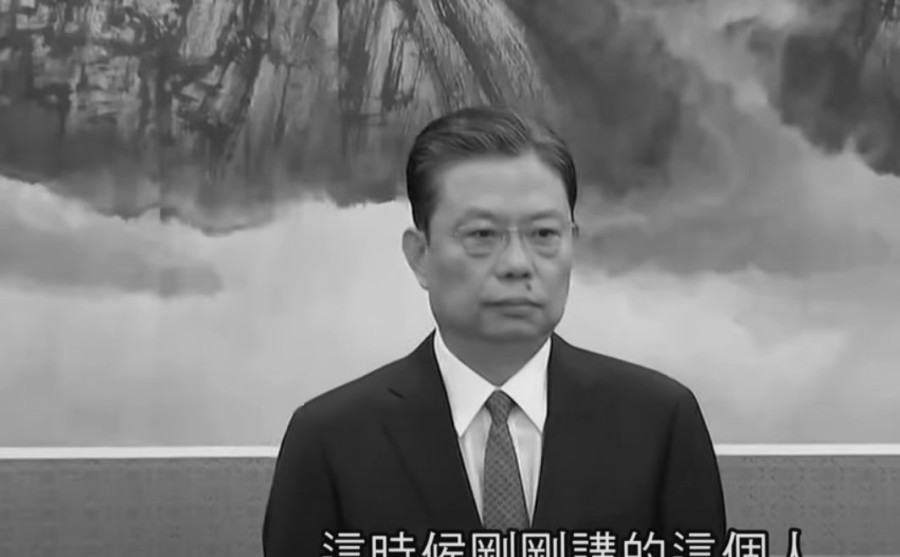
Zhao Leji, the third-ranking official in the Chinese Communist Party (video screenshot)
[People News] On February 4, 2026, the 20th session of the Standing Committee of the 14th National People’s Congress was convened in Beijing on an emergency basis, with Zhao Leji presiding. Observers believed the unusual session was likely intended to provide “legal procedures” after Xi Jinping allegedly violated procedures in detaining Central Military Commission Vice Chairman Zhang Youxia and CMC member Liu Zhenli. Unexpectedly, Zhao Leji did not move to remove Zhang and Liu from their positions. As a result, Xi’s detention actions are now viewed as procedural violations. This is described as the first time the National People’s Congress — long labeled a “rubber stamp” — has taken a firm stance and exercised the authority of a state power organ. Some believe this signals that high-level Party figures who question the legality of Xi’s actions have shifted from “silent resistance” to “open defiance.”
According to China’s Law on Deputies to the National People’s Congress and to the Local People’s Congresses at Various Levels, deputies cannot be arrested, criminally detained, or prosecuted during their term without approval. That authority rests with the Presidium of the National People’s Congress.
Both Zhang Youxia and Liu Zhenli are deputies to the 14th NPC. Therefore, Xi would have had to first revoke their deputy status before detaining them; otherwise, the detentions would be unlawful.
The official announcement from the meeting only terminated the deputy status of three individuals — Zhou Xinmin, Luo Qi, and Liu Cangli. The names of Zhang Youxia and Liu Zhenli did not appear. Both men still retain their status as NPC deputies, belonging to the PLA and Armed Police delegation.
Some observers interpret this as the NPC, in its capacity as the highest state power organ, not agreeing to the detention of Zhang and Liu. They argue that internal CCP power struggles have now entered an openly confrontational phase, amounting to genuine division.
This would mean that, up to now, all measures taken against Zhang Youxia and Liu Zhenli — including restrictions on their personal freedom — lack legal basis and are unlawful.
Since the Ministry of National Defense announced on January 24 that investigations had been opened into Zhang and Liu, ten days have passed. Yet within the military system, no voices have emerged publicly supporting the “Party Central Committee’s decision,” creating an unusual silence. Officials across provinces and municipalities also appear quiet, as if nothing had happened.
For years, observers have described China’s National People’s Congress as a “rubber stamp,” controlled by the CCP, incapable of reflecting genuine public opinion or engaging in real deliberation, serving mainly to formally approve government reports. Some have even called its annual sessions “two-hand meetings,” where delegates only do two things: “raise their hands” and “clap.”
That Zhao Leji would dare to oppose Xi and refuse to revoke the NPC deputy status of Zhang and Liu has stunned outside observers. It is seen as bringing internal Party divisions into the open. It also suggests that Xi, as CCP General Secretary, has noticeably weakened, and that the political momentum behind him is no longer strong enough to intimidate everyone — giving Zhao Leji the nerve to turn the “rubber stamp” into a tool to protect Zhang and Liu.△





News magazine bootstrap themes!
I like this themes, fast loading and look profesional
Thank you Carlos!
You're welcome!
Please support me with give positive rating!
Yes Sure!