
China Face Major Upheaval in 2026
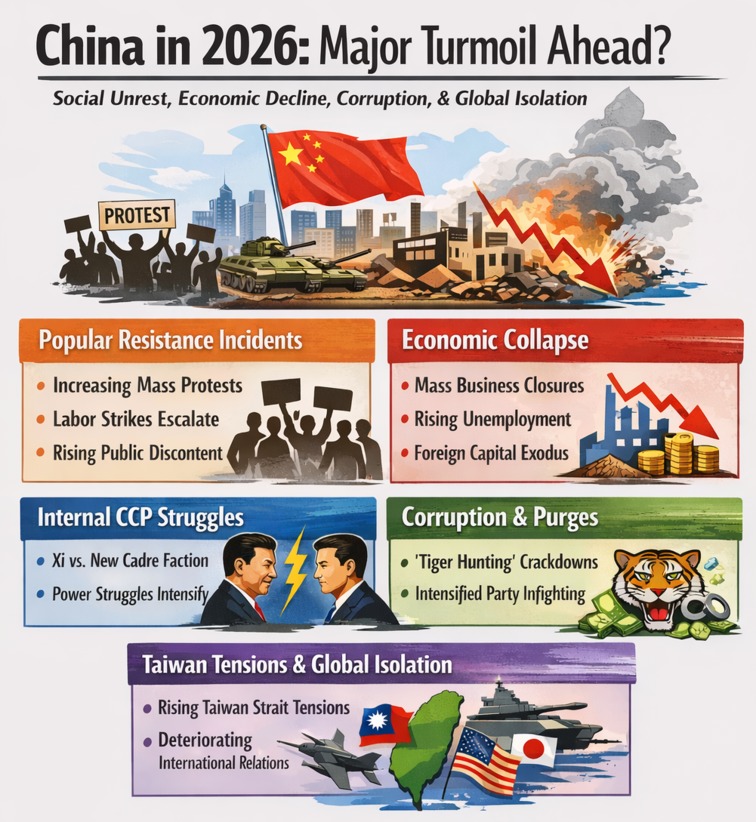
[People News] Based on the development trends in a series of social issues in 2025—including politics, the economy, the military, people’s livelihoods, and natural and man-made disasters in Communist China—the author predicts that in 2026 the Chinese mainland will not be peaceful. Social unrest, economic decline, and people’s suffering will continue. Corruption, internal chaos, and mass alienation of the people brought about by the CCP’s violent and tyrannical rule will intensify. Coupled with the development of natural and man-made disasters and international isolation, this may expose the illegitimacy of the CCP regime, thereby leading to the arrival of a social upheaval. The specific analysis is as follows:
I. Popular Resistance Incidents Will Be Intense
There were many major mass incidents in 2025. For example, the student fall-to-death incident in Pucheng, Shaanxi on January 2 triggered public protests; the mass resistance incident in Jiangyou, Sichuan on July 22, also triggered by student bullying; and the wave of manufacturing worker strikes of “22 incidents in 33 days” from August to early September. After that, China’s manufacturing sector again entered a new period of frequent labor disputes in early November. In the short four days from November 1 to 4 alone, there were at least 14 manufacturing worker strikes or collective wage recovery incidents. By early December, multiple collective worker resistance incidents erupted consecutively in the manufacturing sector. In addition to the one-week large-scale strike involving 3,000 workers at Eson Technology in Shenzhen, Guangdong, there were at least 10 other manufacturing worker strikes nationwide recorded by overseas online media. The main causes of these protests included wage arrears, unpaid social insurance contributions, lack of compensation for factory relocations, and layoffs without compensation. These included, from December 1 to 9: workers at Guangzhou Seagull Housing Industrial Co., Ltd. in Guangdong striking continuously for 9 days; on December 1, workers at Jiangxi Ruida New Energy Technology Co., Ltd. going on collective strike; from December 5 to 8, workers at Jiahui Thread Industry Co., Ltd. in Bao’an District, Shenzhen, Guangdong, climbing onto factory rooftops for days to demand their wages; and so on.
“Made in China 2025” was originally one of the CCP’s boasts to the world as a display of new-quality productive forces, a “war that must not be lost.” Unexpectedly, in 2025 the downturn of the manufacturing industry made China an international embarrassment and turned it into an international joke.
At the end of the year in December, mass resistance incidents in Communist China showed no sign of decreasing. According to records from “Yesterday—China Collective Resistance Incident Record Network,” there were at least 30 incidents. The site records that there were several hundred resistance incidents throughout the year, with an overall upward trend month by month.
As China’s economy declines, unemployment increases, and public grievances accumulate, violent and tyrannical rule has awakened more people. It is believed that in 2026 there will be even more mass resistance incidents, and that they will display characteristics of tacit understanding and concentration among the public. Under the current severe CCP surveillance and information blockade, protests may be difficult to unify and coordinate into a whole. However, once the people form a consensus, it is hard to rule out the emergence of leadership-type figures. As netizens have aptly said: when the sky is full of stars lighting up, a moon will inevitably appear.
II. Economic Decline, Enterprise Closures, and Nationwide Withering of All Industries
According to records from “Yesterday—China Collective Resistance Incident Record Network,” in 2025 more than half of mass resistance incidents in Communist China were triggered by enterprise wage arrears, and manufacturing accounted for as much as 60 percent. This shows that enterprise depression in Communist China has reached the level of affecting regime collapse. In addition, foreign capital continued to withdraw throughout the year. According to Business Today, in the third quarter of 2025, net foreign direct investment (FDI) into China was only USD 8.5 billion, a sharp drop of 51 percent compared with USD 17.36 billion in the second quarter.
Based on this trend, it can be judged that natural and man-made disasters will be more frequent in 2026, and therefore the economy in 2026 will only worsen and will not rebound. Another important reason is that the CCP has both deteriorating investment conditions and is making enemies of the world—continuously waging trade wars, and domestically arresting foreign company staff as spies and framing the U.S. and Europe for stealing technology. Who would dare to invest under such conditions? Unless the CCP’s violent and tyrannical system changes.
III. The Contradictions Between Xi Jinping and the New Cadre Group Are Irreconcilable
Xi Jinping is almost certain to seek a fourth term in 2027. Before that, new leadership adjustments at the local level will involve a younger generation. A report titled China 2026: Trends to Watch by the China Analysis Center of the Asia Society Policy Institute, headquartered in New York, pointed out that a new cadre group born in the 1970s entering the Party and government system will gradually shape new approaches in areas such as U.S.–China competition, innovation policy, and global engagement. “After major reshuffles of provincial leadership teams from the second half of 2026 to the first half of 2027, the new generation of officials may account for more than 60 percent of provincial-level leadership.” “These people will enter the Chinese Communist Party Central Committee by the end of 2027. Unlike past leaders with revolutionary experience and grassroots training, this generation of officials mostly has educational backgrounds and professional capabilities in engineering, economics, or administrative management. Their thinking differs from Xi’s CCP’s rigidity, obsolescence, and regression; thus, the contradictions are irreconcilable.”
In 2026, intra-party struggles within the CCP surrounding personnel arrangements for 2027 and struggles over social development may put on a dramatic show.
IV. Worsening Corruption and Endless Infighting Through ‘Tiger-Hunting’
According to official CCP statistics, in early December 2025, the fall of Dai Beifang, former chairman of the Shenzhen CPPCC, marked the 61st ministerial-level “tiger” brought down by the CCP, already exceeding the total for all of last year. In recent years, the number of “tigers” taken down each year has been increasing.
At the end of the year, a new round of military purges began within the CCP. The Air Force’s anti-corruption leads were openly solicited nationwide, encouraging the entire Party, the entire military, and the entire country to act as informants. There were rumors that both the Air Force commander and political commissar were implicated.
It can be predicted that there will only be more “tiger-hunting” in 2026, not less. One important reason is that the CCP has tasted the benefits of killing three birds with one stone through tiger-hunting: pleasing the public, clearing political enemies, and seizing money. The CCP needs large amounts of money to maintain domestic stability and to spend lavishly abroad, but the economy is weak—where does the money come from? It uses a dictatorial, personal-rule system to encourage Party officials to be corrupt and extort money from the people; once they are fattened up, it then seizes officials’ money in the name of anti-corruption.
The CCP’s practice of seizing money from Party officials has become habitual, and it is impossible for this to weaken in 2026.
V. Deteriorating International Situation; Cross-Strait Tensions Will Only Tighten, Not Ease
In 2025, the CCP can be said to have offended Europe and the United States by holding critical mineral resources such as rare earths and magnets hostage, and it also offended some Asian and Australian countries through trade wars. After the CCP’s dark tactics of supporting Russia in attacking Ukraine were exposed, its international relations grew increasingly poor.
In addition, incidents such as technological theft from the international community, exporting communist values and violent persecution, sentencing Hong Kong journalists, arresting and holding people accountable for public anger over deadly fires in Hong Kong residential areas, and forbidding students from commemorating those who died in fires—within five years turning Hong Kong into an inland municipality or province—have made the international community increasingly see that any guarantee by the CCP is unreliable, and have made the CCP increasingly isolated internationally.
At the end of 2025, tensions also flared with Japan and the United States over the Taiwan issue. It can be said that in 2026, as the CCP’s eagerness to attack Taiwan grows stronger, tensions in the Taiwan Strait will certainly offend the international community even more.
In 2026, the CCP will enter a low point in international relations and be cast into the international cold palace.
(People News exclusive)
△






News magazine bootstrap themes!
I like this themes, fast loading and look profesional
Thank you Carlos!
You're welcome!
Please support me with give positive rating!
Yes Sure!