

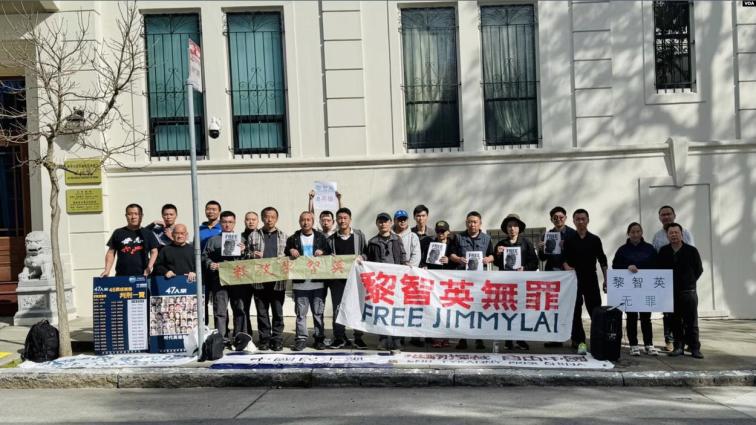
File photo: Jimmy Lai, founder of Apple Daily and one of Hong Kong’s leading pro-democracy activists. (Song Bilong / Dajiyuan)
[People News] As the Lunar New Year of the Horse approached, the Chinese Communist Party (CCP) instructed the Hong Kong government to use Hong Kong’s transformed courts to deliver verdicts in the case of Jimmy Lai and Apple Daily. This New Year therefore carried no sense of celebration.
Jimmy Lai was sentenced to 20 years. Other senior staff of Apple Daily, along with two young individuals, received prison terms ranging from seven to ten years. Although this outcome was expected, it still brings grief and outrage. Except in a few extremely closed countries like North Korea, where the outside world cannot learn about the government’s brutal suppression of its people, this sentencing by the CCP is a rare act of barbarism in contemporary world history.
After the court ruling, CCP state media and various Hong Kong government departments rushed out in unison to endorse the court’s decision. Fearing that the verdict would not convince the public, government bodies intensified their propaganda to overwhelm dissent. But Hong Kong’s courts have already become CCP courts; a court ruling is essentially a CCP ruling. Is this simple truth still unclear to the world?
The charges imposed on Jimmy Lai and others — “inciting subversion of state power” and “colluding with foreign forces” — were decided by a court that abolished the jury system and consisted of three judges who followed orders behind closed doors. Whatever crime they assign, it is merely a pretext. If the process were truly lawful, why not retain the jury and let ordinary Hong Kong citizens decide right from wrong?
To claim Lai “incited subversion” presupposes that years of Hong Kong resistance were stirred up by Apple Daily. In reality, Apple Daily was awakened by broad public opinion in Hong Kong and merely voiced the political demands of the people.
A small newspaper with at most tens of thousands of readers, compared to the heavily armed CCP with millions of troops and a vast propaganda apparatus — how could Apple Daily possibly shake such a regime? Was the former extraordinarily powerful, or was the latter fundamentally weak? Did the newspaper mobilize the masses with a single call, or was the regime already alienated from the people?
Hong Kong people lived for over a century under British colonial rule, exposed daily to vast flows of information from all political perspectives. Each citizen developed an independent worldview and personal values, free from coercion. Regardless of one’s political leanings, there was freedom from persecution, confidence against manipulation, and independent judgment.
Hong Kong people have political agency and are not easily incited. Past protest movements show this clearly. It was not Apple Daily manufacturing resistance through provocative articles; rather, the people organized protests first, and the paper reported them.
Following public opinion and serving as the people’s voice is the duty of the press — even a market-driven necessity. The CCP has inverted reality by blaming millions of Hong Kong people’s pursuit of democracy and freedom on one media outlet. This is not only divorced from facts but reveals a dark intent to criminalize Jimmy Lai.
Accusing Lai of “inciting” resistance reflects the CCP’s reliance on indoctrination, assuming that ordinary people’s political views can be manipulated. The CCP does not understand that in information-free Hong Kong, political positions are always personal choices. No newspaper can dictate public opinion, and no one can be brainwashed.
Suppressing dissent achieves nothing. Public opinion and public sentiment can never truly be suppressed. Silence does not mean agreement; it only means estrangement between the CCP and Hong Kong people. Losing the people’s hearts is far more dangerous than merely silencing their voices. The former is superficial and temporary; the latter is deep and lasting. The CCP habitually focuses on appearances and has repeated that mistake again.
Yes, power lies in the CCP’s hands, and it can do as it pleases. But any regime that relies on violence rather than popular support cannot endure. History and political common sense both confirm this. An ancient Chinese saying goes: “The people are like water, the ruler like a boat. Water can carry the boat, but it can also overturn it.” To retain power, a ruler must follow public will; defying it brings consequences.
Today the world is undergoing upheaval and realignment. A strong rightward political tide is sweeping the globe — from Donald Trump’s return to power, to resistance against Russia’s invasion of Ukraine, to the fall of numerous small authoritarian governments, to Japan’s ruling party’s electoral victories. These events signal a global trend.
What does this rightward tide represent? Anti-communism, anti-globalization, and opposition to authoritarianism. This trend may shape the next half-century. The CCP faces growing diplomatic isolation, intensifying internal factional struggles, and rising public skepticism and opposition. Xi Jinping’s situation grows more difficult.
Recent arrests of senior military figures have shaken morale within the armed forces and distanced the public, threatening Xi’s grip on power. Thus, the harsh sentencing of Jimmy Lai does not show CCP strength, but exposes CCP weakness. It is not a victory, but another defeat — a loss of public trust, global reputation, and alignment with historical trends.
This is not the end of the Jimmy Lai and Apple Daily case. One day they will be vindicated, and Xi Jinping, John Lee, the three shameless judges, and all those who served as accomplices will be nailed to the pillar of historical shame.
(Originally published on the author’s Facebook page)






News magazine bootstrap themes!
I like this themes, fast loading and look profesional
Thank you Carlos!
You're welcome!
Please support me with give positive rating!
Yes Sure!