

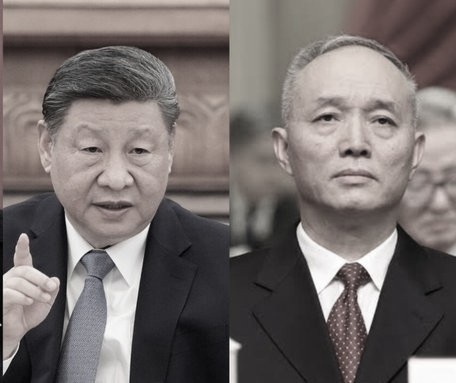
Illustration: On March 12, 2023, CCP Politburo Standing Committee members Cai Qi and Li Xi attend a session of the National People’s Congress. (Noel Celis/AFP)
[People News] In the current CCP power structure, Cai Qi, as one of Xi Jinping’s most core confidants, has already risen beyond the conventional framework of a Politburo Standing Committee member, becoming in practice a “shadow deputy general secretary.” However, as history has repeatedly shown, systems of extreme power centralization often breed the most dangerous forces of backlash. Cai Qi’s rapid rise, extreme governing style, and factional positioning within the Party make him a “double-edged sword”: on the surface, he loyally carries out Xi Jinping’s will, but in reality, the latent risks continue to expand. Once circumstances change, such a figure can easily “turn against his benefactor” at a critical moment, posing a fatal threat to Xi Jinping’s authority. The following analysis examines this escalating risk from four dimensions: Cai Qi’s career trajectory, personality traits, intra-party factional alignment, and his potential for rebellion.
I. Cai Qi’s Path of Promotion
From a local “executor” to the central “chief steward,” Cai Qi’s political trajectory is highly dependent on Xi Jinping, making him a typical representative of the “Xi faction.” His career path clearly reflects Xi Jinping’s deep authorization of confidants and the concentration of power. As early as the Fujian period (1973–1999), Cai Qi rose from the grassroots level, serving as deputy Party secretary and mayor of Sanming City, handling local Party affairs and administrative reforms. During the Zhejiang phase (1999–2014), he successively served as Party secretary of Quzhou and Taizhou, mayor of Hangzhou, member of the provincial Party standing committee and head of the Organization Department, as well as executive vice governor. During this time, he promoted Xi Jinping’s “Eight-Eight Strategy,” led cadre selection, and advanced innovations in the petitioning system, accumulating experience in organizational coordination.
After being transferred to the central level in 2014, Cai Qi’s promotion accelerated. He first served as deputy director of the Office of the Central National Security Commission, later rising to executive deputy director (ministerial rank), presiding over daily operations and becoming the only full-time senior official in the national security system. From 2016 to 2022, he governed Beijing, serving as acting mayor, mayor, and Party secretary, leading the “relief, rectification, and improvement” campaign, including environmental cleanups, COVID-19 zero-COVID measures, and preparations for the 2022 Winter Olympics. After entering the Politburo Standing Committee in 2022, he concurrently assumed the posts of secretary of the Central Secretariat (ranked first, overseeing routine work), director of the General Office of the CCP Central Committee, secretary of the Party Working Committee of Central and State Organs, director of the Central Cyberspace Affairs Commission, and vice chairman of the Central National Security Commission. These positions allow him to control the operation of the central apparatus, document handling, security, confidentiality, intelligence, ideology, and cybersecurity, giving him influence far beyond his formal rank and making him the overall “chief coordinator” of Xi Jinping’s power.
This accumulation of multiple posts not only reflects Xi Jinping’s extreme trust in him, but also exposes the hidden dangers of excessive concentration of power. Cai Qi controls both the “gun barrel” (the security bureau) and the “knife handle” (national security and cyberspace control), and is privy to too many of Xi Jinping’s private matters and decision-making details. Once circumstances change, he occupies an ideal position to strike back.
II. Cai Qi’s Personality Traits
The dual labels of “ruthless” and “highly ambitious.” Cai Qi’s personality is widely described as “ruthless, petty, stubborn, and ambitious but lacking ability,” traits rooted in his Cultural Revolution experiences and governing style. During his tenure in Beijing, the “cleanup of the low-end population” campaign he led is a typical example: after the 2017 Daxing fire, within just 40 days, hundreds of thousands of migrant workers were forcibly evicted, with water and electricity cut off in the dead of winter and illegal structures demolished. In internal speeches, he used extreme language such as “real swords and guns, bayonets drawn” and “chop off their hands,” sparking massive public resentment, yet this was regarded as “taking the blame” to demonstrate loyalty to Xi Jinping. This “one-size-fits-all” approach was efficient but lacked humanitarian concern, and overseas analyses have classified it as driven by a “revenge mentality” and a “compensatory mindset.”
At the same time, Cai Qi’s “great ambition” is reflected in his meteoric rise: he jumped directly from a non–Central Committee member to a Standing Committee member, relying on over 20 years of “personal friendship” with Xi Jinping rather than purely on performance. He is adept at flattery, publicly referring to Xi Jinping as the “backbone” and “pillar,” and emphasizing “learning political loyalty” at propaganda meetings. However, when ambition is combined with ruthlessness, it often translates into “cronyism” and the exclusion of rivals. Analysts believe his character contains elements of being “nostalgic yet vicious,” similar to powerful ministers in history. Under high-pressure conditions, such traits can amplify dissatisfaction, and once an opportunity arises, may turn into backlash.
III. Cai Qi’s Threefold Role in Intra-Party Factions
A core figure of the Xi faction, yet harboring the risk of a “Gang of Three.” Cai Qi is deeply embedded in Xi Jinping’s faction, the so-called “Xi faction,” specifically belonging to both the “Zhijiang New Army” (Zhejiang network) and the “Minjiang New Army” (Fujian network), with a foundation laid through long-term collaboration with Xi from Fujian to Zhejiang. Within the Xi faction, he forms an invisible “small group” with Li Qiang and Zhao Leji, referred to by outsiders as the “Gang of Three” or the “Xi–Li–Cai group,” with highly aligned interests—if one suffers, all suffer. Compared with Li Qiang, who is relatively mild, Cai Qi’s hardline style is more favored by Xi Jinping and is seen as representing the “Fujian faction” overpowering the “Zhejiang faction.”
However, this factional positioning also amplifies risk: the Xi faction is highly personalized and lacks institutional checks and balances. As a “model of loyalty,” Cai Qi nevertheless holds coordination power far beyond normal bounds. Once Xi’s health or authority weakens, Cai Qi could join forces with other factions (such as the military or elder statesmen) to form a “new Gang of Four”–style power reshuffle. Recent rumors, such as Cai Qi “disappearing for 12 days” or his “name mysteriously disappearing,” further highlight signs of factional infighting.
IV. Such a Person Is Highly Likely to Rebel at a Critical Moment
Historical experience shows that confidants like Cai Qi—“ruthless and highly ambitious”—are especially prone to turning against their master within centralized systems. Soviet KGB chiefs or eunuchs of the Ming and Qing dynasties often “turned the tables” at critical moments because they knew secrets and controlled resources, yet had “nowhere left to rise.” Cai Qi holds immense power, yet has no possibility of replacing Xi Jinping. This “ceiling dilemma” may stimulate the motivation to “lay out arrangements for himself.” Coupled with a personality capable of being “ruthless enough” toward a former patron, and combined with recent rumors, the risk has shifted from potential to real.
Amid economic downturn and growing intra-party dissatisfaction, Xi Jinping’s reliance on Cai Qi is like “tying himself to the same boat”—the tighter the binding, the greater the risk of sinking together. Four layers of backlash (power backlash, style backlash, factional backlash, and personality backlash) may strike simultaneously, turning Xi Jinping’s “Chinese Dream” into a “nightmare of losing power.”
In sum, compared with Zhang Youxia, Cai Qi poses a greater risk of backlash. This stems not only from personal ambition, but from a structural crisis inherent in the entire model of centralized power.
(Author’s X account)
△





News magazine bootstrap themes!
I like this themes, fast loading and look profesional
Thank you Carlos!
You're welcome!
Please support me with give positive rating!
Yes Sure!