

Xi Fears the Arrival of a “Khamenei Moment”
[People News] The U.S. military operations against the pro-Chinese Communist Party regimes in Venezuela and Iran — in which the Chinese Communist Party’s “old friends,” Venezuelan President Maduro and Iran’s supreme leader Khamenei, were respectively captured alive and directly blown to death — have clearly shaken Zhongnanhai deeply, as can be seen from the furious tone of the Chinese Communist Party’s official statements. According to reports, in both the capture of Maduro and the killing of Khamenei, intelligence provided by high-level insiders within those two regimes played a key role. This has obviously dealt a direct shock to Chinese Communist Party leader Xi Jinping.
Generals “harboring divided loyalty” — Xi fears “traitors within”
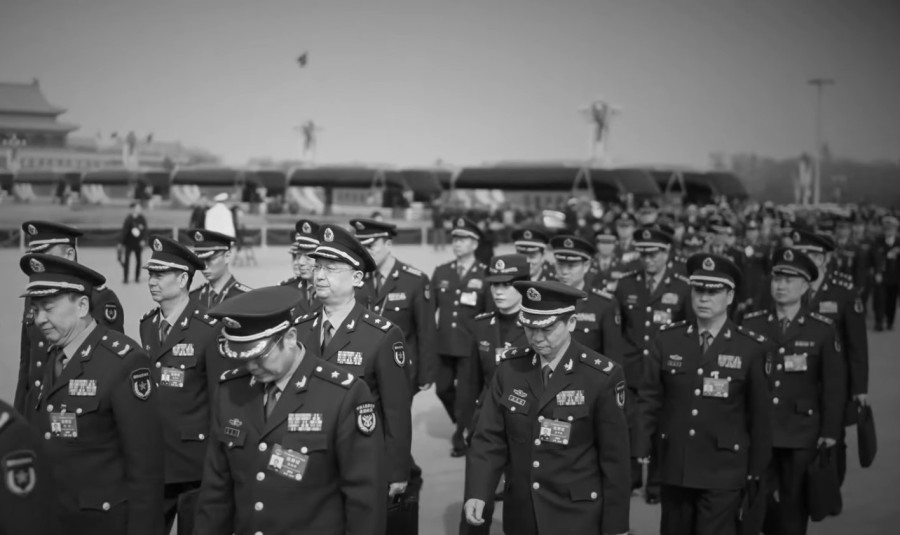
When Xi Jinping attended the full meeting of the Chinese Communist Party military delegation at the National People’s Congress on March 7, he emphasized that within the military “there must absolutely be no one harboring divided loyalty toward the Party, absolutely no place for corrupt elements to hide, and the anti-corruption struggle must be pushed forward unwaveringly.”
Xi’s hint that there are people in the military “harboring divided loyalty” calls to mind the criticism in the Chinese Communist Party military newspaper after Zhang Youxia and Liu Zhenli were officially announced as having fallen from power: that Zhang and Liu had “seriously trampled upon and undermined the responsibility system of the chairman of the Central Military Commission,” and had “seriously fostered and affected political and corruption problems that threaten the Party’s absolute leadership over the military and endanger the foundation of the Party’s rule.”
It is worth noting that at the Fifth Plenary Session of the Central Commission for Discipline Inspection, which ended on January 14 this year, it was mentioned that the top priority for 2026 is to “eliminate those who harbor two ambitions.”
Xi’s personal intervention this time, warning military generals not to have divided loyalty, should be related to two recent major international events: Venezuelan President Maduro being captured alive by the U.S. military, and Iran’s supreme leader Khamenei being blown to death.
Among them, in the early hours of January 3, the U.S. military captured Maduro and his wife, and according to reports, an informant inside the Venezuelan government working for the CIA played a major role. One informant close to Maduro was responsible for monitoring his movements and confirmed Maduro’s exact location before the U.S. operation.
According to a report by the Chinese Communist Party state media outlet Global People, the “traitor within” in the Venezuelan presidential palace was Maduro’s most trusted “night watchman,” his personal guard commander, Major General Javier Marcano Tavares. Born in 1969, Tavares is seven years younger than Maduro. He and Maduro grew up together in a working-class community in Caracas, true childhood companions.
After Maduro was captured, netizens searched for “Zhongnanhai” on multiple online maps, only to find messages such as “Sorry, no related location found in Beijing” or redirections elsewhere, clearly indicating that the authorities had tampered with the results.
On February 28, the United States and Israel launched the military operation code-named Operation Epic Fury. Iran’s supreme leader Khamenei was precisely struck at his meeting location in Tehran and died on the spot. There are reports saying that high-level Iranian insiders also provided the intelligence in that case.
One unverified rumor claims that Esmail Qaani, commander of the Quds Force of Iran’s Revolutionary Guard, “confirmed the location and then left early on official business” before the meeting, and later rumors said that he had fled.
In any case, these reports would have served as a huge “warning” to Xi Jinping, which is why he erupted in anger on the spot before the military delegation, warning, “You must not have divided loyalty.” Behind this lies Xi’s “great fear” that he may one day be “decapitated” by the U.S. military, as Khamenei was.
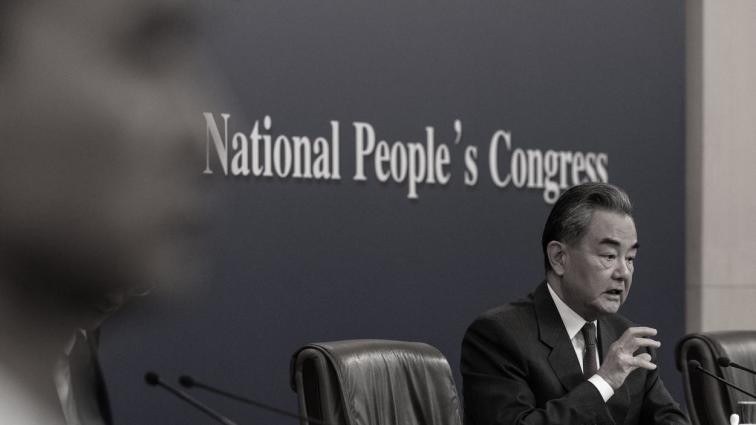
Xi’s fear of being “decapitated” has previously been conveyed through some Chinese Communist Party spokespeople. For example, Chinese Communist Party Foreign Minister Wang Yi condemned the United States and Israel for “brazenly killing a sovereign leader and inciting regime change,” calling it “unacceptable.”
On March 2, Chinese Communist Party diplomatic scholar Gao Zhikai criticized Chinese netizens on Party media for praising the idea that “the United States and Israel could take the head of the opposing commander from among a million troops,” calling it the wrong way of thinking. The result was a total collapse in the comment section: tens of thousands of comments, not one agreeing with Gao Zhikai. Chinese netizens’ view was: striking the top leadership is exactly right; to capture bandits, first capture the king. Overseas netizens commented that the servants under authoritarian systems are able to sense the dictator’s fear.
Xi may be building higher-standard blast-proof bunkers
Xi’s fear that the terrifying moment of being “decapitated” may arrive seems already to have led him to order subordinates to accelerate bunker expansion to a higher standard.
On March 5, Chinese democracy activist Liu Min in the United States cited information from Beijing residents saying that, very strangely, the Western Hills area of Beijing is currently under continuous 24-hour construction, with large-scale engineering works underway. Many people are discussing privately that Xi Jinping and others are expanding the underground command center in the Western Hills. In fact, since last year, expansion work in the Western Hills area has continued, and the scale has been getting larger and larger.
According to that report, people privately believe this is because Xi Jinping fears a “decapitation operation” like the one that recently killed Iran’s supreme leader Khamenei, and is therefore hurrying to expand underground command and shelter facilities. People living in Beijing have, more or less, heard about these matters. The more they understand them, the more frightened they feel.
Under the Chinese Communist Party’s strict information blockade, it is already no easy thing for the outside world to get even a little information from local residents, so this deserves continued attention. Moreover, this revelation is consistent with foreign media reports from last year, and it is also possible that an existing military engineering project is being rapidly expanded and upgraded in response to new threats.
At the beginning of last year, Britain’s Financial Times reported that satellite images obtained by the paper showed a construction site of about 1,500 acres roughly 30 kilometers southwest of Beijing, where large-scale construction began in mid-2024. Multiple U.S. officials disclosed that the Chinese Communist Party military is building a huge underground bunker in western Beijing. U.S. intelligence agencies believe the facility will serve as a wartime command center, far larger than the Pentagon, including bulletproof and nuclear-resistant bunkers for use by the Chinese Communist Party leadership.
According to a contemporaneous report by Radio France Internationale, there was no obvious military presence at the construction site, but warning signs prohibited drones and photography. Guards and supervisors at the site all refused to comment on the project, and access roads behind the site had been blocked by checkpoints. One guard said the public was not allowed to enter the popular hiking and tourist area near the site, and a local shopkeeper described it as a “military zone.”
Hong Kong’s South China Morning Post reported on January 7, 2018, that a government-funded geological survey had found that a nuclear shelter built for the Chinese Communist Party’s top leadership, along with their subordinates, troops, and staff, was buried more than 2 kilometers underground in limestone karst caves.
The year 2027 marks the 100th anniversary of the Chinese Communist Party military. Earlier analyses often suggested that the Chinese Communist Party might attack Taiwan by force around 2027. These nuclear bunkers may at least partly be part of war preparation.
Military newspaper issues a prophetic warning: the strongest fortress is often breached from within
The military action launched by the United States and Israel against Iran has ruthlessly exposed the limits of Xi Jinping’s global ambitions. What follows is Xi’s inner fear.
If war were to break out in the Taiwan Strait, U.S. special forces would conduct reconnaissance operations in coastal areas. The Chinese Communist Party’s nuclear-related facilities, including top-level underground command centers — that is, nuclear bunkers — would be important targets for U.S. strikes.
Qian Qihu, an academician of the Chinese Communist Party’s Academy of Engineering, once boasted: “Our protective engineering can defend not only against present-day strategic weapons strikes, but also against future possible enemy strategic weapons strikes. No bunker-busting bomb can do anything to it.”
But what the Chinese Communist Party authorities must guard against is not only decapitation by enemy forces, but even more so opposition from inside China, including Chinese Communist Party insiders who have been turned.
The U.S. Central Intelligence Agency has already successively released videos aimed at recruiting Chinese Communist Party officials and military officers, and is preparing to launch a censorship-circumvention platform to help Chinese people obtain free information.
Since Xi Jinping entered his third term, the economy has fallen into serious crisis, political controls have intensified, and internal purges have escalated. The Communist Party and Xi Jinping himself have already become targets both within and outside the system. Even if Xi Jinping has the Chinese Communist Party military nuclear bunkers in Beijing’s Western Hills to hide from a U.S. military raid, the anger of the officers and soldiers around him may be an even harder danger to guard against.
In April 2016, November 2017, and November 2022, Xi Jinping repeatedly inspected the Joint Operations Command Center of the Central Military Commission inside the bunker. But interestingly, the generals who accompanied Xi on those inspection visits have since been purged one after another.
Among the Central Military Commission members who accompanied Xi during the November 2017 inspection of the nuclear bunker was then–Defense Minister Wei Fenghe, who later fell from power. In November 2022, when Xi inspected the Joint Operations Command Center, those accompanying him included then–Defense Minister Li Shangfu, who also later fell. The official charges against former Defense Minister Wei Fenghe included “failing in loyalty,” prompting speculation that he had been recruited by hostile forces. Wei had been the first commander of the Rocket Force.
Afterward, Central Military Commission Vice Chairman He Weidong, Central Military Commission Vice Chairman Zhang Youxia, Central Military Commission member and Chief of Staff Liu Zhenli, and Wang Xiubin, executive deputy director of the Joint Operations Command Center that actually controls the bunker, all fell from power as well. Xi Jinping cannot guarantee that the new people put in place are not also “colluding with the enemy.”
After Iran’s supreme leader was decapitated, on March 2 the “Jun Zhengping Studio” under the Chinese Communist Party military newspaper posted on official Weibo calling on people to “remain vigilant,” saying that the strongest fortress is often breached from within.
This looks more like a prophetic warning that is later fulfilled. And that is the deepest core fear of Zhongnanhai and Xi Jinping.
(Reprinted from Dajiyuan publication) △




News magazine bootstrap themes!
I like this themes, fast loading and look profesional
Thank you Carlos!
You're welcome!
Please support me with give positive rating!
Yes Sure!