

Senior member of the Senate Foreign Relations Subcommittee on East Asia and the Pacific, Democratic Senator Chris Coons of Delaware (left), and Subcommittee Chair, Republican Senator Pete Ricketts of Nebraska (right).
[People News] A U.S. senator said Tuesday (January 27) that after removing Zhang Youxia — formerly the second-highest-ranking figure in the Chinese military after himself — Chinese Communist Party leader Xi Jinping is unlikely to accelerate plans to attack Taiwan. He also said there remains broad bipartisan consensus in the United States on how to address what they see as the greatest threat the Chinese Communist Party poses to the international order.
According to Voice of America, Republican Senator Pete Ricketts, chair of the Senate Foreign Relations Subcommittee on East Asia and the Pacific, said Tuesday at the Council on Foreign Relations: “I think it’s unlikely that Xi would accelerate his plan (to attack Taiwan), because it is very, very difficult, and he just removed his top general.”
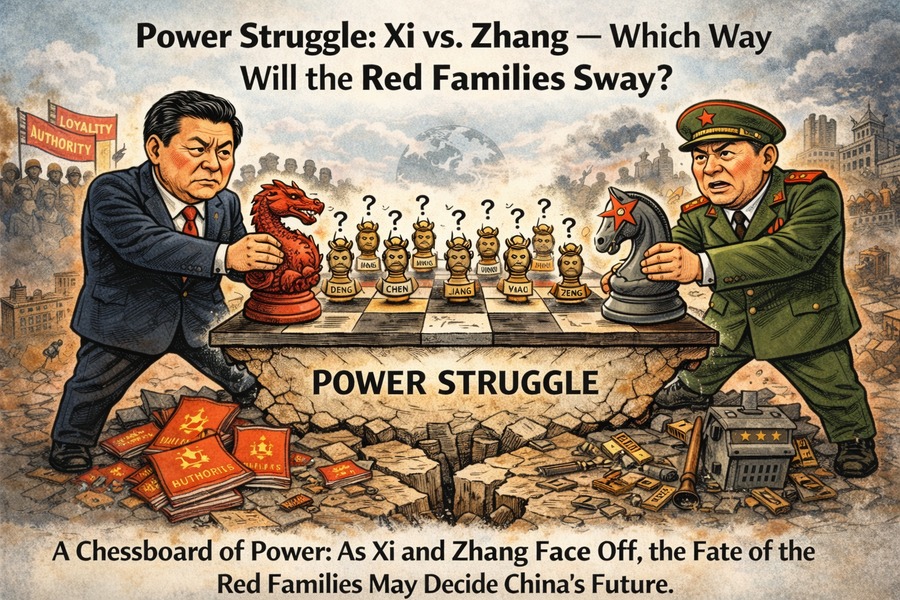
China’s Ministry of National Defense announced on January 24 that Zhang Youxia, Vice Chairman of the Central Military Commission, was under investigation for alleged “serious violations of discipline and law.” Ricketts suggested that Zhang might be under investigation either because he failed to make sufficient progress toward the PLA’s goal of being ready to invade Taiwan by 2027, or because questions were raised about his loyalty.
Ricketts and Democratic Senator Chris Coons, the senior Democrat on the same subcommittee, jointly attended a forum at the Council on Foreign Relations titled “Congress and China (CCP): Is There Still Bipartisan Consensus?” When asked whether the United States was prepared if Xi were to move against Taiwan ahead of schedule, Ricketts gave the above response.
Ricketts explained that Xi has long viewed unifying Taiwan as part of his political legacy. On the question of attacking Taiwan, Xi’s primary concern would be ensuring success. Failure, he said, could cost Xi not only his position but possibly his life, so he would not act rashly.
“If he tries and fails, he won’t just lose his job — he could lose his life. Dictators don’t retire to the countryside. They’re either killed in office or die in office. So this is something he’s always thinking about, and he has to be very confident he can succeed. Because if he fails, the consequences for him personally would be extremely severe.”
Xi has instructed the Chinese military to achieve “leapfrog development” before 2027, the 100th anniversary of the founding of the PLA. In 2021, then–U.S. Indo-Pacific Commander Philip Davidson warned that the Chinese military could be capable of attacking Taiwan by 2027 — the well-known “Davidson Window.” Later, former CIA Director William Burns also repeatedly confirmed intelligence indicating that Xi has directed the PLA to develop the capability to be “ready to invade Taiwan” by 2027.
Given this, Ricketts believes the U.S. still has some time to prepare for a possible move against Taiwan, but the top priority is delivering the weapons Taiwan has already purchased.
“One of the things we need to do — and this is something we heard when we last visited Taiwan — is clear the backlog and address the root causes delaying weapons deliveries. They’ve already bought tens of billions of dollars’ worth of weapons from us. We have to deliver. We haven’t been doing that. We must do that. So we still have a lot of work to do to deter Communist China from taking such action,” he said.
The Trump administration announced on December 17 an arms sales package to Taiwan worth more than $11 billion, including HIMARS long-range precision strike systems, anti-armor drone missile systems, and Javelin anti-tank missiles.
Senior Democratic Senator Coons said the United States lacks the sense of urgency required by the current situation. “In the South China Sea and across the region, the CCP has become unusually assertive and aggressive.”
He noted that as a senior Democrat responsible for intelligence and defense appropriations, he works closely with Republican colleagues to prioritize key projects such as submarines, ships, and long-range strike capabilities — but U.S. efforts are still moving too slowly.
“But frankly, we are not moving fast enough. Our defense industrial base and procurement processes have become rigid and are unable to acquire and deploy cutting-edge capabilities at the scale and speed we need,” Coons said.
However, both Ricketts and Coons believe there remains broad bipartisan consensus on deterring a Chinese military attack on Taiwan and countering other actions by the Chinese Communist Party.
Ricketts said: “Yes, I think there is still consensus in both parties that the Chinese Communist Party poses the greatest threat to the international situation. I’m not sure we always agree on specific policies or responses. But I think that’s beyond doubt, and it’s one reason Chris and I work closely together on issues like deterring the CCP from taking Taiwan by force. I think there is still broad agreement on that.”
“I believe that in my state, in your states, and certainly in Congress, there is growing attention to ensuring we are prepared for potential conflict and managing our competition responsibly,” Coons added.
The U.S. Senate Foreign Relations Committee is expected to review four Taiwan-related bills on Thursday, covering issues such as symbols of Taiwan’s sovereignty, energy security, protection of undersea cables, and assistance for Taiwan’s diplomatic allies and friendly nations.
△






News magazine bootstrap themes!
I like this themes, fast loading and look profesional
Thank you Carlos!
You're welcome!
Please support me with give positive rating!
Yes Sure!