

China Is Facing a Major Moment of Choice
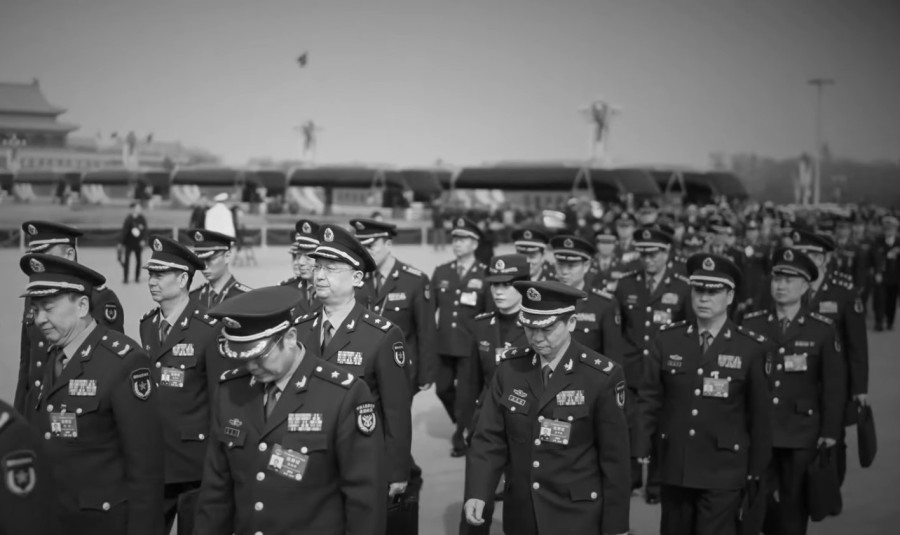
[People News] Today I saw an article online by Sheng Xue titled “Zhang Youxia and Liu Zhenli Placed Under Investigation.” It was like an alarm bell, awakening those who still harbor illusions about internal power struggles within the Chinese Communist Party. The article sharply analyzes the deeper logic behind the military purges in the Xi Jinping era: this is not simple anti-corruption, but a political purge driven by the supreme ruler’s extreme fear for his own security. Zhang Youxia, as a senior military figure and a princeling from a revolutionary family, being swiftly taken down and labeled with unusually harsh language is no accident. This incident marks an important turning point in Chinese history. It not only exposes Xi Jinping’s distrust of “the barrel of the gun,” but also signals that the entire country stands at a crossroads: either sliding toward a fully North Korea–style hell on earth, or returning to the path of a normal nation through internal transformation.
The article’s core point—that Xi Jinping “is fearing the gun in his own hands”—accurately captures the current paradox of power. Since coming to power, Xi has tried to build an absolutely loyal “Xi family army” through continuous purges of top military leaders such as Guo Boxiong, Xu Caihou, Li Shangfu, and Wei Fenghe. Yet these purges do not eradicate corruption; instead, they create an atmosphere of fear, repeatedly breaking the chain of command and exhausting experienced generals. The Rocket Force, a strategic arm personally reshaped by Xi, has become one of the hardest-hit areas of the purge—this in itself is an irony of Xi’s logic that “loyalty outweighs competence.” The article’s comparison to the Lin Biao incident is particularly profound: after Lin Biao’s “defection,” Mao Zedong sank into suspicion and decline. Xi’s situation is even more precarious, as he lacks the buffer of revolutionary legitimacy and faces multiple pressures from health and external challenges.
If Xi successfully completes this major purge, China will inevitably move toward full North Korea–style transformation. Imagine a highly personalized power structure where the military becomes a tool for the leader’s psychological security, and any potential dissenter is treated as a threat. Economically, the exhaustion of local government finances, the collapse of the real estate sector, and the withdrawal of foreign capital are already set in motion. Politically, the purge will expand into Party and government systems, strengthening surveillance and ideological control. Socially, declining livelihoods will turn into widespread despair. The country will become a hell on earth, resembling the Kim dynasty in North Korea—closed, poor, and ruled by fear, with citizens surviving like walking corpses. Xi’s demand for “absolute loyalty” will suffocate all innovation and vitality, and China will retreat from the world stage into an isolated totalitarian fortress.
Conversely, if this purge fails—perhaps due to factional backlash within the Party, accumulated dissatisfaction in the military, or external pressure such as a Taiwan Strait crisis—China may have a chance to return to the path of a normal nation. This would mean breaking the personality cult and restoring collective leadership and rule-of-law principles; professionalizing rather than politicizing the military; reopening the economy to attract investment and stimulate growth; and loosening social controls to allow speech and innovation. Such a transformation is not unreachable. It hinges on one key factor: forming a consensus inside and outside the Party that the Zhang Youxia incident is a turning point and that Xi’s path is pushing the country toward the abyss.
As the article points out, Xi’s paranoia has already damaged the combat effectiveness of the CCP military and accelerated the regime’s decline. The year 2026, as a key node after the 20th Party Congress, could become the “year to oppose Xi and eliminate evil” if these views become a shared understanding both inside and outside the Party—from the top leadership to the grassroots, from the military to civilian society. This is not mere fantasy, but grounded in historical logic: after Mao Zedong’s era ended, China briefly returned to rationality; now, a similar turning point may be brewing. Sheng Xue’s analysis reminds us that the choice lies in everyone’s hands. China is facing a great moment of decision—sink forever into darkness, or see the light of dawn again?
(Author’s X account)
△






News magazine bootstrap themes!
I like this themes, fast loading and look profesional
Thank you Carlos!
You're welcome!
Please support me with give positive rating!
Yes Sure!