
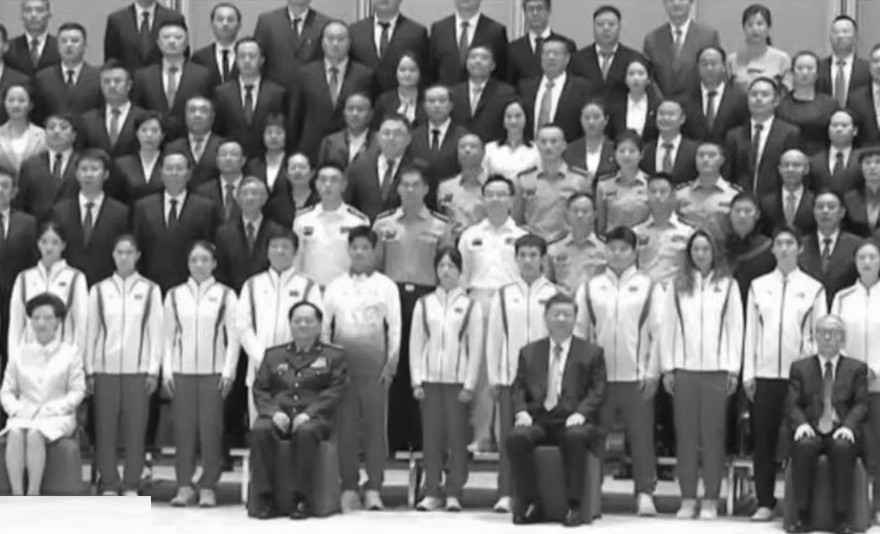
On November 9, Xi Jinping and Zhang Youxia met with representatives of advanced national sports in Guangzhou. Their seating arrangement in the centre indicated that Zhang Youxia's status is equal to or higher than that of Xi Jinping. (Video screenshot)
[People News] During the abnormal power upheaval at the top of the Chinese Communist Party that erupted on January 18, 2026, Xi Jinping attempted to consolidate control of the military by arresting Zhang Youxia. Though the move appeared decisive, it exposed serious misjudgments about both the Party’s internal political ecosystem and the external environment. This was not a simple purge or anti-corruption campaign; rather, it triggered a chain reaction in which multiple factions joined forces to check Xi’s power, fracturing the authority structure and leaving the situation unstable to this day. Xi’s decision clearly underestimated several key factors and ultimately pushed himself into a passive position in negotiations. The consequences of these miscalculations can be analyzed from five perspectives.
First, Xi underestimated the unprecedented unity of the “Red Second Generation” and Party elders.
In the past, these groups often acted separately due to conflicting interests. This time, however, the event touched a core bottom line of the CCP regime—protecting the Party and preserving its rule. Forces associated with the Jiang faction, the Youth League faction, and the so-called “Red Descendants” quickly reached consensus, forming what could be described as a “unity born of pressure.” This unity was not based on shared ideals but on collective dissatisfaction with Xi’s alleged arrangements for a hereditary successor. The Party’s inner circle had already learned that Xi’s designated heir was being specially protected in Ningxia, with a path closely replicating Xi’s own early career model—something viewed internally as a long-term political risk. Party elders saw this as a breach of the system’s risk threshold and intervened in an unusually united manner. As a result, Xi’s counteraction failed to achieve a quick conclusion and instead forced him into negotiations, with figures like Wen Jiabao—“non-direct parties”—brought forward as buffer intermediaries. Xi had expected a swift resolution but instead prompted multi-factional joint resistance, prolonging the period of power restructuring.
Second, Xi underestimated Zhang Youxia’s influence within the Party, government, and military.
Zhang was not an isolated figure; his network runs deep, spanning the military establishment and high-level decision-making circles. Even if any alleged military or political coup attempt failed, Zhang’s influence was sufficient to shake the entire power structure. Official anomalies—his name not being removed from websites, collective silence from central media, and the absence of loyalty pledges from senior military officials—reflect this influence. Xi overestimated his own authority, assuming that arresting one man would intimidate the entire military. He overlooked Zhang’s “invisible network” across Party, government, and military sectors. This miscalculation led to a purge that stalled halfway, with internal information circulating between January 19–20, rumors spreading externally, and official propaganda unable to establish a unified narrative. Ultimately, even if Xi retains his position, his power will inevitably shrink; he may be forced to relinquish the chairmanship of the Central Military Commission or even restructure the CMC itself in exchange for compromise.
Third, Xi underestimated the determination of military generals who support Zhang.
The alleged military upheaval began on the evening of the 18th and is seen as the starting point of the power fracture, yet Zhang’s failure did not extinguish support within the armed forces. The driving force behind this episode was not a single faction but a convergence of dissatisfaction with Xi, particularly among military leaders who saw Zhang as a representative figure. Supporting Zhang became symbolic of defending their own interests. This determination stems from resistance to Xi’s alleged hereditary succession plans and fear of being targeted in purges. If Xi believed military loyalty was unbreakable, he ignored the generals’ “bottom-line thinking.” As a result, abnormal conditions persist in the military: no video pledges of loyalty, no senior officials publicly taking sides, and reports that Xi’s sister Qi Qiaoqiao was placed under soft detention by pro-Zhang forces at a guesthouse starting on the 19th, with heightened security measures in place. This reflects a tense standoff of deterrence and counter-deterrence within the military, dragging the situation into a mire of multi-party negotiations.
Fourth, Xi underestimated the political awareness of the general public.
For years, CCP propaganda has tried to portray the public as politically ignorant, yet in this event, the information vacuum and abnormal status of key figures were keenly observed by ordinary people. Official accusations against Zhang Youxia and Liu Zhenli were collectively questioned by netizens. The public did not passively accept media narratives; for example, reports such as The Wall Street Journal’s claim of Zhang leaking nuclear secrets were widely viewed as deliberate disinformation or controlled storytelling. Instead, through social media and rumor networks, the public quickly formed its own understanding of the power struggle. This awareness amplified the event’s impact and increased internal pressure. Had Xi not underestimated this factor, he might have quickly unified propaganda messaging to calm the situation. Instead, the prolonged rumor phase allowed public dissatisfaction to ferment, further eroding his authority.
Fifth, Xi underestimated the international community’s ability to detect disinformation.
During the event, official channels allegedly attempted to use “smoke bombs”—such as multiple rumors about hereditary successors and confusion over regional backgrounds—to divert attention. However, the international community has long developed a sharp sense for identifying CCP disinformation. Intelligence agencies and media outlets can infer realities from official silence and unusual personnel situations, especially on sensitive topics like nuclear intelligence, where “conviction pretexts” are more easily scrutinized. Xi’s miscalculation exposed the alleged succession maneuvering under global scrutiny, bringing international pressure into the negotiation process and limiting his hardline options. The result has been not only prolonged internal power restructuring but further damage to China’s external image.
Summary
This episode is not a concluded coup but a forced launch of power restructuring. Xi Jinping’s move to detain Zhang Youxia was intended to consolidate authority and pave the way for a hereditary succession system, yet these five miscalculations produced the opposite effect. The situation is now in a prolonged negotiation stalemate, with all sides engaged in mutual deterrence. If Xi wishes to stabilize the situation, he must reassess these factors. Otherwise, the consequences of these misjudgments may go beyond a mere reduction in power and could reshape the rules of the game at the very top of the CCP.
(Author’s X account)
△



News magazine bootstrap themes!
I like this themes, fast loading and look profesional
Thank you Carlos!
You're welcome!
Please support me with give positive rating!
Yes Sure!