

The 46th symbol of the "Tui Bei Tu" has historically been linked to the potential end of the Chinese Communist Party (CCP), with the key figure known as the "White-haired Old Man" generating considerable speculation. (Dajiyuan)
[People News] At the start of 2026, Xi Jinping arrested Zhang Youxia, the most powerful, experienced, and influential elder in the CCP military, who currently serves as the Vice Chairman of the Central Military Commission. This action was akin to dropping a political "nuclear bomb" on the CCP's political landscape, resulting in significant turmoil within the party.
Xi's arrest of Zhang Youxia is politically distinct from the purges of other high-ranking officials over the past decade. This is because Zhang not only shares a close personal relationship with Xi Jinping but was also Xi's most trusted military ally, helping him consolidate power for nearly a decade prior to the 20th National Congress. Following Xi's "stroke" incident, Zhang Youxia effectively gained the highest authority in the military, overseeing and controlling the armed forces.
This incident reflects the ongoing internal strife within the CCP, which has now reached a boiling point. For Xi Jinping, this represents a high-stakes political gamble, as it risks not only turmoil among the CCP's leadership but also further erodes his support from the military and the public, solidifying his image as cold-blooded, resolute, and unrecognizing of kin.
The reason Xi has opted for such a risky and extreme course of action, beyond the necessity of seizing military power, I believe, is also influenced by an undeniable factor: his profound fear stemming from a belief in prophecies.
Recently, The Dajiyuan reported receiving information from reliable sources indicating that 'Xi Jinping genuinely believes in prophecies and is very fearful of death. There is an image in the prophecy depicting someone shooting with a bow and arrow, which he interprets as corresponding to rockets. Consequently, he has withdrawn the rocket forces and detained them. This is the primary reason.'
Additionally, Zhang Youxia has long been perceived by the public as the 'person with a bow' foretold in the 'Tui Bei Tu' ('Prophecies of the Back-Pushing Diagram') ('There is a soldier with a bow'). Therefore, in my view, Xi's motivation for detaining Zhang Youxia, aside from seizing military power from him, is significantly driven by his apprehension regarding the prophecy.
Xi's action against Zhang Youxia appears to be a preemptive measure to eliminate potential threats, but can he truly escape the fate predicted in the prophecy?
It has been said that if you cannot clearly see the present, you should read some history, as it has all occurred before; and if you cannot comprehend history, then observe the present, for history is repeating itself. Thus, to uncover the mystery of today's situation, we should first look back at history.
1. History as a Mirror — Prophecies Affirmed by Those in Power
An ancient proverb states: 'Heaven's will is difficult to oppose.' A review of Chinese history reveals that the realisation of many prophecies often begins with the fears of those in power regarding these prophecies. Despite the efforts of rulers to evade the outcomes foretold, they cannot stop the prophecies from coming to fruition; in fact, their actions often accelerate the realisation of these prophecies.
1.1 'The moon will rise, the sun will set; the mulberry bow and the winnowing basket, how many will perish in the Zhou state.'
As early as the reign of King Xuan of Zhou, a children's rhyme circulated among the populace, stating: 'The moon is about to rise, the sun is about to set; the mulberry bow and the sieve bag, how close is the demise of the Zhou state.' This rhyme not only foreshadowed the change of dynasties but also clearly indicated that 'bows and arrows' were an ominous sign of such a transition. King Xuan of Zhou was extremely cautious about this and firmly believed in its significance. Consequently, he decreed that 'rumours must not be spread,' and those who did so would face execution without mercy. Additionally, he ordered that anyone seen selling bows and arrows, regardless of age or gender, should be 'captured and killed,' attempting to eliminate the ominous signs through violent means.
However, historical records indicate that while hunting in the fields, King Xuan of Zhou suddenly encountered the vengeful spirit of Du Bo, who appeared in a white horse-drawn carriage, wearing a red hat, rushing towards him from the roadside. Armed with a red bow and red arrow, he shot an arrow that struck King Xuan of Zhou's heart. The children's rhyme was not eradicated but was fulfilled in a manner that King Xuan of Zhou did not foresee.
1.2 'The one who causes the fall of Qin is Hu.'
In the later years of Qin Shi Huang, he received a prophetic saying: 'The one who causes the fall of Qin is Hu.' At that time, Qin Shi Huang believed that 'Hu' referred to the northern 'Hu people,' specifically the Xiongnu. Therefore, he dispatched General Meng Tian to lead an army of 300,000 to confront the Xiongnu and eliminate future threats. After the Xiongnu were expelled from the Hexi Corridor and pushed north of the Yin Mountains, Qin Shi Huang still felt uneasy. To guard against 'Hu,' he conscripted 700,000 labourers to undertake a massive construction of the Great Wall to sever the threat posed by the 'Hu people' to the Qin dynasty.
However, Qin Shi Huang never anticipated that the 'Hu' in the prophecy was not outside the borders but within the palace, referring to his son Hu Hai. Following Qin Shi Huang's death, during the reign of the second emperor Hu Hai, the Qin dynasty crumbled, thus fulfilling the prophecy.
1.3 'The Li family shall rule.'
In the later years of Emperor Yang of Sui, a prophecy circulated among the populace declaring that 'the Li family shall become kings.' This led Emperor Yang to harbour suspicions against the Li clan and his loyal ministers. As a result, a massive purge was initiated. During this time, all officials and generals of Li descent were placed under suspicion; some were demoted and exiled, while others were falsely accused and executed. Consequently, fear gripped everyone in the court, and the character 'Li' became almost taboo.
Ironically, this bloody precaution ultimately backfired. The individual who truly fulfilled the prophecy, Li Yuan, remained unharmed throughout this turmoil. Not only did Emperor Yang refrain from taking lethal action against him, but he also appointed him to defend Taiyuan, granting him military authority. When chaos ensued and the Sui dynasty fell, Li Yuan seized the opportunity to rise to power, ultimately establishing the Tang dynasty.
Emperor Yang's extensive purge did not alter the inevitable collapse of the Sui dynasty, nor could it change the fate of 'the Li family shall become kings.' Instead, it prematurely removed all potential variables that could disrupt this outcome, allowing Li Yuan to encounter fewer obstacles and competitors, thus smoothly ascending to the historical stage.
2. Xi Targets 'The One with the Bow' to Accelerate the Fulfilment of Three Major Prophecies
It seems that history is repeating itself, albeit with different players. Currently, Xi is apprehending Zhang Youxia, which appears to be hastening the realisation of three significant prophecies.
2.1 'Tui Bei Tu': 'The Warrior Enters the Imperial Palace from the Back Door'
The renowned Chinese prophetic text 'Tui Bei Tu' features its forty-sixth hexagram, which is widely interpreted as reflecting the present circumstances in China.
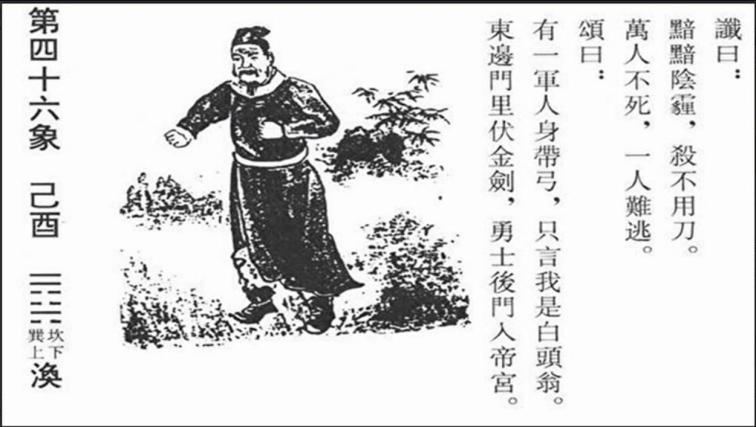
'Tui Bei Tu' Hexagram 46
The prophecy states: 'In the dim and gloomy haze, killing does not require a knife. Ten thousand do not die, but one cannot escape.' The accompanying ode reads: 'There is a soldier with a bow, who merely states I am the white-haired old man. In the eastern door lies a hidden golden sword. The warrior enters the imperial palace from the back door.' (See Figure 1)
Zhang Youxia, as the first Vice Chairman of the Military Commission with the surname 'Zhang', is a soldier who genuinely fits the description of 'the one with a bow', perfectly aligning with the first line of the ode 'There is a soldier with a bow'.
The second line, 'who merely states I am the white-haired old man', is likely referring to Xi Jinping. The traditional character for Xi, '習', features a feather atop the character for white, symbolising 'white feather'. The term 'white-haired old man' implies adding 'white' above the character '翁', which results in the character '習' (the inverted '習' signifies 'overthrowing Xi').
When the first and second lines of the ode are considered together, they suggest that Zhang Youxia, 'the one with a bow', is destined to be the one to 'overthrow Xi'.
Furthermore, the phrase 'only say I am' in the second sentence conveys a sense of self-declaration, suggesting that 'Bai Tou Weng' (an alias for Xi Jinping) possesses a strong tendency for self-promotion. In reality, Xi positions himself as 'a revered figure' and repeatedly demands loyalty from the military, reflecting a political stance that seeks both recognition and obedience. However, the military appears to be largely unresponsive to this demand. In contrast, 'Dai Gong' (Zhang Youxia) enjoys a very high reputation within the military.
Thus, the metaphor of 'only say I am' seems to encapsulate Xi's psychological gap, which contributes to his suspicion and wariness towards Zhang Youxia.
In the third sentence, 'In the east gate lies the hidden golden sword', the term 'hidden' implies the use of irregular tactics (ambush), seemingly corresponding to Xi's recent capture of Zhang Youxia. To counter the threat posed by 'Dai Gong', Xi employed 'hidden' tactics, likely capturing Zhang Youxia when he was completely unprepared. This aligns with insider reports suggesting that the capture was a sudden event and that Zhang Youxia did not resist when taken away.
While Xi's capture of Zhang Youxia may seem like an act of 'avoiding prophecy', it has, in fact, ignited a greater crisis.
In the fourth sentence, 'The warrior enters the imperial palace through the back door', the term 'back door' suggests a disaster arising from within. After Xi captured Zhang Youxia, the 'gatekeeper' at the 'front door', he believed the danger was eliminated; however, he actually created a significant power vacuum, nearly pushing the entire military to the opposing side.
In the midst of the Chinese Communist Party's (CCP) 'self-revolution' and 'internal purging' frenzy, the criteria for purging the military have become unpredictable, or rather, there are no longer any clear standards. Achievements no longer serve as a protective shield; former trusted aides and family friends can quickly turn into adversaries, and even repeated displays of loyalty can no longer ensure safety.
In this distorted system, an individual's fate can abruptly change for the most absurd reasons. Whether one is a high-ranking official like Li Keqiang or a powerful figure like Zhang Youxia, one could be mercilessly crushed by the CCP's purging machine simply for 'carrying a bow' or being perceived as 'uncontrollable,' leaving no one safe.
Zhang Youxia was initially a buffer between Xi and the military. With his arrest, Xi now faces thousands of generals and officers filled with doubt and fear.
Previously, officers and generals sought promotions and wealth, but now their only goal is to save their lives. With Zhang Youxia's purging, the vast majority of mid- to high-ranking military officers will feel a sense of 'sorrow for the dead rabbit and the sad fox,' their hearts cold and their courage shaken. Faced with Xi's extensive purges, if death is unavoidable, will they simply wait for their fate?
From this viewpoint, are the 'warriors' already on the path to the 'back door'? Perhaps the fourth statement will soon come to fruition.
At this juncture, let us revisit the prophecy that states, 'In the dim and gloomy haze, killing does not require a knife. Ten thousand do not die, yet one cannot escape.' This seems to resonate perfectly.
The expression 'dark and gloomy, killing without a knife' seems to reflect the countless lives lost to the CCP virus pandemic over the past few years. These individuals were not killed by knives; instead, they fell victim to the CCP's lies, were poisoned by CCP vaccines, succumbed to infections from the CCP virus, or were tortured to death during the extreme 'zero-COVID' measures.
The phrase 'no one can escape' likely refers to the individual who acts against the will of heaven and the course of history. Despite their attempts to 'avoid the prophecy,' they ultimately cannot evade the judgment and reckoning of natural law.
The phrase 'no one survives' may imply that while many who understand the truth and the 'warriors' aligned with the will of heaven will endure suffering, they will ultimately survive this historical upheaval and witness the dawn of a new era.
2.2. Iron Plate Diagram: 'The white-feathered bird crashes on this side of the mountain'
The 'Iron Plate Diagram' is a prophetic book that has been widely circulated among the populace for many years, notable for the high accuracy of its predictions. The title 'Iron Plate Diagram' itself suggests that the events described within are as solid as iron, almost predetermined. This is why the book has historically been classified as forbidden.
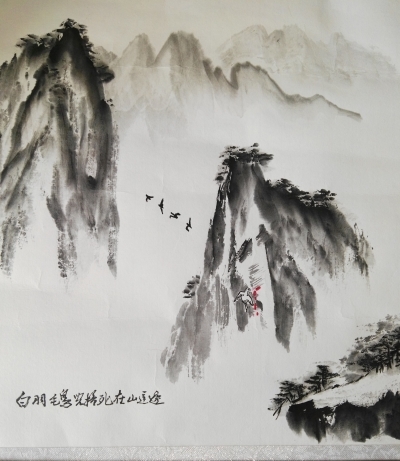
The last image of the "Iron Plate Diagram" (Image: Zhenjian Network)
The final image in the 'Iron Plate Diagram' predicts the manner of the CCP's downfall. It depicts five birds, four of which have black feathers and have already flown over the mountain pass; the fifth bird, with white feathers, crashes halfway up the right mountain peak, blood splattering against the cliff, appearing to fall. The image is accompanied by the phrase: 'The white-feathered bird crashes on this side of the mountain.'
It is commonly believed that these five birds symbolise the five leaders of the Chinese Communist Party (CCP). The four black birds represent Mao, Deng, Jiang, and Hu, while the fifth white bird symbolises Xi Jinping. I personally think this association is quite fitting; as previously noted, the traditional character for 'Xi' (習) features a feather (羽) above the character for 'white' (白), which can be interpreted as 'white feather'.
Notably, independent commentator Du Zheng disclosed in an article for Taiwan's 'Shang Bao' this January that in the spring of 1988, Xi Jinping used the alias 'White Feather' to engage with Taiwanese individuals and gather intelligence on Taiwan's political landscape. This indicates that 'White Feather' is an identity that Xi himself has used and acknowledged.
The two key messages conveyed by this image are: first, the white feather bird (Xi) is the last 'emperor' of the red dynasty, suggesting that the CCP will meet its end under Xi's rule; second, the white feather bird (Xi) will ultimately be buried alongside the CCP.
Furthermore, it is important to note that this white-feathered bird was not shot down by a bow and arrow, but rather crashed into a cliff on its own. This serves as a metaphor indicating that Xi Jinping's determination to preserve the party is a choice he has made to sacrifice himself for the CCP.
2.3 The Hidden Character Stone: 'The Chinese Communist Party Will Perish'
In 2002, a 'Hidden Character Stone' was discovered in Zhangbu Township, Pingtang County, Guizhou Province, revealing six large characters on the fracture surface of a stone that had split apart five hundred years ago: 'The Chinese Communist Party Will Perish'.

Guizhou Pingtang Hidden Character Stone. (Minghui Net)
Subsequently, Li Tingdong, an academician of the Chinese Academy of Geological Sciences, Liu Baojun, and several prominent geological experts formed an investigation team to conduct a field study of the 'Zangzi Stone.' They analysed it from geological and structural perspectives and concluded that the 'Zangzi Stone' is a natural formation made up of ancient biological fossils, showing no signs of artificial carving, and it dates back 270 million years.
Clearly, this is a matter of fate. The stone's appearance serves as a message to people: this is the truth (stone), do not dismiss it as a falsehood, and do not treat it lightly.
Moreover, it is noteworthy that on the mountain path leading to the 'Zangzi Stone,' a 500-year-old ancient maple tree broke in half and fell on a calm, rainless night. Afterwards, it was discovered that the interior of this ancient maple tree was already infested with pests and in a state of severe decay.
As the ancient maple tree fell, it also struck another nearby tree, which was an apricot tree.
The ancient maple tree features 'red' maple leaves shaped like 'five stars,' symbolising the Communist Party (the five-star flag). While it appears vibrant and beautiful on the surface, it is, in fact, riddled with corruption (pests are everywhere) and is extremely decayed.
The apricot tree serves as a metaphor for 'faith'; those who believe in the Communist Party and those who associate closely with it will end up like this apricot tree, crushed during the CCP's disintegration and downfall, becoming a sacrificial offering to the Party.
To date, over 457 million people have withdrawn from the CCP's party, league, and youth organisations, opting for 'three withdrawals' to ensure their safety.
Conclusion
Zhang Youxia's loss of power has become the most shocking political event in the CCP since the start of 2026, which will have far-reaching implications for the future political landscape of the Party.
While Xi Jinping has arrested Zhang Youxia, he has not gained control over the military; rather, he has created a fundamental opposition with the army, which has largely resulted in the 'gun barrel' being aimed at himself, simultaneously pushing the Chinese Communist Party (CCP) to the edge of a volcano.
Furthermore, Xi's capture of Zhang Youxia serves as a grand endorsement for the 'Tui Bei Tu' (Prophecy of the Backwards Push), while also accelerating the realisation of the prophecies foretold by the 'Tie Ban Tu' (Iron Plate Diagram) and the 'Cang Zi Shi' (Stone with Hidden Characters). At present, prophecies and reality are intertwined, marking a significant turning point in history.
In reality, Xi has long positioned himself as 'the sole authority', dismantling collective leadership and abolishing the succession system, thereby tightly linking the fate of the CCP to his personal safety. The system is no longer above the individual; instead, the individual has become the system itself. (This explains why Zhang Youxia, who effectively controls the highest military power of the CCP but does not wish to alter the existing system, has ultimately failed under Xi Jinping's rule, which adheres to the 'iron law' that 'political power grows out of the barrel of a gun'!)
Thus, should a 'warrior' emerge to hold Xi accountable, the CCP system will likely collapse in tandem. The reckoning of 'one person' is, in essence, the preservation and liberation of 'ten thousand people'.
The prophecy regarding the 'fall of the Chinese Communist Party' is nearing its moment of realisation.
(Excerpted from The Dajiyuan)
△





News magazine bootstrap themes!
I like this themes, fast loading and look profesional
Thank you Carlos!
You're welcome!
Please support me with give positive rating!
Yes Sure!