

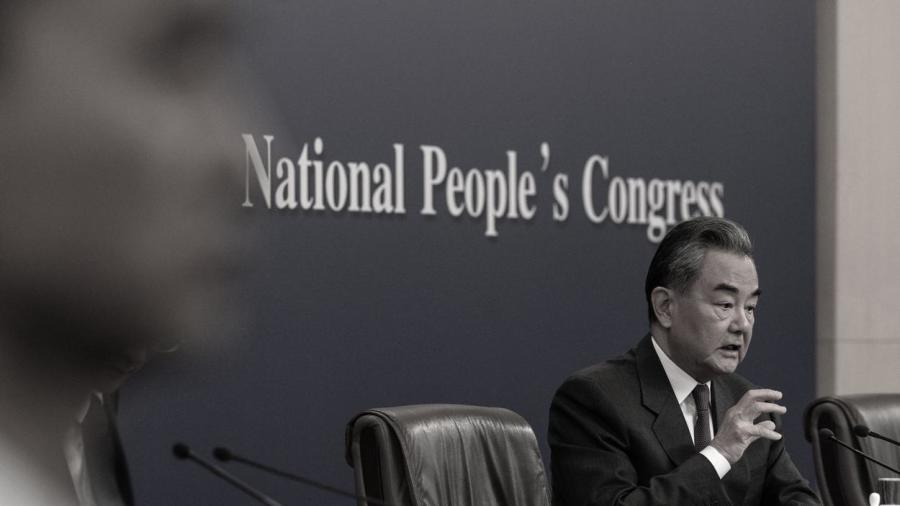
The image shows representatives from the Chinese military attending the Two Sessions in Beijing. (Video screenshot)
[People News] Following the arrests of Zhang Youxia and Liu Zhenli, the Chinese Communist Party's military newspaper has become a key outlet for observing the unfolding situation. The newspaper's characterisation of Zhang and Liu has generally indicated a diminishing severity, shifting from a political issue to a focus on corruption. Furthermore, under the stringent control of public opinion by Cai Qi, the military newspaper continues to express differing viewpoints. The unusual tone of the military newspaper corresponds with the unusual movements within the military. Military analysts have identified a direct signal—unusual troop movements.
On the front page of the military newspaper dated February 3, in addition to relaying the Central Committee of the Communist Party of China and the State Council's response regarding the 'Coordinated Planning of the Modern Capital Urban Circle,' and publishing the 'Regulations on the Election Work of Military Group Organizations'—a routine matter—there are three articles that warrant attention.
One article titled 'Seeking Truth and Pragmatism to Achieve Political Achievements' from 'August 1 Sharp Comments,' although brief, opens with the assertion that 'Party members and cadres should not seek vanity, should not engage in empty achievements, and should not pursue false reputations.' It continues with 'Chairman Xi pointed out,' and the article further states that 'the contribution rate to combat effectiveness is an important standard for evaluating actual achievements.' This article clearly serves as a subtle critique of the corruption attributed to Zhang Youxia and Liu Zhenli, which has resulted in a decline in the military's combat effectiveness. Despite their military accomplishments and prestige, they can no longer be considered valid standards for assessing political achievements.
The most significant point is that this article only dares to speak indirectly, avoiding direct mention of Zhang Youxia and Liu Zhenli. What does this signal? For several days, the military newspaper had been mentioning Zhang Youxia and Liu Zhenli, but suddenly ceased to do so. Does this indicate a reluctance to publicly criticise them any longer, or has the situation genuinely changed?
The other two articles discuss the so-called combat exercises of the 9th Company from a certain brigade in the 77th Group Army, and the so-called heroic stories from a brigade in the 82nd Group Army. The 77th Group Army is part of the Western Theatre Command and is stationed in Chongzhou, Chengdu, Sichuan Province. The 82nd Group Army, stationed in Baoding, is the 'ace' unit responsible for the defence of Beijing. Liu Zhenli previously served as the commander of this army and has a strong foundation within it.
Currently, it is reported that only the Eastern and Western Theatre Commands have shared the news regarding Zhang Youxia's investigation, but they have not made any official statements. The Northern, Southern, and Central Theatre Commands, along with the Rocket Force, have remained unusually silent, refraining from sharing or commenting on the matter.
Previously, the military newspaper published articles on its front page for two consecutive days, reporting that the 82nd Group Army and the Beijing Garrison Command were studying the spirit of the Fourth Plenary Session of the 20th Central Committee and learning to implement Xi Jinping's military strengthening thoughts.
Now, the military newspaper has once again highlighted the 82nd Group Army and the 77th Group Army. This action may be intended to signal to other military regions that have yet to express their stance, creating a façade of 'some have already made their positions known.' However, it also reflects a lack of active statements from various theatre commands, as the saying goes, 'what is lacking is what is called out.'
The unusual behaviour of the military newspaper mirrors the shifting sentiments among the troops and indicates movements within the military.
Former Navy Lieutenant Colonel Yao Cheng observes that the current military deployment is essentially complete. This is not merely a routine exercise; it is divided into two distinct levels.
Firstly, the combined brigades in each military theatre are currently engaged in 'hidden training' deployments within their designated areas. What does hidden training entail? It involves operational preparations that include hypothetical adversaries and targeted strategies.
Even more remarkable is the second aspect: the area surrounding Beijing has been encircled by troops. According to reliable sources, the 79th Army from the Northern Theatre, the 80th Army from Shandong, and the 81st, 82nd, and 83rd Armies from the Central Theatre have all been mobilised. Such a large-scale, coordinated troop movement across the country cannot be the private initiative of any individual or unit; it is a deliberate military readiness strategy.
So, who are they preparing to defend against? The answer may be 'preventing escape.' This highly confidential 'emergency combat plan' is reportedly communicated without written documents, relying solely on direct communication and verbal instructions, maintaining a very high level of secrecy. Is Zhang Youxia the strategist behind this?
Yao Cheng has made a bold prediction: New Year's Eve, which he refers to as 'Removal of Xi.'
Yao Cheng points out that the New Year period is when military readiness is at its weakest and unexpected forces can easily emerge. By controlling the area around Beijing and compelling Xi Jinping to resign for a fair judicial trial, this could be the ultimate objective of Zhang Youxia's 'emergency plan.'
A crucial point that Zhang Youxia is currently advocating is the 'nationalisation of the military.' Only when the military ceases to be a private army for a dictator can the safety of officers' lives and property be protected under the law, rather than being subject to Xi Jinping's arbitrary decisions about who to arrest.
Could Zhang Youxia become the warrior who 'exchanges life for life'? Will the internal divisions within the military lead to a chain reaction? Our only option is to closely observe the troop movements around Beijing, as well as the approaching New Year's Eve, which is sure to be extraordinary.
(First published by People News)
△





News magazine bootstrap themes!
I like this themes, fast loading and look profesional
Thank you Carlos!
You're welcome!
Please support me with give positive rating!
Yes Sure!