
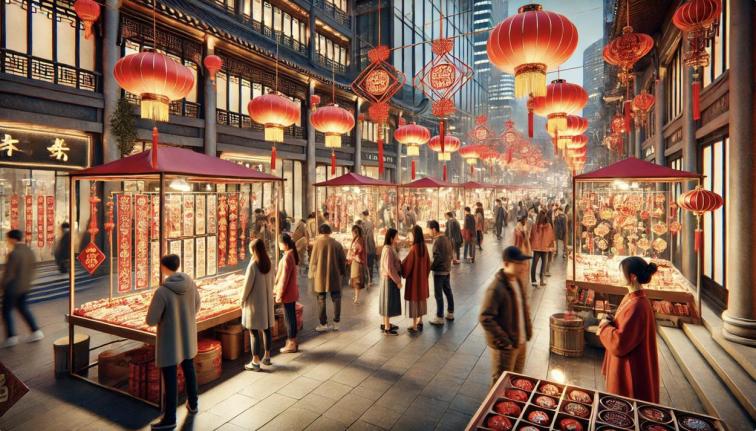
China’s Lunar New Year Market Sees Sparse Crowds (AI-Generated Image)
[People News] Recently, reports have emerged online indicating that several regions in mainland China are displaying yellow lanterns in the lead-up to the traditional New Year. These areas include Dongcheng in Beijing, Jinan in Shandong, Zhuozhou in Hebei, Leshan in Sichuan, Lanzhou in Gansu, Chongqing, Xi'an in Shaanxi, Taiyuan in Shanxi, and Zhengzhou in Henan. This move has sparked public discontent, and as the situation escalated, many locations quickly took down the yellow lanterns.
Traditionally, red lanterns are hung both inside and outside homes around the New Year to create a festive atmosphere. In my experience, there has not been a precedent for hanging yellow lanterns in the past thirty years. Feng Shui experts have noted that while yellow was historically a colour associated with royalty, it is considered taboo to hang yellow lanterns during the New Year, except in temples; otherwise, it is viewed as inauspicious, symbolising loneliness, war, family discord, and more.
Additionally, the term 'yellow' is linked to concepts such as dusk, the yellow springs, and yellow stalls, making the display of yellow lanterns before the New Year likely to provoke negative connotations.
So, why would the Chinese Communist Party opt to hang yellow lanterns this year, even if it contradicts tradition? Observant netizens have also noticed two other peculiarities. One is that during the recent opening ceremony of the Milan Winter Olympics, the Chinese team's uniforms were blue and white, with red merely serving as a small accent on a white scarf, marking a significant departure from the traditionally red-dominated uniforms.
The other is that the recently released Spring Festival Gala poster features hosts dressed in blue and black attire, and many leaked rehearsal images also showcase blue and black clothing.
The connection of three strange events is certainly not coincidental; it follows directives from the upper echelons of the Chinese Communist Party (CCP). The actions taken by the CCP are likely related to the ancient Chinese concept of the 'Red Horse and Red Sheep Calamity.'
The term 'Year of the Red Horse and Red Sheep' refers to the years of Bingwu (丙午) and Dingwei (丁未), which correspond to the zodiac signs of the horse and sheep, respectively. In the Heavenly Stems, Bing signifies intense and blazing Yang fire; when the Earthly Branches align with Wu in a Bing year, it marks the Year of the Red Horse, creating an atmosphere of eruption and transformation. Conversely, Ding represents gentle Yin fire, which is easily influenced by its surroundings; in a Ding year that encounters Wei, it becomes the Year of the Red Sheep, where strong fire and dry earth create obstacles, challenges, and changes.
The 'Year of the Red Horse and Red Sheep' appears once in each cycle of the sixty-year sexagenary calendar. The ancients believed that such years are prone to political upheaval, wars, plagues, and other 'calamities,' which is why the term 'Red Horse and Red Sheep Calamity' exists. A notable historical event, the Humiliation of Jingkang, took place in the Bingwu year (1126).
At the end of the Southern Song Dynasty, the minister Chai Wang (柴望, 1212–1280) investigated the disasters associated with the Year of the Red Horse and Red Sheep. He meticulously searched through historical records and compiled the common historical phenomenon of 'Bing and Ding Calamities' (Red Horse and Red Sheep Calamity) in his writings, hoping to serve as a cautionary example for the emperor.
In addition to the humiliation of Jingkang, Chai Wang found that from the Warring States period through the Qin and Han dynasties to the Five Dynasties—specifically from the 52nd year of King Zhao of Qin (公元前255年) to the 12th year of Tianfu of the Later Han (公元947年)—there were 21 occurrences in the years of Bingwu and Dingwei. Over this span of more than a thousand years, 'disasters and anomalies were too numerous to count,' with each instance corresponding to significant historical changes or upheavals.
The major calamities associated with the Red Horse and Red Sheep disasters arose from both internal political chaos and external threats. These included significant disasters and social transformations, as well as the fall of dynasties. Such major variables caused considerable turmoil for the nation, society, and its people, with most being linked to regime changes.
For instance, in 195 BC, during the Bingwu year, Liu Bang, the founding emperor of the Han dynasty, died, leading to Empress Lü seizing power. In 646 AD, Wu Zetian entered the palace. The Cultural Revolution, which began in 1966, also took place in a Bingwu year. The upcoming Bingwu year of 2026, marked by a strong 'fire energy,' and the Dingwei year of 2027, are similarly drawing attention. Particularly now, as the Chinese Communist Party regime appears to be on the verge of collapse, with ongoing power struggles at the top, many are anxiously awaiting potential changes in 2026, especially regarding the party leader who has suffered multiple strokes.
It is evident that the Chinese Communist Party also subscribes to the notion of the 'Red Horse and Red Sheep disaster,' as otherwise, the three unusual events mentioned would not have occurred.
In traditional Yin-Yang and Five Elements theory, water symbolizes Yin and can extinguish fire. Colours such as blue, black, and grey are generally categorised as having water properties. Yellow, in contrast, belongs to the earth element in the Five Elements, which generates fire, indicating that yellow can absorb fire's energy. Thus, yellow, blue, and black are all employed to mitigate excessive fire energy.
In other words, the Chinese Communist Party (CCP) aims to navigate the 'Red Horse and Red Sheep Robbery' through various strategies to sustain its malevolent regime. However, what the CCP fails to realise is that the tactics it employs are merely minor tricks; the true decree of fate has already foretold its demise, and no amount of struggle will change that.
(First published by People) △






News magazine bootstrap themes!
I like this themes, fast loading and look profesional
Thank you Carlos!
You're welcome!
Please support me with give positive rating!
Yes Sure!