
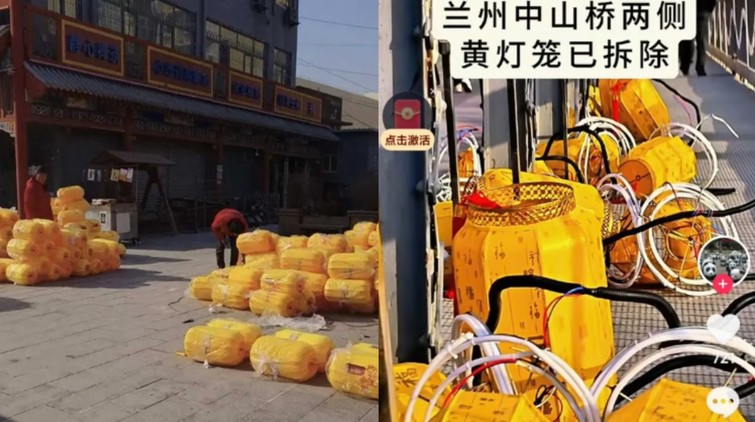
Recently, the display of yellow lanterns in various locations across mainland China has ignited intense discussions. (Video screenshot / Composite image)
[People News] On February 10, Sun Shaocheng, the former secretary of the Inner Mongolia Autonomous Region, who had retired four months prior, was officially announced to have his qualifications as a representative of the National People's Congress revoked. He is the first high-ranking official to be dismissed this year. On the same day, four other officials were also reported to be under investigation.
Since the start of this year, under Xi Jinping's direct leadership, the Chinese Communist Party (CCP) has continued its aggressive anti-corruption campaign, resulting in ongoing turmoil within the party's upper ranks.
A notable recent shift in the military sector involves the investigation of Zhang Youxia, Vice Chairman of the Central Military Commission, and Liu Zhenli, a member of the Commission, for breaches of discipline and law. Currently, only Xi Jinping and Zhang Shengmin remain in the entire Central Military Commission.
In the political sphere, just over a month into the year, at least seven officials at the ministerial level have been investigated, including Sun Shaocheng.
Official reports indicate that Sun Shaocheng has held several ministerial-level positions, with the pinnacle of his career being the Secretary of the Inner Mongolia Autonomous Region from April 2022 to September of last year.
Public records show that Sun Shaocheng was born in July 1960 in Haiyang, Shandong. He began his career in July 1984 and holds a graduate degree as well as a Doctor of Law. Official documents do not mention Sun Shaocheng's university education, but instead jump directly to 'graduate degree while in service, Doctor of Law,' which coincidentally aligns perfectly with the 'graduate degree while in service, Doctor of Law' of CCP leader Xi Jinping, which is quite surprising.
Sun Shaocheng joined the Communist Party of China in May 1986, making him a veteran member with 40 years of party affiliation. After spending decades within the ranks of the CCP, the extent of his embezzlement of the common people's hard-earned money remains undisclosed by the authorities.
Currently living abroad, commentator Du Wen explained that the reason for the investigation into Sun Shaocheng can be summarised in one word: collective punishment. The central figure in this collective punishment is Wang Lixia. Sun Shaocheng and Wang Lixia are not just 'working together'; they are part of a 'shared system.' Their relationship transcends the simple 'secretary—chairman' dynamic; one controls the party while the other governs; one sets the direction while the other oversees execution. They constitute a community of interests. Additionally, Sun Shaocheng's son and Wang Lixia's son are business partners, sharing the profits.
Du Wen noted that after Wang Lixia's fall from grace, Sun Shaocheng spearheaded the purge of Wang Lixia's remaining faction in Inner Mongolia. At that time, Sun Shaocheng was quite proactive, believing he was safe. Du Wen had previously asked a friend to advise Sun Shaocheng to flee quickly, warning that it would be too late if he hesitated. However, he believed he was in the clear. Du Wen argues that Sun Shaocheng failed to recognise a fundamental rule in the CCP's anti-corruption campaign: if either the provincial 'number one' or the head of government is investigated, the other is almost certainly implicated.
Du Wen remarked that at that time, the Central Commission for Discipline Inspection (CCDI) had indicated that Sun Shaocheng was ineffective in party management and was not making enough arrests. He took over from Shi Taifeng, but during his leadership, the number of arrests was only a quarter of what Shi Taifeng had achieved. Furthermore, he was involved in corruption and sharing illicit gains with Wang Lixia. Thus, his downfall was merely a matter of time. This incident should not have unfolded so rapidly, but in light of the Zhang Youxia incident, the Communist Party of China (CPC) opted to use him as a scapegoat to stabilise the situation. What does this imply for Xi Jinping? It suggests that this is not a triumph in the anti-corruption campaign; rather, it is a sign of systemic failure. It reflects Xi Jinping's shortcomings in enforcing strict party governance.
On February 10, the four officials under investigation for serious disciplinary and legal violations were:
1. Xu Delin, the former party group secretary and director of the Standing Committee of the Baotou Municipal People's Congress, a Mongolian born in March 1961, with a graduate education, holding a Master's degree in Business Administration, and recognised as an economist. He began his career in October 1978 and previously served as the director of the Standing Committee of the Baotou Municipal People's Congress in the Inner Mongolia Autonomous Region. Xu Delin joined the Communist Party of China in December 1983, marking 43 years of party membership.
2. Bao Ye, a member of the party group and deputy league leader of the Alxa League Administrative Office in Inner Mongolia Autonomous Region, a Mongolian born in July 1969, originally from Faku, Liaoning. He graduated from the Political Education Department of Harbin Normal University with a Bachelor's degree in Law. He became a member of the Communist Party of China in July 1994, with 32 years of party membership.
3. Tian Xiaochuan, a former member of the Party Leadership Group and Vice Chairman of the Political Consultative Conference in Hulunbuir City, Inner Mongolia, is of Han ethnicity and was born in August 1962 in Longkou, Shandong. He holds a graduate degree from the Inner Mongolia Party School and began his career in August 1982. He joined the Communist Party of China in June 1989, accumulating 37 years of party membership.
4. Bai Zhenying, the former member of the Party Committee and Chairman of the Trade Union at Inner Mongolia Electric Power (Group) Co., Ltd., has no personal information available online. However, his position as a member of the Party Committee at a provincial-level power company indicates he likely has around 30 years of party membership.
The information above reveals that these officials have decades of party membership. Their affiliation with the Communist Party has not transformed them into 'public servants' dedicated to 'serving the people'; rather, they have become 'advanced elements' racing towards the crematorium on the path of corruption. The Communist Party of China has become thoroughly corrupt, and can officials who have risen from this decayed system truly avoid corruption?
As we enter 2026, seven central management cadres have already been investigated in January alone. According to reports from the Central Commission for Discipline Inspection and the National Supervisory Commission of the Communist Party of China, over one million corruption cases were filed for investigation in 2025, with a staggering 983,000 officials facing disciplinary actions, marking a new record high.
Officials in various positions, when wielding power, often become arrogant and oppressive, mistreating the common people and persecuting practitioners of Falun Gong who uphold the principles of 'Truth, Compassion, Forbearance.' Their cruelty emboldens them, yet they fail to foresee the retribution that awaits them. Now, as the Chinese Communist Party (CCP) raises the banner of anti-corruption, these officials are trembling in fear, knowing they could be arrested and imprisoned at any moment. The CCP authorities flaunt these arrests as achievements in their anti-corruption efforts, using them to pay tribute to the blood-stained flag of the Party. Some officials, unable to bear the weight of this fear, have taken their own lives. The malevolent regime of the CCP is unlikely to endure much longer; many media outlets predict that 2026 will mark the end of the CCP.
Recently, many major cities across various provinces in China have been decorated with yellow lanterns, leading to public speculation that yellow lanterns are only hung for the deceased, suggesting that the Chinese Communist Party is on the verge of collapse. 'Coincidentally, China has unveiled the auspicious mascots for the Year of the Horse: the Four Horsemen of the Apocalypse—Death, Famine, Pestilence, and War.' 'It’s a funeral for the Party and the nation.' 'This reflects the unprecedented changes we are witnessing in a century.'
Chen Wei Yu, the host of 'Wei Yu Kan Shi Jian,' remarked that the CCP is fearful that the prophecy of the Red Horse and Red Sheep calamity is coming to fruition, which is why they have replaced red lanterns with yellow ones. The fire element in the Year of the Fire Horse is excessively strong, raising concerns about a significant incident; it appears that feng shui masters are still providing counsel within the court. It is said that the last folk sage to enter Zhongnanhai predicted: 'In the Year of the Fire Horse, the nation's fortune will come to an end. 2026 is the Year of the Fire Horse.'
(First published by People News) △





News magazine bootstrap themes!
I like this themes, fast loading and look profesional
Thank you Carlos!
You're welcome!
Please support me with give positive rating!
Yes Sure!