
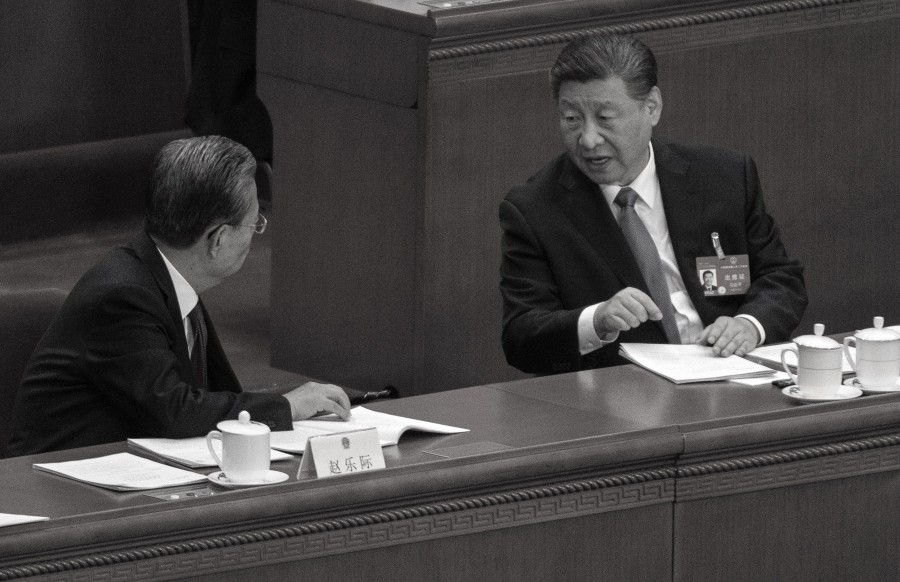
On March 8, 2024, during the second plenary session of the National People's Congress, Xi Jinping knocked on the table while addressing NPC Chairman Zhao Leji. (Photo by Kevin Frayer/Getty Images)
[People News] On February 14, 2026, the Chinese Communist Party Central Committee and State Council held their Spring Festival reception at the Great Hall of the People in Beijing. The meeting was presided over by Li Qiang. Xi Jinping delivered a speech. The seven members of the Politburo Standing Committee attended, along with Vice President Han Zheng. State media described the banquet hall as “brilliantly lit and filled with festive joy, with more than 2,000 people from various sectors gathering together in celebration.”
Yet beneath this ritual of power and carefully staged political feast, behind the forced smiles celebrating the Year of the Horse, lie layered crises: a vacuum in military authority, Xi Jinping’s “island predicament,” and collective panic within the bureaucratic system.
This year’s State Council reception was held on the 28th day of the twelfth lunar month, two days before Lunar New Year’s Eve. In previous years, the reception was generally held on the day before New Year’s Eve. Reviewing the past decade, only in 2017 and 2026 was it held two days before New Year’s Eve; in all other years it was held one day prior.
On January 25, 2017, the CCP held the State Council reception; January 27 that year was New Year’s Eve and also the first day of the holiday. This year’s holiday lasts nine days, officially beginning on February 15, 2026. If the earlier date were to accommodate the holiday schedule, then in 2017 the reception should have been held on January 26. Why were the receptions in these two years held two days before New Year’s Eve, “ahead of schedule”? What power codes and political secrets are hidden within Zhongnanhai? The outside world does not know.
The central reception should have been a high-profile moment to display unity among the CCP leadership, political harmony, Party cohesion, and effective governance. Especially given the sudden arrest of Zhang Youxia, First Vice Chairman of the Central Military Commission—removing a major concern for Xi and reclaiming military authority—Xi should have appeared triumphant. Yet from CCTV footage, Xi’s entrance lacked the composure and confidence of previous years. His gait appeared unsteady, his face tired. During his speech at the podium, smiles were rare; facial muscles appeared stiff and tense, occasionally forcing a strained grin. Gone was the vigorous ease of 2024 or the confident poise of 2025.
On January 20, at the opening ceremony of a seminar for provincial and ministerial-level leaders studying the spirit of the CCP’s Fourth Plenum of the 20th Central Committee, Zhang Youxia and Liu Zhenli were notably absent, sparking rumors that both had “encountered trouble.” When Xi entered the hall and walked toward the podium, his face reportedly carried barely concealed delight—like a starving dog that suddenly perks up after stealing a bone from the pot.
Yet in less than a month, Xi’s triumphant arrogance seemed to vanish. At the February 14 reception, his mournful expression suggested that while he appeared to hold the overall situation in hand, he was in fact suffering deeply. Removing Zhang Youxia was thought to be winning the top prize in a power lottery, but instead it triggered a political landmine. The military reportedly resisted collectively; officials remained silent and withheld support. Zhao Leji of the National People’s Congress allegedly did not cooperate in stripping Zhang and Liu of their representative status. Li Xi of the Central Commission for Discipline Inspection reportedly excluded their cases from the annual anti-corruption report. Xi appeared isolated amid the backlash of factional struggle.
In his February 14 speech, aside from formulaic rhetoric, Xi unusually described 2025 as “an extraordinary year,” acknowledging complex domestic and international conditions, emphasizing that “the economy is advancing under pressure,” and asserting that “as long as we maintain strategic resolve, we will accumulate small victories into great ones.” Compared with his confident phrases in prior years, this tone seemed more like whistling in the dark to bolster himself—less “strategic resolve” than strategic retrenchment.
Xinhua reported that leaders from the Party center, NPC Standing Committee, State Council, Supreme People’s Court, Supreme People’s Procuratorate, CPPCC, and Central Military Commission attended. The CMC was reportedly reduced to Xi and Zhang Shengmin. CCTV footage showed no shots of Zhang Shengmin. Uniformed officers were sparse. Elder statesmen such as Hu Jintao, Wen Jiabao, Zhu Rongji, and Li Ruihuan were also absent from the televised scenes, implying they did not attend.
Although Xi used Wang Xiaohong to neutralize Zhang Youxia, he reportedly now faces systemic resistance within the military power chain, exposing deep mistrust between the PLA and Xi. During Spring Festival greetings to grassroots troops, Xi remained in Beijing, speaking via video from the Bayi Building—highlighting his constrained military authority.
Veteran Party elders have not publicly endorsed Xi regarding the Zhang incident, reflecting political confrontation. Online rumors circulated of an open letter from Zhang Youxia’s son Zhang Xin to Xi, accusing procedural illegality and abuse of power. Combined with reports of princeling Liu Yuan urging Xi to relinquish power, Xi’s position appears precarious.
With the CMC reduced to two figures, the system of “the Party commanding the gun” appears strained. The reception’s festive narrative, in military terms, resembles an “empty city strategy.” Military loyalty has become a major political variable, concentrated between Xi and Zhang Shengmin. Political trust appears diminished.
Xi’s speech also referenced 2026 as the opening of the “15th Five-Year Plan” and the CCP’s 105th anniversary. Yet within less than two months, 11 centrally managed officials were announced under investigation, 10 disciplined and transferred to judicial authorities; additional prosecutions and sentences were reported. In 2025 alone, the Central Commission for Discipline Inspection reportedly opened cases against 115 provincial- and ministerial-level officials, disciplining 69—50 unnamed—creating what the article calls a “disappeared officials” landscape.
Within the bureaucracy, fear prevails. Of the 2,000 attendees, how many were truly at ease? Smiles on the surface, but hearts like startled birds. Today seated in the Great Hall of the People representing the people, tomorrow perhaps seated in Qincheng Prison.
The 2026 CCP high-level reception resembled a rehearsal for the end. The carefully packaged festivity was not a celebration of Xi’s restored power, but a final masquerade, reflecting Xi’s isolated predicament and fading shadow of authority.
(First published by People News) △




News magazine bootstrap themes!
I like this themes, fast loading and look profesional
Thank you Carlos!
You're welcome!
Please support me with give positive rating!
Yes Sure!