
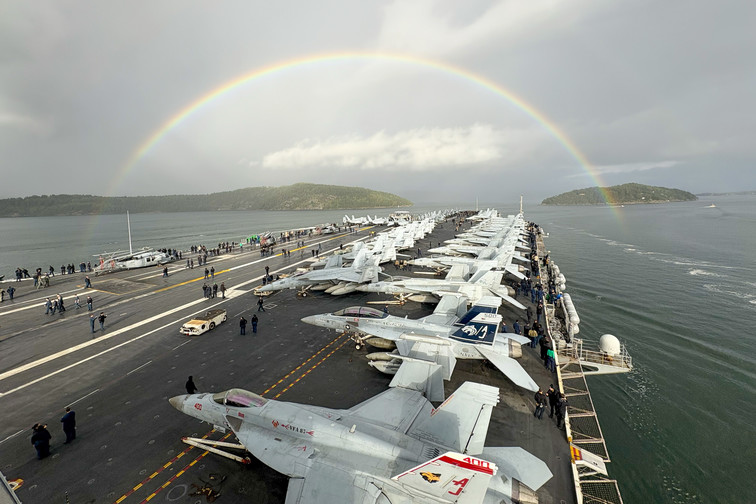
(U.S. Navy photo by Mass Communication Specialist 1st Class Weston Mohr)
(The Center Square) – U.S. Southern Command announced strikes on three suspected drug boats in the eastern Pacific and Caribbean.
The strikes, part of Joint Task Force Southern Spear, hit suspected drug boats that U.S. military officials said were operated by terrorist groups.
"Intelligence confirmed the vessels were transiting along known narco-trafficking routes and were engaged in narco-trafficking operations," U.S. Southern Command said in a social media post.
Late on Feb. 16, at the direction of #SOUTHCOM commander Gen. Francis L. Donovan, Joint Task Force Southern Spear conducted three lethal kinetic strikes on three vessels operated by Designated Terrorist Organizations. Intelligence confirmed the vessels were transiting along known… pic.twitter.com/mib9XtptSB— U.S. Southern Command (@Southcom) February 17, 2026
The first two strikes, in the eastern Pacific, and the third, in the Caribbean, killed a total of 11 people. No U.S. military forces were hurt.
Since President Donald Trump began the controversial military strikes on suspected drug boats in the region in September, at least 37 strikes have killed 120 people. Democrats, a few Republicans, and some international groups have condemned the U.S. military strikes. However, Congress failed to pass a measure requiring Trump to get permission before launching such strikes.
U.S. officials have not estimated the weight or value of illegal drugs that have been destroyed in the military strikes.
Trump has yet to use the military on suspected drug operations in other parts of the world, but has said he would consider military action elsewhere to stop drug smuggling.
Monday's strikes come as the U.S. Coast Guard continues to stop other suspected drug smuggling boats, seize drugs and turn those on board over to local authorities.
Last week, the U.S. Coast Guard Cutter Seneca's crew unloaded about 17,750 pounds of cocaine worth more than $133.5 million in Port Everglades from four interdictions in international waters off the eastern Pacific Ocean, according to the Coast Guard. The Seneca's crew seized 4,410 pounds of cocaine on a go-fast boat on Jan. 25 and another 13,340 pounds of cocaine from three go-fast boats on Jan. 31.
"This deployment demonstrates our enhanced posture and continued success in the fight against narco-terrorism and transnational criminal organizations," said Capt. Lee Jones, commanding officer. "The Coast Guard, in conjunction with our inter-agency and international partners, continues to patrol areas commonly associated with drug trafficking in the Eastern Pacific, denying smugglers access to maritime routes by which they move illicit drugs to our U.S. land and sea borders."
Coast Guard officials said they plan to accelerate anti-drug operations in the Eastern Pacific Ocean in support of Operation Pacific Viper.
"The Coast Guard continues increased operations to interdict, seize and disrupt transshipments of cocaine and other bulk illicit drugs by sea," officials said. "These drugs fuel and enable cartels and transnational criminal organizations to produce and traffic illegal fentanyl, threatening the United States."
Last week, the Mexican Navy announced a joint bust with the U.S. Coast Guard of several tons of cocaine near Clarion Island.
Trump has said that each drug strike at sea potentially saves 25,000 American lives.
Drug overdose deaths are a leading cause of American deaths. The U.S. Centers for Disease Control and Prevention reported provisional data found about 87,000 drug overdose deaths from October 2023 to September 2024. That's down from about 114,000 the previous year and the lowest since 2020.
Most of the world's cocaine supply comes from nearby Colombia. China and other Asian nations produce most of the precursor chemicals needed to make fentanyl, the potent opioid responsible for most U.S. overdose deaths in recent years.
Since the 9/11 terrorist attacks in 2001, U.S. presidents of both parties have used the military to kill terrorists abroad, including members of Al-Qaeda and ISIS.





News magazine bootstrap themes!
I like this themes, fast loading and look profesional
Thank you Carlos!
You're welcome!
Please support me with give positive rating!
Yes Sure!