
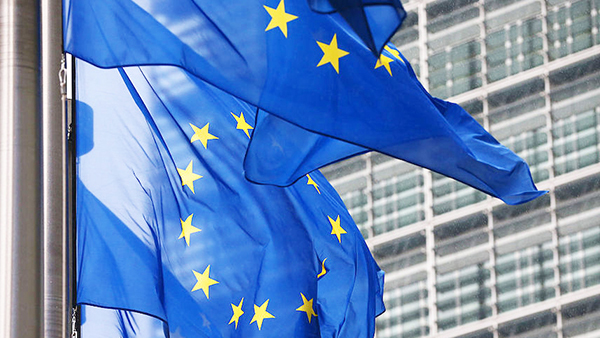
The EU flag outside the European Commission building in Brussels, Belgium.
[People News] Germany has long had a high dependence on the Chinese market, but this situation is now undergoing a structural transformation. Previously, whenever the EU considered any tough measures against China, Germany would consistently intervene to block them. However, with China flooding Europe with inexpensive products, industries such as German automobile manufacturing are now facing a survival crisis, prompting a change in Germany's policy towards China.
According to a report by Liberty Times, the Süddeutsche Zeitung recently published a commentary titled 'Germany Recognizes Its Own Issues,' which highlights the EU's weak link. The authorities in Beijing have always been acutely aware of this: the weak link is not Brussels, but the capitals of the individual member states. Brussels, the capital of Belgium, is home to the main institutions of the European Union (EU) and the North Atlantic Treaty Organization (NATO), and is often referred to as the 'capital of Europe.'
The CCP has capitalized on this insight; whenever Beijing employs a carrot-and-stick approach, it intentionally bypasses Brussels to directly engage with individual member states through its 'divide and rule' tactics.
In fact, one of the CCP's most frequently used strategies when confronted with a stronger adversary is to 'defeat them one by one.'
The strategy of 'defeating each one separately' has long been viewed by the Chinese Communist Party (CCP) as one of its fundamental strategic tools. This approach is often complemented by the 'united front' strategy (alliancing with the left, attacking the right, and courting centrists), which aims to divide and isolate opposing forces, thereby avoiding the challenge of confronting multiple strong adversaries simultaneously, ultimately leading to complete disintegration.
In dealing with the European Union, the CCP has employed a tactic strikingly similar to 'defeating each one separately,' known as 'divide and rule.'
For instance, Chinese companies have invested billions of euros in Hungary to establish factories, while the Budapest government under former Prime Minister Viktor Orbán has consistently hindered the EU from issuing strong statements against China.
In 2021, following a dispute between the CCP and Lithuania regarding Taiwan's status, the CCP swiftly removed Lithuania from its customs system, resulting in a situation where, overnight, no Lithuanian products could be exported to China.
Germany has also repeatedly been a target of Beijing's 'divide and rule' strategy. In July of this year, during a meeting between Chinese Commerce Minister Wang Wentao and German Economic Minister Katherina Reiche, Wang expressed that China hopes Germany will play a proactive role within the EU, encouraging Brussels to adopt a 'rational position.' This indicates the role that Beijing envisions for Berlin.
The shift in Germany's policy towards China is not without reason. For decades, German companies, particularly in the automotive sector, have invested substantial amounts in China. Consequently, Germany is always concerned that if it provokes Beijing, its investments and business operations in China could be jeopardized.
The German government did not foresee that when German companies invested heavily in China—helping to develop the Chinese economy, providing job opportunities for the Chinese people, and assisting in China's industrialization and economic transformation—this would originally be a win-win deal that should have secured long-term market respect and political friendship. However, the Germans did not anticipate that the Chinese Communist Party (CCP) would completely disregard this; rather than expressing gratitude to the German companies operating in China, it views these firms as a vulnerability for the German government, using them as leverage for pressure and threats.
As a result, whenever the EU considers implementing tough measures against China, Germany consistently applies the brakes. From Germany's viewpoint, this approach seems reasonable, but the EU pays a steep price for Germany's stance. As long as the Beijing authorities believe that exerting pressure on individual companies or member states is sufficient to restrain Brussels, the economically significant EU will continue to be politically marginalized.
Sources indicate that Germany and France are advocating for a new initiative within the EU to enable it to swiftly implement stringent countermeasures in response to economic coercion. This initiative will notably diminish the influence of individual member states on Brussels' decision-making processes.
Analysts note that this new measure introduced by Germany will not shield its domestic industry from potential retaliation by China. If the Beijing authorities respond to the EU's countermeasures enacted under the new regulations, German companies will likely be the first to suffer. This is largely due to the close interconnection of German industrial supply chains with China, alongside Germany's significant economic interests in the country. Some companies have already started stockpiling rare earth materials in preparation for a potential conflict between Europe and China.
In the long run, Germany is starting to adopt a strategy of 'de-risking' and regional diversification to lessen its reliance on the Chinese market. While this process may be lengthy and challenging, it will significantly undermine Beijing's 'divide and rule' tactics aimed at the EU. This is exactly what the EU desperately requires. △





News magazine bootstrap themes!
I like this themes, fast loading and look profesional
Thank you Carlos!
You're welcome!
Please support me with give positive rating!
Yes Sure!