
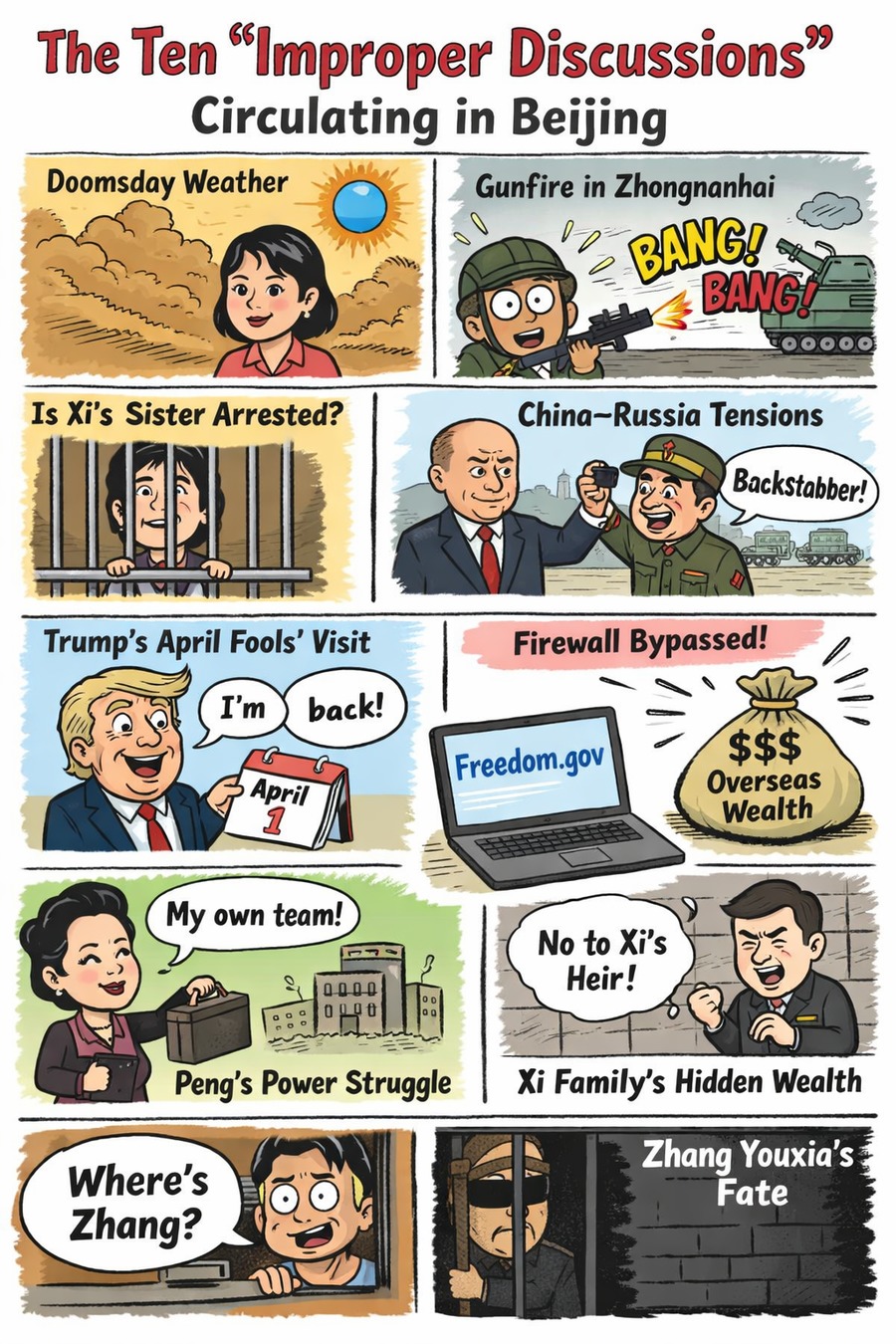
The Ten “Improper Discussions” Circulating Privately in Beijing’s Official Circles
[People News] In 2026, the Year of the Bingwu Horse, Beijing is shrouded in an eerie stillness and undercurrents of turbulence. From the massive sandstorm and blue sun on the fifth day of the Lunar New Year, to reports of gunfire from Zhongnanhai at night, to the ten topics spreading wildly in private official conversations—these whispers are no longer isolated complaints but clear signals of collective psychological collapse within the system. The ban on “improperly discussing the central authorities” has become meaningless, and the criticism points directly at Xi Jinping.
1. Apocalyptic Signs in Beijing
On the fifth day of the Lunar New Year, a sandstorm blotted out the sky, a rare blue sun appeared, and wildfires raged in multiple regions. In private, officials interpret these as heavenly warnings: the dynasty’s mandate is exhausted. “The sky has turned yellow—how much longer can this last?” The implication is that Xi Jinping has lost Heaven’s Mandate.
2. Gunshots in Zhongnanhai
On the night of February 21, intense rumors spread: gunfire, armored convoys entering, floor-to-ceiling windows shaking. Within the system, stories circulate of Li Qiaoming staging a coup attempt, pro-Russian factions counterattacking, and Zhang Youxia’s old subordinates confronting Xi’s loyalists. The military’s rare silence and the Central Guard Bureau’s top-level combat readiness are woven into narratives of “coup gunfire” and “high-level splits.” “Once the gunshots ring out, whose grip on the gun falters?” The implication is that Xi’s authority is wavering.
3. Were Xi’s Sister Qi Qiaoqiao and Others Detained?
Rumors claim Qi Qiaoqiao has been under house arrest at a Shenzhen guesthouse since late last year, barred from travel, with associates restricted. Business circles report disciplinary interrogations over benefit transfers and deleted WeChat accounts. Official whispers lean toward “protective confinement” or that anti-Xi forces are “cutting at the hem.” Combined with Zhang Youxia’s downfall, the Xi family’s fate appears precarious. “If he can’t even protect his own family, what ‘ironclad empire’ is there?” The finger points to Xi’s family as his greatest vulnerability.
4. Shifts in China–Russia Relations
Wang Yi met Ukraine’s foreign minister in Munich, pledging new humanitarian and energy assistance (reconstruction of Ukraine’s energy system), publicly acknowledged by Kyiv. Beijing’s move from “strategic ambiguity” to aiding Ukraine is seen as “abandoning Russia to save itself.” Russian media accuse China of betrayal; officials mock the “limitless friendship’s bottomless face-changing.” Some judge the Russia–Ukraine war nearing its end and Putin possibly turning toward the dollar system, prompting Beijing to “pick the fruit early” to gain Western relief. “Soft words to Russia, rushed loyalty to Ukraine—is this strategic resolve?” The implication is diplomatic miscalculation and inconsistency under Xi.
5. Trump’s April Fools’ Visit
Donald Trump is reportedly scheduled to visit Beijing from March 31 to April 2, spanning April Fools’ Day. Officials privately joke “Fooling You 2.0.” Amid trade tensions and Taiwan issues, the timing is viewed as signaling looming storms. “When Trump arrives, will tariffs ease or harden? The top leadership has no confidence.” The suggestion is Xi’s passivity in international maneuvering.
6. The U.S. Targeting China’s Great Firewall
The U.S. State Department’s Freedom.gov platform aims to bypass censorship with one click. Officials privately cheer “tear down the firewall,” yet worry “if outside voices flood in, can inside stability hold?” It is viewed as a powerful blow to information control. The implication: Xi’s information blockade is a paper tiger.
7. Transfer of Xi Family Assets
U.S. intelligence reports claim the Xi family holds over $1 billion in overseas assets (business, finance, real estate), despite Xi’s alleged instructions to divest. The 2026 National Defense Authorization Act reportedly requires disclosure of Politburo Standing Committee overseas wealth; rumors of asset freezes swirl. Officials whisper that Xi’s sister monopolized discounted oil from Venezuela and Iran, earning 400 billion yuan annually; family wealth is described as a “political nuclear bomb.” “After ten years of anti-corruption, family assets still float overseas—doesn’t that hand enemies a blade?” The target is alleged double standards and enrichment.
8. Strong Party Opposition to a Supposed Illegitimate Heir
Rumors allege Xi has an illegitimate son being groomed in Ningxia to inherit a “Xi family realm.” Military and “Red Second Generation” elites reportedly strongly oppose this, with Zhang Youxia’s removal seen as clearing obstacles. Peng Liyuan’s control over military cadre evaluations is said to place loyalists in key posts. Officials whisper about a “weak successor” like Zhu Yuanzhang paving the way for Zhu Yunwen. If confirmed, backlash could be fierce. “If succession becomes chaotic, all the Red elites must choose sides—who dares gamble?” The implication is dynastic ambition and Party fragmentation.
9. Peng Liyuan Establishing Her Own Faction
Peng is rumored to be the power behind a “Shandong clique,” with Li Ganjie as her key ally. She is said to influence military personnel and elevate Shandong-origin officials. With Ma Xingrui’s recent fall and rumors of Peng’s confinement in Shandong, the clique is said to be collapsing. Officials interpret this as cracks in “Xi-Peng co-rule” and Peng’s failed bid to build her own base. “If even pillow talk turns cold, what unity remains?” The implication is marital fissures and internal power struggle.
10. Zhang Youxia’s Situation After Alleged Illegal Arrest
Multiple versions of his arrest circulate (intercepted en route to Party School, seized at the August 1 Building, trapped at a banquet). Relatives reportedly detained. Latest whispers claim he is sustained by forced feeding, already deceased, or secretly executed the night of arrest. Held under dual surveillance by the Beijing Garrison and Central Guard Bureau, with no verdict, no announcement, no body release. Military insiders call it “black-box execution.” “If even a senior elder ends like this, who still believes in loyalty?” The finger points to Xi’s purges and suspicions of military elders.
Under the overlapping pressures of the Bingwu year, high-level purges, economic downturn, and international strain, these official whispers have merged into a narrative of “storm clouds gathering” and “the eve of great change.” This wave of “improper discussion” signals a shift from fear to contempt: officials increasingly see Xi as blustering but hollow—a paper tiger. Once that perception spreads, backlash could come faster and fiercer than any wild beast. Historically, dictators fear not external enemies but internal awakening and centrifugal forces—Beijing appears to be witnessing that very moment.
The yellow sand, blue sun, yellow lantern farce, and high-alert silence are surface phenomena; the real undercurrent lies in official whispers. The man at the storm’s center may still believe the “knife handle” is firmly in hand and the realm secure. Yet when millions of officials shift from kneeling loyalty to collective disdain, once the flame of backlash ignites, there is no turning back.
Storm clouds gather over the tower; Beijing’s strangeness is merely the prelude to greater upheaval. △




News magazine bootstrap themes!
I like this themes, fast loading and look profesional
Thank you Carlos!
You're welcome!
Please support me with give positive rating!
Yes Sure!