
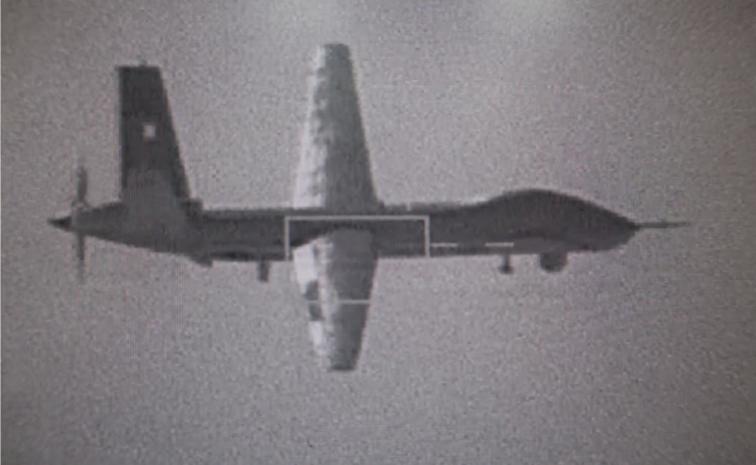
Taiwanese F-16V fighter jet monitors a Chinese CH-4 reconnaissance drone. (Photo provided by Taiwan’s Ministry of National Defence / Dajiyuan)
[People News] On the 26th, the Washington-based think tank "New America Security Centre" published a report titled "Taiwan's Hellish Scenario: Rethinking Asymmetric Defence." The report, which exceeds 30 pages, offers a detailed analysis of the three critical stages that a potential war in the Taiwan Strait could evolve into, based on sophisticated military simulations. This report not only highlights the harsh realities of war but also sheds light on Beijing's specific military strategies.
According to the report, the conflict in the Taiwan Strait will commence with a "large-scale preparatory strike." Before launching a direct attack, Beijing is anticipated to initiate a coordinated assault that would sever Taiwan's digital networks, incapacitate satellite systems, and disrupt navigation signals. This strategy aims to incapacitate Taiwan's civilian infrastructure and military communication networks as quickly as possible, effectively isolating Taiwan.
Following this, the PLA will execute an unprecedented cross-domain saturation strike, which will involve thousands of airstrikes and missile attacks targeting Taiwan's aircraft, naval vessels, missile launch sites, radar installations, and command centres.
Once the first wave of strikes is completed, the conflict will enter its most challenging second phase: "Crossing the Sea and Amphibious Landing." Amphibious operations are considered one of the most complex military endeavours, as they necessitate the coordination of air, sea, and land forces and are heavily reliant on weather and sea conditions.
The report suggests that the People's Liberation Army (PLA) is likely to position large amphibious assault ships beyond the range of Taiwan's coastal defence firepower, opting instead to deploy smaller landing craft and helicopters for the final high-risk beachhead assault. Concurrently, the PLA is expected to engage in strategic deception by disseminating false information about the timing and location of the invasion.
More alarmingly, as the landing operation unfolds, the PLA's airborne forces may initiate a surprise attack aimed at executing a 'decapitation' strike against government institutions in Taipei. They will attempt to capture airports and control critical terrain, thereby hindering Taiwan's coastal defence forces from the rear and aiding the landing troops in breaching the beachhead.
Once the PLA establishes a foothold on the beach, the conflict will transition into its final and most unpredictable phase: 'Advancing towards Taipei and maintaining supply.'
The report emphasises that even if the PLA gains a foothold in Taiwan, the path to Taipei will be fraught with challenges. The PLA will have to navigate through rugged mountain passes, cross numerous rivers, and fight their way through densely populated urban areas.
Additionally, supply lines will be pivotal in determining the outcome of the conflict. Consequently, the PLA will be heavily dependent on a reliable and continuous maritime transport network. The report highlights that Beijing has already planned to mobilise civilian vessels to enhance military shipping capabilities, ensuring that frontline troops do not falter due to supply interruptions.
This simulation from the Centre for a New American Security (CNAS), titled 'Hellscape,' serves as a crucial reminder to all stakeholders: in the face of such a comprehensive invasion threat, traditional military strategies may no longer be adequate, and 'asymmetric defence' will be essential for maintaining peace in the Taiwan Strait moving forward.
△








News magazine bootstrap themes!
I like this themes, fast loading and look profesional
Thank you Carlos!
You're welcome!
Please support me with give positive rating!
Yes Sure!