
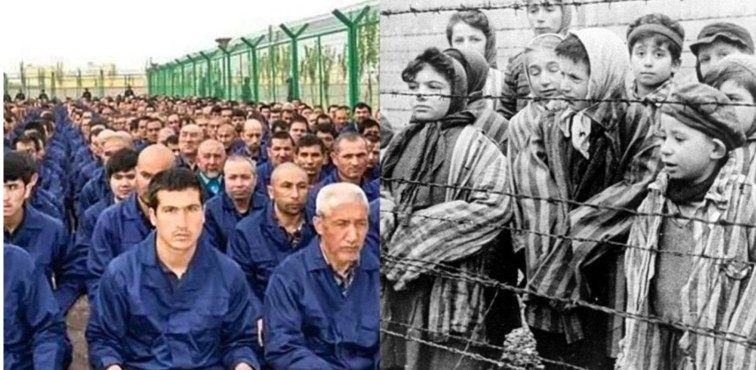
Former guards and imprisoned women from Xinjiang re-education camps have confirmed the existence of systematic rape and sexual abuse within the facilities. The image shows a composite of a Xinjiang re-education camp and a World War II Jewish concentration camp. Photo: Screenshot from the official website of the East Turkestan Government-in-Exile (file photo).
[People News] A Chinese police officer who previously served in Xinjiang defected at the renowned tourist site Neuschwanstein Castle in Germany. He then travelled to the World Uyghur Congress, based in Munich, to seek asylum in Germany. He provided extensive documentation from his time in Xinjiang, revealing the torture inflicted on detainees in Xinjiang prisons and disclosing how authorities monitor the daily lives of Uyghurs, which has garnered international attention.
According to a recent report by Deutsche Welle (DW), a Chinese tourist named Zhang Yabo went missing after defecting from his tour group at a famous tourist site in Germany last summer. He later appeared at the headquarters of the World Uyghur Congress in Munich, where he formally applied for political asylum in Germany.
Unveiling the Interrogation Trap After Serving a Sentence
Zhang Yabo, who was born and raised in Henan, has been living in Xinjiang for over a decade. From November 2014 to September 2023, he held various roles, including police officer at the Yutian County Detention Centre in Hotan Prefecture, village police in Yuruqi Village, police officer at the Rehabilitation Hospital in Hotan Prefecture, police officer for seasonal labour export in Shaya County, police officer at the Wuqikun Maidang Police Station in Han'erik Town, and police officer at the Hotan Prefecture Detention Centre. Throughout this time, he travelled to nearly 50 prisons across Xinjiang, responsible for escorting prisoners or retrieving individuals who had completed their sentences.
Zhang Yabo recalled that on a day in 2020, over 60 prisoners from Hotan County were released from the Aksu Shaya Prison in Xinjiang after completing their sentences. He, along with other police officers, transported a bus full of these released individuals to the entrance of the Hotan County National Security Team (Domestic Security Protection). The national security police were enthusiastic and immediately began re-interrogating these 'freed' Uyghurs, a process they referred to as 'digging deeper for clues.'
'At this point, the interrogation was essentially a guided 'fill-in-the-blank' exercise,' Zhang Yabo explained in an interview. 'As long as we could extract some 'new issue' from the interrogation, even if it was merely old matters that had been long forgotten, it could result in a 'second sentencing.'
He recalled that when the national security police encountered released Uyghur prisoners, "it felt even more intimate than meeting family." This is due to the fact that every police officer in Xinjiang suffers from "KPI (Key Performance Indicator) anxiety." Their KPIs are not measured by the number of cases solved, but rather by how many Uyghurs and other ethnic minorities they can imprison or re-imprison. The reasons for these imprisonments can be as trivial as praying once, singing a song, wearing a headscarf, watching a video, or even playing basketball, where even exercising can be viewed as a potential indicator of being a "violent terrorist" suspect. This leads to increased surveillance, followed by interrogation and torture, ultimately resulting in coerced confessions and imprisonment.
In order to escape persecution, Uyghur villagers "act crazy and pretend to be foolish."
In 2014, shortly after taking office, Xi Jinping delivered a series of internal speeches to officials in Xinjiang. Following these speeches, Xinjiang initiated a special operation known as the 'Severe Crackdown on Violent Terrorism' and a 'People's War on Terror', which resulted in the forced detention of Uyghurs in what are termed 'vocational skills training centres' by the authorities, but referred to as 're-education camps' or 'Xinjiang concentration camps' by international media.
From November 2017 to August 2018, Zhang Yabo served as a supervising police officer at a rehabilitation hospital in the Hotan region. This psychiatric hospital was effectively repurposed into a 'concentration camp', with the number of doctors, police, and 'patients' far exceeding typical levels.
Zhang Yabo explained that the Xinjiang 'concentration camps' are categorised into three levels based on the strictness of supervision: high, medium, and low. The psychiatric hospital where he worked was classified as the lowest level. Due to the need to transport 'patients' and 'trainees', he frequently moved between different levels of detention facilities and witnessed various forms of torture firsthand.
In response to media reports detailing the experiences of 'trainees', including beatings, solitary confinement, and rape, Zhang Yabo confirmed that torture and abuse 'are routine in the concentration camps'. He often heard the agonising screams of 'trainees' being tortured and even witnessed a female detainee being raped by a colleague during an interrogation.
Zhang Yabo mentioned that while he did not personally witness 'trainees' being beaten to death on the spot, he was aware of several cases where individuals died within days following torture. He stated that almost every week, someone dies in the 'concentration camps'.
He further disclosed that in Xinjiang, a significant number of Uyghurs and other ethnic minorities are arbitrarily labelled as mentally ill and subjected to forced detention and 'treatment.' Simultaneously, many individuals opt to 'act insane' or bribe doctors to impersonate mentally ill patients in order to avoid harsher torture, willingly entering the 'rehabilitation hospital' where Zhang Yabo is employed.
His Uyghur police colleague once informed him about those who were pretending, and he chose to overlook it. He understands that the price of this pretence is the daily consumption of powerful psychiatric drugs, stating that 'one can develop a mental illness even without being sick.'
The normalisation of repression behind 'graduation'
In December 2019, the U.S. House of Representatives passed the Uyghur Human Rights Policy Act. Concurrently, the European Parliament adopted a resolution strongly condemning Beijing's mass detentions of Uyghurs and Muslim minorities, urging the Chinese Communist Party to immediately cease arbitrary detentions and release those imprisoned, including Ilham Tohti, a laureate of the Sakharov Prize for Freedom of Thought.
In the same month, Shohrat Zakir, the Chairman of the Xinjiang Uyghur Autonomous Region, announced that all students at the education and training centres had graduated. The then Foreign Minister Wang Yi also declared that the students had all secured stable employment with government assistance.
However, observers believe that the repression in Xinjiang is far from over. Zhang Yabo estimates that approximately 40% of the adult population in his village has been detained. Following the closure of the re-education camps, nearly half of those released were imprisoned again for various reasons. Among those who completed their sentences, almost all faced short-term detention, and about one in ten received a second sentence. In every village he has encountered, Uyghurs are ensnared in a cycle of 'prison—detention center—prison.'
Weekly Submission of 'Suspected Terrorist Activity' Leads
In an interview, Zhang Yabo explained that grassroots police in Xinjiang are assigned weekly tasks requiring them to provide leads to their superiors. These leads must be substantial enough to justify the detention or sentencing of additional individuals to be deemed effective.
Zhang Yabo, who is well-acquainted with the local villagers, does not view the mild-mannered Uyghurs as terrorists. 'I have never feared these 'terrorists'; my fear stems from the scrutiny of my superiors,' he stated. He added that failing to meet expectations could lead to reprimands from leadership, loss of bonuses, and missed opportunities for promotions and vacations. He and his wife, who works in the same region, often see each other only once a month.
The pressure from KPIs on grassroots police is immense, yet not all officers perform poorly. Zhang Yabo noted that those national security officers tasked with 'digging deep for leads' often drive luxury cars, use the latest smartphones, and reside in the most opulent homes in the county. Behind this lavish lifestyle lies the grim reality of countless Uyghurs who, having just been released from prison, find themselves once again trapped in a cycle of interrogation, torture, and coerced confessions.
Those who were not immediately sent back to prison also faced challenging circumstances. After returning to their jurisdiction, they were required to attend a homecoming 'meeting' and queue for short-term detention. This was followed by strict and normalised control measures: daily meetings, weekly discussions, monthly evaluations, quarterly assessments, and annual summaries.
Conscience Condemned, Choosing to Flee
As time went on, Zhang Yabo began to question the system. Influenced by work pressure and internal conflict, he resigned in 2023, citing family and health reasons, and signed a confidentiality agreement. After leaving the system, he relocated to a southern city to work as a barber and became involved with the Christian faith.
Before his escape, he had already separated from his wife, sold his assets to raise funds, and arranged his departure through a travel agency, with the entire trip costing approximately 35,000 yuan.
In August 2025, he travelled to Europe with his son, who was in middle school. Before leaving, he specifically reminded his son to 'take a photo with mom,' while his family was completely unaware of his plans. During a visit to Neuschwanstein Castle, he cleverly used the terrain and crowds to evade the tour guide's attention and successfully led his son away from the group.
When the World Uyghur Congress asked about his motivation for speaking out, Zhang Yabo presented his baptism certificate and firmly stated: 'I am a Christian, and I will have to answer to Jesus after I die.' He emphasised: 'If one day I am asked what I did about the injustices there, at least I can say: I spoke the truth.'
Zhang Yabo has now officially applied for political asylum in Germany.
△







News magazine bootstrap themes!
I like this themes, fast loading and look profesional
Thank you Carlos!
You're welcome!
Please support me with give positive rating!
Yes Sure!