
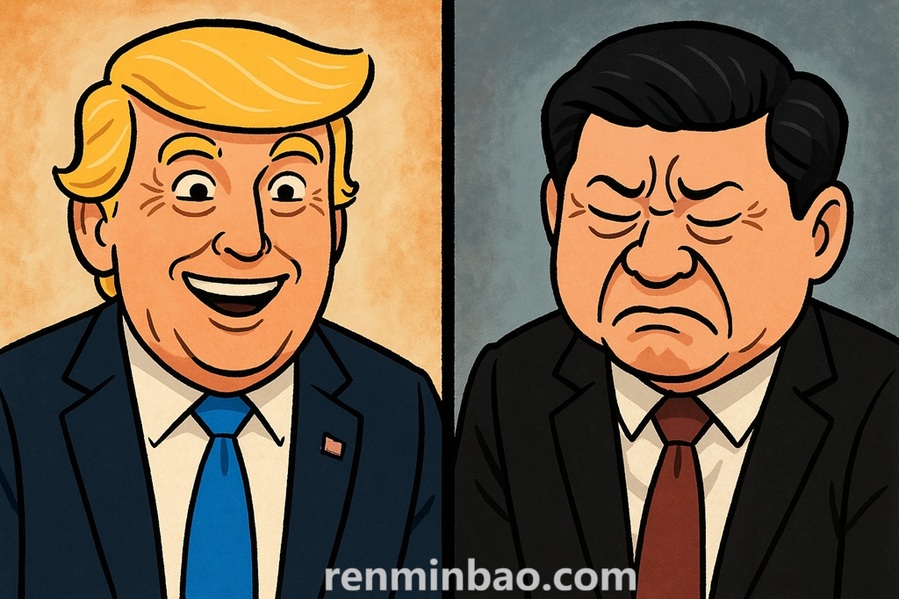
Trump has launched heavy blows against Venezuela and Iran without leaving the Chinese Communist Party any face at all. This has shaken the Chinese Communist Party’s image as the leader of the “little brother” countries, and Xi Jinping is like a mute person swallowing bitter herbs, suffering but unable to speak.
[People News] The U.S.-Israel military action “Epic Fury” is delivering devastating, crushing blows against Iran. The core institutions of the Iranian regime have been hit hard one after another, causing breaks in the chain of command and serious difficulties in military coordination. A U.S. Department of Defense report shows that the U.S. military has destroyed more than 20 Iranian naval vessels and submarines, achieved complete control of Iranian airspace, and struck more than 2,000 targets, including missile launchers, drone facilities, and command centers.
With overwhelming superiority, the U.S. military has rapidly established dominance in the air and at sea, and the doomsday of Iran’s current regime is near. At this moment, global attention and public opinion have, without prior coordination, focused on the great helmsman of the East and Iran’s backstage boss, Xi Jinping. The permanent removal of Khamenei, for the Chinese Communist Party, is not some distant butterfly effect, but an earth-splitting, mountain-shaking collapse right before its eyes.
The collapse of Iran’s mullah regime will deliver severe shocks and far-reaching effects to the Chinese Communist Party’s energy security, economic lifeline, geopolitical and diplomatic position, as well as to the political authority of the Xi-style dictator.
Oil cut off
With the Strait of Hormuz changing hands, the Chinese Communist Party’s oil and energy security is flashing red, and Xi Jinping’s strategy of prying loose the petrodollar settlement system has ended in ruin.
A Fox News report on March 4, 2026, pointed out that the United States has destroyed the main strength of Iran’s navy, resulting in the fact that “there is not a single Iranian ship sailing in the Arabian Gulf, the Strait of Hormuz, or the Gulf of Oman.” White House Press Secretary Karoline Leavitt emphasized that the United States has “eliminated the Iranian regime’s navy,” which means that Iran has already lost actual control over the Strait of Hormuz.
The Strait of Hormuz carries about 20% of the world’s oil transportation volume, with an average of more than 20 million barrels of crude oil passing through it every day. As the world’s largest oil importer, the Chinese Communist Party imported 11.6 million barrels of crude oil per day in 2025, of which the Middle East accounted for about 40% to 50%, and Iran supplied about 13% to 14%, or about 1.38 million barrels per day. If the United States controls the Strait of Hormuz, the Chinese Communist Party will face the risk of having its supply strangled at any time.
China’s strategic oil reserves cover only about 90 days of demand. If Iranian oil is lost, the Chinese Communist Party may be forced to turn to supply chains in Russia, Africa, or South America, but these may not be able to fully make up the difference. On top of that, logistics costs and sanction risks will push mainland oil prices upward, and the stock prices of the three major oil companies inside the Great Firewall have recently hit the daily limit multiple times. For every 10-dollar rise in oil prices, China’s GDP may fall by 0.1% to 0.2%, which, for the Chinese Communist Party’s counter-cyclical economy, is undoubtedly making a bad situation worse. Transportation in China, along with the prices of related manufactured products, will rise.
In addition, with the loss of Iran as an oil source, the oil-renminbi settlement system that relies on Iran as a key partner will move toward termination, and the Chinese Communist Party’s strategy of challenging the petrodollar system will be declared bankrupt.
Money gone
The Chinese Communist Party’s Belt and Road investments in Iran are going down the drain; telecommunications, infrastructure, railways, and other projects are collapsing unfinished, and AI giants such as Huawei and ZTE are facing huge investment risks.
The collapse of the Iranian regime means that China’s Belt and Road projects in Iran face major losses. Since 2013, under the Belt and Road framework, China has invested more than 1.3 trillion U.S. dollars in total, including 775 billion dollars in construction contracts and 533 billion dollars in non-financial investment. In 2021, under Xi Jinping’s personal direction, China and Iran signed a 25-year “Comprehensive Strategic Partnership Agreement,” under which China promised to invest 300 to 400 billion U.S. dollars in oil, finance, and telecommunications. Once the regime collapses, those projects will rapidly become unfinished ruins, just as happened in Venezuela, and the money could disappear in a matter of minutes.
As early as more than ten years ago, Chinese Communist Party companies Huawei and ZTE signed telecommunications infrastructure contracts worth hundreds of millions of dollars with Iran, taking responsibility for providing the Iranian authorities with surveillance systems and tools for public opinion censorship. In recent years, Hikvision’s AI facial-recognition surveillance cameras have entered Iran and been used by the authorities as a weapon for maintaining stability. These vast investments now face enormous risks and may vanish because of regime change and U.S. sanctions.
The broader effect lies in the break in the Chinese Communist Party’s westward Belt and Road line. The China-Iran railway, Chabahar Port, and the international transport corridor, as key nodes linking Central Asia, West Asia, Europe, and Africa, will, after the fall of Iran’s current regime, be locked down by the United States, causing damage to these projects. In 2025, the Chinese Communist Party’s newly signed Belt and Road contracts reached 213.5 billion U.S. dollars. Once Iran-related investments are wiped out, this will produce negative stress effects, and the risks to the China-Pakistan Economic Corridor and China-Europe freight rail services will rise. As the Chinese Communist Party’s westward investment chain is cut in half, potential losses may reach tens of billions of dollars. In addition, as pro-American countries such as Saudi Arabia and the United Arab Emirates turn toward strengthening energy cooperation with the United States, the Chinese Communist Party’s investment layout in the Middle East will shrink sharply.
The whole scene is in chaos
Iran is an important strategic chess piece for the Chinese Communist Party in containing the United States in the Middle East, and also a core strategic asset in its push for global hegemony. It is also a hard card the Chinese Communist Party seeks to play in U.S.-China competition. This time, it has been smashed completely.
As the Chinese Communist Party’s key strategic partner in the Middle East, Iran’s collapse destroys Beijing’s balance for checking the United States. The Chinese Communist Party regards Iran as a strategic-depth asset in confronting U.S. hegemony, maintaining influence through energy cooperation, technology transfer, and military integration. Once Iran is lost, the Chinese Communist Party will be like a power that has lost its shield against the United States. The United States will then concentrate its strategic resources toward the India-Taiwan region. This is a key part of America’s restoration of dominance in Asia, and also a solid step toward its goal of reshaping the global geopolitical order. What follows is that the Chinese Communist Party’s room for maneuver on the core political issue of Taiwan will face a severe challenge, and the negotiating space around Taiwan as a core political interest will shrink.
Trump has successively carried out surgical strikes on key points in the Chinese Communist Party’s global layout, including the Panama Canal, Venezuela, and Iran. This is equivalent to trimming Xi Jinping’s skirt hem on the international political stage, systematically dismantling the Chinese Communist Party’s global deployment. The grand narrative of the Chinese Communist Party’s “community with a shared future for mankind” is on the verge of bankruptcy; Xi Jinping’s communist ambitions and schemes for global governance are close to overturning completely. “The East rises and the West declines” has wonderfully turned into “the East sinks and the West soars.” Trump’s continuous combination punches have thoroughly thrown Xi Jinping’s global hegemony strategy into disarray.
Face smashed
There is a Chinese saying: when beating a dog, look at its master. Trump has launched heavy blows against Venezuela and Iran without leaving the Chinese Communist Party any face at all. This has shaken the Chinese Communist Party’s image as the leader of the “little brother” countries, and Xi Jinping is like a mute person swallowing bitter herbs, suffering but unable to speak.
The Chinese Communist Party Ministry of Foreign Affairs can only issue empty official rhetoric and diplomatic formulae. Beijing can do no more than shout a few loud slogans at the United Nations. Other than that, Xi Jinping dares to do nothing and can do nothing. The advanced air defense systems shipped to Venezuela and Iran turned out to be useless, becoming nothing more than piles of high-tech scrap metal.
How are all those “little brother” countries that regard the Chinese Communist Party as their big brother supposed to think about this? Can Xi Jinping, this so-called big brother, still keep up appearances? It seems Xi Jinping can only act fierce at home while carrying a gun like a rat, or else engage in political infighting and arrest generals, or carry out stability maintenance and arrest petitioners. Every year, he spends trillions of renminbi on military expenditures, and the number of spies stationed in various countries is greater than locusts, yet none of it has any effect at all. Every day he incites the people to oppose America, oppose America, but the moment Trump shows a little force, Xi Jinping falls silent, wets his pants, and does not dare to strike back at all. Where can all this lost face, inside and out, possibly be put? He can only bury his head in work on self-revolution and arrest people across the officialdom without a single blind spot!
The downfall of Iran’s theocratic ruler Khamenei constitutes a systemic challenge to the Chinese Communist Party. It reflects the fragility of the regime’s path of external dependence and highlights the investment failure and strategic mistakes in Xi Jinping’s global planning.
Xi Jinping is finished, and panicking. Could it be that the “yellow lantern effect” in Beijing from some days ago has started showing its power? A prediction for China’s character of the year in 2026: yellow — the yellow of being finished.
(First published by People News) △




News magazine bootstrap themes!
I like this themes, fast loading and look profesional
Thank you Carlos!
You're welcome!
Please support me with give positive rating!
Yes Sure!