

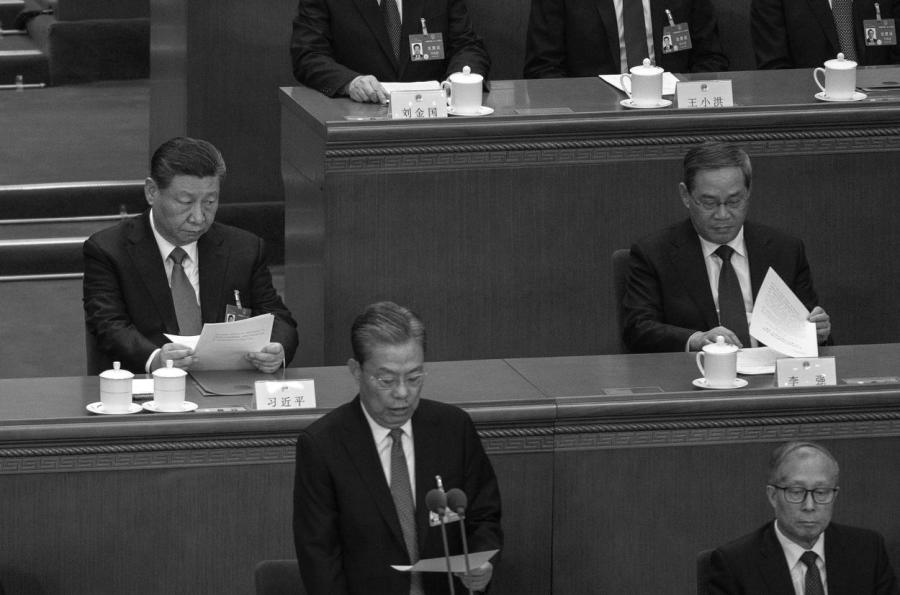
The Chinese Communist Party (CCP) is deeply mired in debt, with its money-grabbing efforts continuing unabated. Its collapse may not be far off. (Jeff Nenarella/Dajiyuan)
[People News] Current affairs commentator Hong Yaonan published an article on Newtalk on March 5: the fiscal data in Chinese Communist Party Premier Li Qiang’s government work report show that China’s debt is increasing year by year, and that it is very clearly shifting from a “growth-type state” to a “debt-type state.” He raises the question: when new debt can no longer generate new growth, how will the economy adjust? When an empire begins to rely on debt to maintain stability, how much longer can it last?
Hong Yaonan points out in the article: in recent years, Li Qiang’s government work reports have still maintained the familiar narrative rhythm of “stabilizing growth, stabilizing employment, stabilizing expectations.” However, if one spreads out the fiscal data year by year, a clear trend emerges — China’s model of economic governance is gradually shifting from a “growth-type state” to a “debt-type state.”
He lists the Chinese Communist Party’s debt situation over the past three years: in 2023, China’s fiscal deficit ratio remained at 3%, and local special-purpose bonds totaled 3.8 trillion yuan. In 2024, the deficit ratio was still 3%, but the deficit规模 had already reached 4.06 trillion yuan, local special-purpose bonds were raised to 3.9 trillion yuan, and for the first time 1 trillion yuan in “ultra-long-term special government bonds” was introduced. By 2025, Beijing formally raised the deficit ratio to “around 4%,” the deficit规模 expanded to 5.66 trillion yuan, local special-purpose bonds reached 4.4 trillion yuan, ultra-long-term special government bonds were 1.3 trillion yuan, and 500 billion yuan in special government bonds was issued to replenish capital for large banks. In 2026, this pattern is still continuing: a deficit of 5.89 trillion yuan, local special-purpose bonds of 4.4 trillion yuan, ultra-long-term special government bonds of 1.3 trillion yuan, plus another 300 billion yuan in special government bonds.
Hong Yaonan analyzes that when fiscal deficits and the scale of government borrowing continue to rise, while economic growth keeps slowing, this indicates that government spending is gradually replacing market momentum and becoming an important force in sustaining growth. In other words, the Chinese government is using debt to support the growth momentum that should originally have been created by the market.
For a long time, Beijing has emphasized the fiscal discipline of “keeping the deficit ratio below 3%.” But when the deficit ratio is officially raised to around 4%, it means that the role of government finance in economic governance is expanding. When the demographic dividend weakens, the real estate market adjusts, and investment efficiency declines, fiscal spending then becomes an important tool for maintaining growth. As a result, the economy may fall into a cycle: rising debt → declining stimulus effect → need for even greater debt. This is precisely a typical phenomenon that many countries have experienced before entering long-term economic stagnation.
Hong Yaonan believes that China’s economic miracle of the past two decades was, to a large extent, built on a simple formula: infrastructure investment + real estate + credit expansion = GDP growth. This model once drove rapid development, but it is now simultaneously facing three structural constraints: the population has begun to decline, the real estate market is falling, and the marginal returns on investment are declining. When these three factors appear at the same time, debt gradually shifts from a “development tool” to a “stability tool.” To some extent, China is using debt to buy time for economic transformation. However, under the Chinese Communist Party’s governance model of highly centralized decision-making, the promotion of local officials is still closely tied to investment and GDP growth. As a result, borrowing often becomes the most direct and easiest policy tool for creating political achievements. When this cycle continues for many years, debt is no longer merely a policy option, but gradually evolves into institutional inertia.
Hong Yaonan points out that when the economy slows, it needs more debt to keep operating; when debt increases, it in turn needs more growth to cover up the risks. In the short term, Beijing can still rely on state credit, financial controls, and a high savings rate to maintain stability. But in the long run, an economy that relies on debt to sustain growth must eventually face the same question: when new debt can no longer generate new growth, how will the economy adjust? But when an empire begins to rely on debt to maintain stability, how much longer can it last? △







News magazine bootstrap themes!
I like this themes, fast loading and look profesional
Thank you Carlos!
You're welcome!
Please support me with give positive rating!
Yes Sure!