
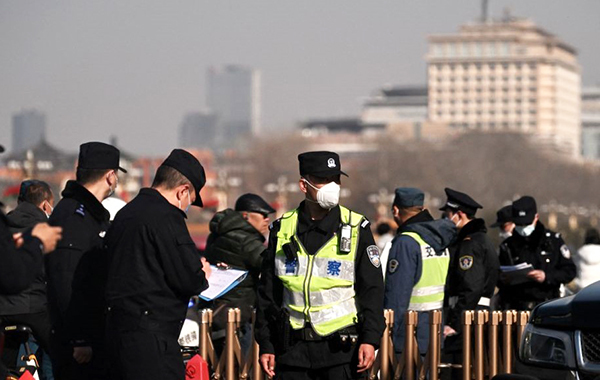
Before the CCP's Two Sessions convened, Beijing police conducted inspections at Tiananmen Square.
[People News] The most talked-about topic in Beijing these days is undoubtedly the "Two Sessions." On March 4th, Tiananmen Square was under tight security as China officially entered its annual week of political significance. You might wonder what’s so captivating about these routine meetings. Isn’t it just a group of so-called representatives sitting together, raising their hands, and going through the motions? However, the 2026 Two Sessions promise to be quite theatrical.
According to official announcements from the Chinese Communist Party (CCP), the 14th National Committee of the Chinese People's Political Consultative Conference (CPPCC) will commence at 3 PM on March 4th and conclude at 11 AM on March 11th, spanning 7 days. The 14th National People's Congress (NPC) will begin on March 5th and wrap up at 3 PM on March 12th, lasting for 8 days.
As per the official agenda, the "Two Sessions" will address the government work report and the draft outline of the 15th Five-Year Plan for national economic and social development.
Is China’s economy following Xi’s path? Li Qiang’s challenging performance
The primary concern for observers is the economic agenda. Premier Li Qiang is set to deliver the government work report at the NPC, which presents a significant challenge for him. It is anticipated that Li Qiang will announce the economic growth target for 2026, with experts predicting it will be set between 4.5% and 5%.
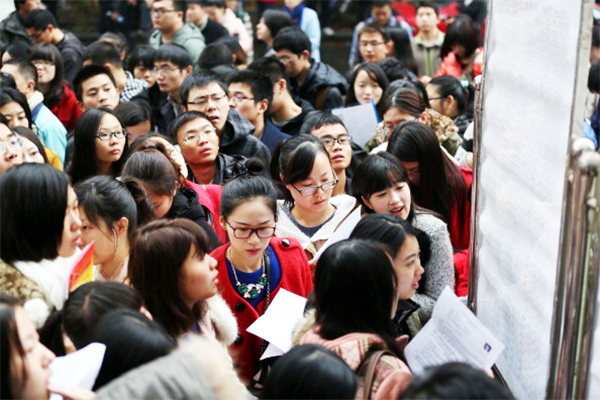
While the CCP government asserts that last year’s GDP growth met the expected 5%, public sentiment indicates a noticeable disconnect. The real estate market remains stagnant, and young people continue to struggle in their job searches.
It is widely recognised that the Chinese Communist Party (CCP) can adjust economic data at any time to ensure political stability. Liu Jieyi, spokesperson for the Chinese People's Political Consultative Conference, acknowledged at a press conference on the 3rd that the Chinese economy is currently 'pressing forward under pressure.'
The '14th Five-Year Plan,' which is set to be finalised during this year's Two Sessions, represents a strategy devised by Beijing to transition the economy from its previous reliance on 'borrowing money to build houses and engage in construction' to a more focused approach on 'high technology and innovation-driven' growth.
However, the challenge lies in the fact that when people lack confidence in the future and prefer to save rather than spend, can a sole reliance on high-tech research and development genuinely support the livelihoods of ordinary citizens? Zeng Ruisheng, director of the China Institute at the School of Oriental and African Studies, University of London, frankly stated in an interview with Radio France Internationale that the current policies appear to continue reinforcing the 'Xi Jinping line,' which may struggle to address the underlying issues of weak household consumption.
At present, China is grappling with several pressures, including a sluggish real estate market, high youth unemployment, significant local government debt, and deflation. The latest official data indicates that manufacturing activity contracted more than expected in February, suggesting that the economic recovery remains fragile.
Despite the economic slowdown, military spending is projected to continue its growth. Analysts predict that this year's defence budget increase will be consistent with previous years, slightly exceeding 7%. For Beijing, military expenditure is not solely about preparing for conflict; it is also about 'maintaining power.'
Is the absence of 'actors' on the podium indicative of missing individuals?
Beyond economic issues, the personnel changes at the Two Sessions have also garnered considerable attention. During the opening ceremony of the Chinese People's Political Consultative Conference (CPPCC) on the 4th, the notable 'absence' on the podium became a focal point for media from various countries. Out of the 23 members of the Politburo, 21 were present, with the absentees being Zhang Youxia, the Vice Chairman of the Central Military Commission, who has been under investigation since January, and Ma Xingrui, the former Secretary of the Xinjiang Party Committee, who has not been seen in public since last October.
In fact, the reduction in representatives ahead of this year's Two Sessions has been described as 'the most severe since the Cultural Revolution.'
The 14th National People's Congress (NPC) initially had 2,977 representatives, but now only 2,878 remain, marking a decrease of 99. The military representatives have experienced the most significant cuts; according to incomplete statistics, approximately 36 military representatives have been dismissed over the past two years. The 14th National Committee of the CPPCC originally had 2,169 members, and there are currently around 2,100 members.
Khamenei and Trump Create Turmoil in Zhongnanhai
Just days before the opening of the Two Sessions, Xi Jinping's close friend Khamenei passed away, which was a significant shock for Beijing. More than 90% of Iran's oil is sold to China, and the two nations have a $400 billion cooperation plan in place.
Now, with Iran's political situation in disarray, China's energy supply faces potential threats. More critically, Beijing's leadership is particularly concerned about the precedent of the U.S. 'targeted elimination' and fears that anti-government protests in Iran could trigger a chain reaction affecting the domestic population.
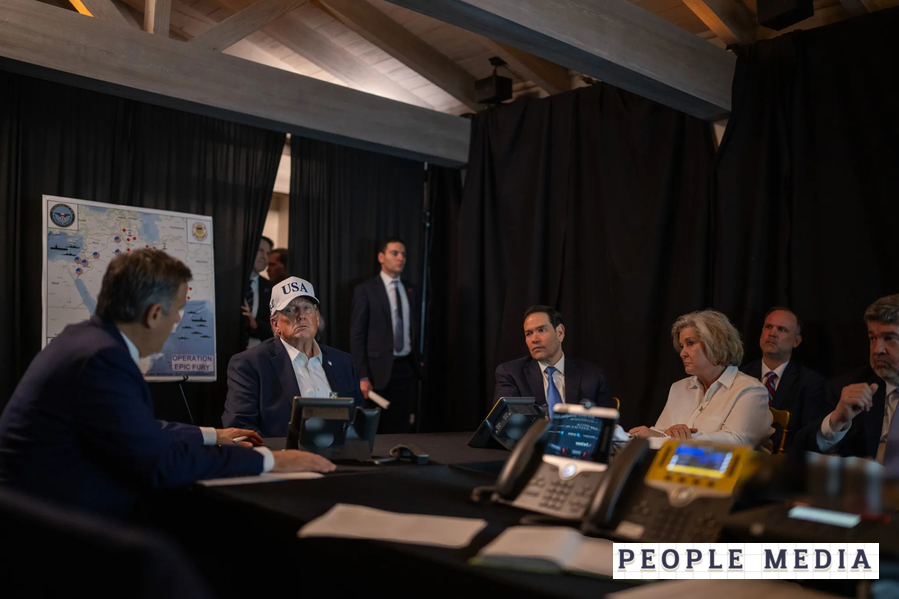
Meanwhile, Sino-U.S. relations continue to be fragile. U.S. President Trump, who eliminated Xi Jinping's close friend Khamenei, is expected to visit Beijing in early April. The expression Xi Jinping will wear when greeting Trump, who has taken out his friend, will certainly be a major test of his acting skills. While he is clearly filled with resentment, he must still present a smiling face. Despite his fear of becoming the next target of the U.S. military, he has no choice but to muster the courage to exchange pleasantries with Trump.
To understand why AFP describes the Two Sessions as a "highly ceremonial event with almost no room for improvisation," one must consider this scene: Chinese actor Jin Dong, who portrayed Xi Jinping's father Xi Zhongxun, and martial arts star Donnie Yen were surrounded by media as they entered the venue, quickly becoming the most popular members of the Chinese People's Political Consultative Conference. This illustrates that the Two Sessions serve merely as a rubber stamp for the decisions of the Chinese Communist Party and will not address the livelihood challenges faced by ordinary citizens.
(People News first published)
△





News magazine bootstrap themes!
I like this themes, fast loading and look profesional
Thank you Carlos!
You're welcome!
Please support me with give positive rating!
Yes Sure!