

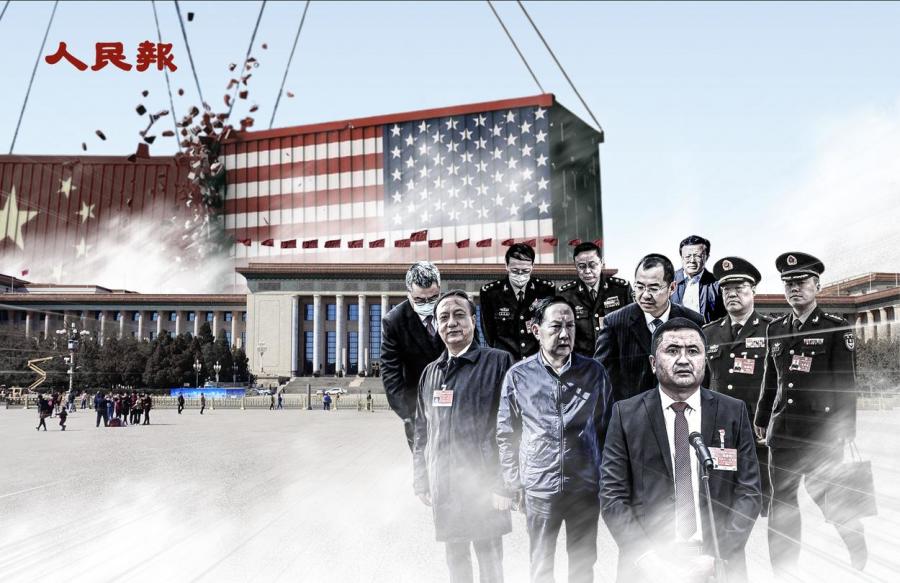
The image depicts Beijing's Tiananmen Square. (Lintao Zhang/Getty Images)
[People News] Recently, renowned mainland actress Yao Chen announced on Weibo that she has been divorced for several years. Initially, this was merely a straightforward disclosure of a celebrity's private life, simply put, accompanied by the two words that have become popular in recent years—' official announcement.' Just a few days after the news broke, a certain state media outlet felt compelled to respond, publishing a scathing commentary that specifically criticised Yao Chen, asserting that divorce is a private matter and should not be labelled as an 'official announcement,' a term that carries authoritative and governmental implications.
Why, in the midst of international issues and economic fluctuations, is a national-level state media outlet so concerned with the 'wording' of a celebrity's divorce? What is really at stake here? Is it a battle over the interpretation of a term, or is it about the attention that celebrities have drawn away?
On March 16, Yao Chen revealed on Weibo that she had been divorced from photographer Cao Yu for many years. Following this announcement, the news, tagged with the term 'official announcement,' quickly climbed to the trending topics, and by March 24, the related discussions had garnered an impressive 300 million views.
On March 23, the opinion section of People’s Daily, 'People’s Daily Three Reviews,' unexpectedly published a fiery article titled 'One of the So-Called Official Announcements: Self-Disclosure of Private Matters, How Can It Be “Unintentional”!'
The article launched a fierce critique of the entertainment industry, arguing that when celebrities announce their divorces or marriages on Weibo and label it as an 'official announcement,' it constitutes 'self-disclosure of private matters, taking up public resources.' It further claimed that the term 'official announcement' holds authoritative weight and should not be used lightly. The article also contended that these celebrities are packaging their private lives as public events to 'harvest traffic,' which severely disrupts the normal flow of information dissemination.
Following the publication of this commentary, it not only triggered reprints within China but also garnered attention from international media. What makes this commentary so significant?
The Opinion Channel is a dedicated section of People’s Daily Online for publishing authoritative commentaries and guiding articles. Additionally, the 'People’s Daily Online Three Reviews' is a flagship commentary column that typically releases three in-depth reviews on trending social issues, signalling an official stance and a call for rectification. The article's author is identified as a 'Special Commentator of this website,' which usually indicates that the piece has been collectively discussed and approved by the editorial team. Moreover, the inclusion of 'one of' in the title suggests that there will be subsequent parts, 'two of' and 'three of,' which will continue to critique this online phenomenon from various perspectives.
Thus, it can be expected that the release of such articles often indicates that a particular industry or phenomenon is about to undergo 'rectification.' This time, the focus of criticism is directed at the term 'official announcement.'
Interestingly, the official reasoning is as follows: if you are announcing the completion of a significant project, a satellite launch, or a grand narrative of 'positive energy,' then using these two words is seen as solemn and authoritative. However, if you are merely getting a divorce or starting a relationship, then you lack the level to use this term.
First, we need to set the record straight. Official media now claim that 'official announcement' signifies authority and the official position, implying that celebrities are unworthy of using it. This reasoning is akin to 'the crow occupying the magpie's nest.'
Let's reflect on how the term 'official announcement' became a sensation in 2018. It was coined during the marriage of mainland stars Zhao Liying and Feng Shaofeng. Prior to that, had this term ever appeared in government documents? Hardly. It emerged as a form of self-deprecation from grassroots internet culture and the entertainment industry, aimed at countering gossip media, meaning: 'Don't listen to rumours; hear the real news directly from the person involved.'
This is a typical folk expression. And what is the situation now? The authorities have noticed the term's popularity and utility, and they want to 'nationalise' it. It's akin to the common people nurturing a robust tree, only for officials to come along and declare: 'This tree has grown too splendidly; only I can enjoy its shade, and you commoners are not allowed to approach.'
Yao Chen simply utilised this tool that everyone was using, yet she was told, 'This now belongs to the public; you commoners cannot engage with it.' In the eyes of some, anything labelled with 'official' becomes a power taboo. If the common people can also casually make 'official announcements', what sanctity remains in the content released by the government?
So, what exactly constitutes a public resource?
In today's social media landscape, the trending topics list is the largest public resource. Official media believe that the public should focus on grand narratives. However, the reality is stark; when the government issues a formal announcement, it often goes unnoticed, while a celebrity's divorce can garner millions of likes.
Why do ordinary people show little interest in certain 'serious news' and instead gravitate towards celebrity gossip? Is it truly that they lack aspirations? What is the underlying truth?
When Yao Chen officially announced her divorce, the comment section was open for everyone. People could offer their blessings, make sarcastic comments, or analyse the reasons behind the announcement. In that environment, the public felt a sense of engagement; it felt like we were having a conversation with a 'real person.'
However, take a look at the comments under some 'genuine official announcements.' What do you find? Either there are 'selected comments' or the comment section is completely closed. The general public is not naive. One platform allows for interactive communication, while another only permits respectful acknowledgement without dissent. In one space, I am an active participant; in another, I am merely a passive recipient of information. Naturally, my attention will be drawn to the space that offers more freedom.
The authorities now aim to reclaim a narrative by suppressing celebrities like Yao Chen, attempting to pull everyone's focus 'back.' However, if the space you provide remains cold and unquestionable, then even if you manage to reclaim thousands of terms, you cannot restore the desire for equal communication.
In summarising this 'three evaluations by the People's Daily,' we observe not a love for language, but rather an anxiety over the loss of control of public opinion.
The authorities have realised that even with the most powerful media apparatus, their ability to attract followers is still less effective than that of a female star. Thus, they opt to target 'soft targets'—criticising Yao Chen poses no risk, and reclaiming vocabulary is also easily within reach.
Yao Chen has been caught in the crossfire, but the real casualties are our individual spaces for expression.
(First published by People News)
△




News magazine bootstrap themes!
I like this themes, fast loading and look profesional
Thank you Carlos!
You're welcome!
Please support me with give positive rating!
Yes Sure!