

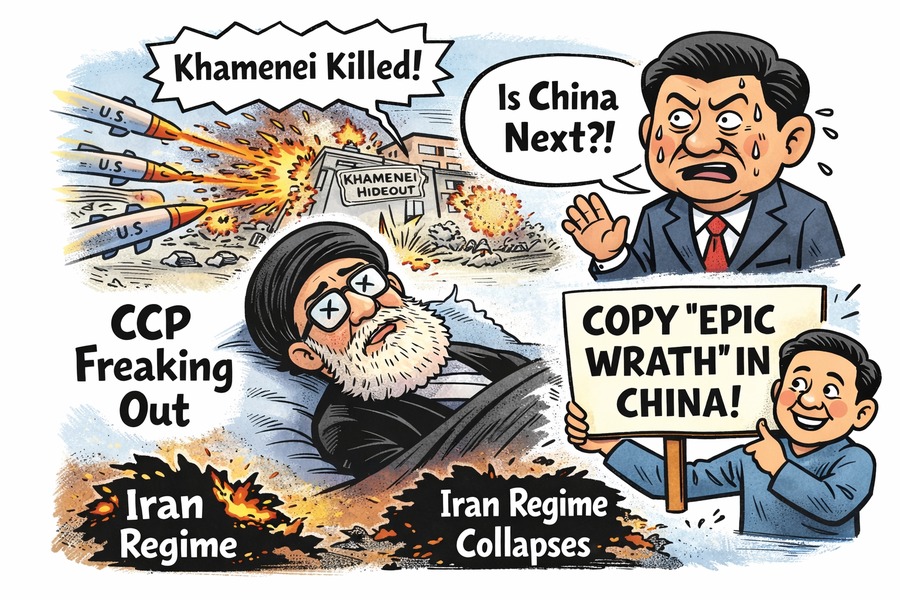
Corruption within the Chinese Communist Party is rampant, with personnel exceeding their necessary roles, resulting in weapons that appear impressive but are ineffective. (People News/AI-generated image)
[People News] Many international military analysts have characterised Chinese-made weapons with the phrase: "powerful on paper, fragile in actual combat." This was particularly highlighted by the incident involving former Venezuelan President Maduro, who was captured by U.S. forces, which exposed the ineffective performance of Chinese-made air defence systems, causing significant embarrassment for the Chinese Communist Party. Observers believe that the ongoing purges within the military have extended from the Rocket Force to the Equipment Development Department of the Central Military Commission and various major military-industrial groups, resulting in the downfall of many high-ranking generals and technical experts. This situation is closely tied to the damaged reputation of Chinese-made weapons, which has infuriated Communist Party leader Xi Jinping.
Chinese weapons are described as "strong on the outside but weak on the inside."
The term "powerful on paper" refers to the specifications of Chinese weapons as presented in promotional brochures, including range, radar detection capabilities, and missile speed. The Chinese Communist Party often claims that its weapons can compete with or even exceed the advanced equipment of the U.S. and Russia, all while being priced significantly lower than their American and Russian counterparts.
Conversely, "fragility in actual combat" highlights the high failure rates, system incompatibility, and inadequate material strength that Chinese weapons frequently demonstrate in real battlefield conditions, such as extreme weather, strong electronic interference, and prolonged high-intensity operations, which can lead to a rapid breakdown in combat effectiveness.
As the 2026 corruption scandal within the Chinese military-industrial complex reveals numerous cases of falsified research and development data and misappropriated funds, the phrase 'strong in data, fragile in real combat' has come to be viewed as a direct critique of the 'externally strong but internally weak' phenomenon in China's military modernisation.
The subpar quality of weapons has caused embarrassment for the party leader.
According to a report from New Head Shell, several posts related to the performance of Chinese arms sales during the Middle Eastern conflict have recently emerged on the social media platform X. These include rumors regarding the combat effectiveness of the Chinese export anti-ship missile CM-302 (Yingji-12E) and the Hongqi-9B air defense system, which have drawn the attention of military analysts and netizens alike. However, most of this information lacks confirmation from official or independent sources, and its authenticity requires further verification.
The X account YiFeng Su noted that these air defence systems supplied by China to Iran were destroyed by U.S. forces within hours of the conflict's onset, leading to the deaths of many Chinese technicians and experts operating the systems. Xi Jinping was reportedly furious about this, detaining numerous academicians and project leaders involved in military engineering, believing they had deceived the party, embezzled substantial funds, and produced a range of substandard equipment. However, this information has not been confirmed by official sources of the Chinese Communist Party.
According to an article shared by @Freedominc20631, Reuters has reported that Iran utilised the Chinese export variant of the CM-302 anti-ship missile to strike targets, but failed to achieve any hits, which has raised questions about the missile's effectiveness. The CM-302 is believed to be the export version of China's YJ-12E anti-ship missile, designed for supersonic penetration and low-altitude flight capabilities, which theoretically could significantly reduce the air defence response time for naval vessels.
Experts note that modern anti-ship missiles typically use composite guidance systems, which include satellite navigation and terminal active radar guidance, rather than the so-called 'blind flight after launch.' However, without early warning aircraft, drones, or satellite data links to provide real-time target coordinates, even advanced missiles may lose lock due to target movement. Additionally, if the target is equipped with a comprehensive air defence system, such as the Aegis combat system and SM-6 missiles used by U.S. naval vessels, supersonic missiles could still be intercepted. Electronic warfare and decoy missiles may also divert the missile's guidance system away from its intended target.
In a separate development, the X account @sam51824016070 claimed that Beijing supplied Iran with three sets of HQ-9B air defence missile systems, which were reportedly destroyed by U.S. forces within hours of the conflict starting, along with reports of casualties among Chinese technicians and anger from Chinese leadership. However, these assertions are currently based on unverified information circulating online and have not been confirmed by official or independent sources.
Reports suggest that the Chinese Communist Party (CCP) has consistently denied exporting the Hongqi-9 series air defence systems to Iran. While foreign media have claimed that some of Iran's air defence systems were damaged in airstrikes, there is currently no satellite imagery, on-site photographs, or official statements from the United States that confirm the destruction of any Hongqi-9B systems. Additionally, there are no credible reports of casualties among Chinese technicians or of the Chinese government conducting internal investigations into military research personnel. △








News magazine bootstrap themes!
I like this themes, fast loading and look profesional
Thank you Carlos!
You're welcome!
Please support me with give positive rating!
Yes Sure!