

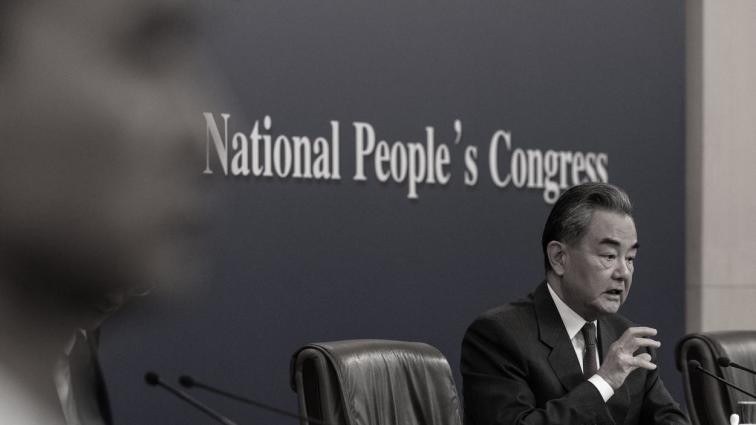
Photo Caption: The first session of the 14th National People's Congress will open on March 5, 2023, at the Great Hall of the People in Beijing, China. (Photo by Lintao Zhang/Getty Images)
[People News] On March 27, the Politburo of the Central Committee of the Communist Party of China convened a meeting primarily to review the "Regulations on the Work of Local Committees of the Communist Party of China" (hereinafter referred to as the "Regulations"). Reports indicate that the meeting also addressed other issues. According to overseas sources, these "other issues" involve personnel appointments, including the recently announced Secretary of the Ministry of Emergency Management, Zhang Chengzhong, and the yet-to-be-publicised Secretary of the Ministry of Foreign Affairs, who is reportedly Wang Yajun, the Chinese ambassador to North Korea.
In fact, the same regulations were previously reviewed at the Politburo meeting on December 14, 2015, suggesting that this current review is intended for amendments to the regulations. However, the Chinese Communist Party (CCP) has opted not to discuss this, possibly to avoid drawing too much external attention. What specific changes have been made?
It is noteworthy that during the 2015 discussion of these regulations, the CCP leadership did not attach significant importance to them, and they did not even make the headlines. The major news headline that year was "The Politburo of the Central Committee convenes a meeting to analyze and study the economic work for 2016 and to research and deploy urban work," which focused on economic issues, followed by the review and approval of these regulations along with the "Opinions on Establishing and Improving the Honorary Recognition System for Party and State Meritorious Contributions" and the "Decision on Implementing Comprehensive Two-Child Policy Reform to Improve Family Planning Service Management."
The news reports from that time also highlighted this point, with four paragraphs dedicated to economic and urban issues, while other topics were covered in single paragraphs. Concerning the 'Regulations' on the work of local committees of the Communist Party of China (CPC), the report noted that 'the local party committees at the provincial, municipal, and county levels serve as the leadership core of the region, playing a crucial role and bearing significant responsibilities in implementing the decisions and directives of the Party Central Committee...'.
The relative neglect of this issue over a decade ago sharply contrasts with the current Politburo meeting, which is primarily focused on this topic. This suggests that the performance and loyalty of local officials in executing central directives have left the party leader quite dissatisfied. Additionally, it indicates the party leader's intention to tighten control over local officials, imposing stricter constraints on them. What kind of constraints are we referring to?
First, let’s examine the old 'Regulations' that were fully published by the People's Daily on January 5, 2016. Article 14 states that the local committees of the CPC and their members must adhere to Marxism-Leninism and Mao Zedong Thought, and implement the spirit of Xi Jinping's series of speeches, among other directives. Article 15 specifies that local committees of the CPC must always maintain a high degree of consistency with the Party Central Committee in terms of ideology, politics, and actions, resolutely implement the decisions and directives of the Party Central Committee and the decisions of higher-level party organisations, and firmly uphold the authority of the Party Central Committee, among other stipulations.
The author speculates that the content revised at the recently convened Politburo meeting is likely related to this, as supported by reports from state media.
Reports suggest that the meeting emphasised, "Local party committees must firmly uphold the authority and centralised leadership of the Party Central Committee with Comrade Xi Jinping at its core, prioritising the implementation of the Party Central Committee's decisions and directives, and diligently ensuring that what the Party Central Committee has established is firmly adhered to..." This indicates that Article 15, or another article in the revised 'Regulations', has incorporated the term 'Xi Core', changing it to 'must always maintain a high degree of consistency in thought, politics, and action with the Party Central Committee led by Xi Jinping.'
This action clearly aims to reinforce the position of 'Xi as the sole leader', but it also suggests that if someone were to succeed the party leader in the future, the 'Regulations' would need to be amended again. The omission of the 'core' designation in the previous 'Regulations' may have been intended to prevent such changes.
It is clear that after Xi regained power by ousting Zhang Youxia and Liu Zhenli, alongside a significant purge of the military, he also signalled to local officials to pledge their loyalty, aiming to further consolidate his power.
In recent years, many have observed that numerous officials who have fallen from grace have been charged with 'making reckless comments about the central authority.' Indeed, due to the regressive policies of 'Xi Central', public dissatisfaction has grown, and officials across various regions are also expressing their grievances.
On February 6 of this year, Ni Qiang, the former secretary-general of the Hainan Provincial Committee of the Communist Party of China, was expelled from the Party and public office. It has been widely circulated online that Ni Qiang, after drinking, candidly remarked that the Hainan Free Trade Port, led by Xi, was destined to be a failed project, the second Xiong'an. His comments were secretly recorded and reported to the provincial disciplinary committee, resulting in his expulsion from both the Party and his official position.
Zhou Derui, the former member of the Tianjin Municipal Party Committee and head of the Organisation Department, who was dismissed last year, has recently come under scrutiny for his critical remarks about the central government. For example, after the 2022 New Year, during a small dinner gathering in Tianjin's 'Spring of the Haihe River', Zhou mockingly commented on Xi Jinping's 'common prosperity policy': 'If everyone is rich, who will deliver takeout or tighten screws?' Furthermore, at the graduation seminar of the spring class at the Municipal Party School in 2023, Zhou made an off-the-cuff remark, jokingly transforming 'housing is for living, not for speculation' into 'housing is for living, not for arguing; the more you argue, the more prices rise,' which drew laughter from the audience.
Such party officials clearly do not take Xi seriously. I have also heard from some officials within the system that many people harbour a strong aversion to Xi, viewing him as shallow and self-righteous, and they are eager for a change in leadership. How can such officials profess loyalty to Xi?
The party leader understands that a single 'regulation' cannot silence all dissenting voices, but it can at least compel party officials bound by such constraints to be more cautious and prudent, at least in their outward expressions of loyalty to Xi.
In addition to requiring local officials to strengthen their loyalty to themselves, this Politburo meeting also introduced a demand to local party committees that was not mentioned in the 2015 Politburo meeting: to 'fully maintain national security and social stability.' This statement once again highlights the anxiety at the highest levels. As for whether to maintain stability through violence or other means, the Politburo did not provide any guidance; in other words, the top leadership is primarily concerned with results, not the methods used to achieve them.
The issue at hand is that, as public rights protection and protests continue to escalate, local officials' use of violence to maintain stability incurs high costs. Are all local officials prepared to take the fall for this? What is the true impact of such 'regulations'?
(First published by People News) △







News magazine bootstrap themes!
I like this themes, fast loading and look profesional
Thank you Carlos!
You're welcome!
Please support me with give positive rating!
Yes Sure!