

Chinese Communist Party Military Account Summarizes Lessons from the Annihilation of Iran’s Top Leadership, Revealing Fear
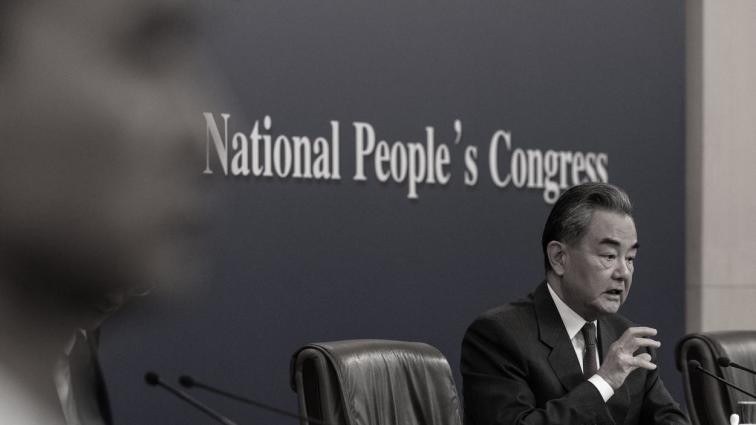
[People News] As the Chinese Communist Party’s “Two Sessions” are being held, the U.S.-Israel allied strikes on Iran have not stopped. More Iranian military facilities and combat units have been wiped out, and there are reports that Israeli special forces have already entered Tehran to carry out further clearing operations. At this moment, the Chinese Communist Party, shocked by the U.S. military’s surprise strike operations and overwhelming military power, is no longer pointing fingers at the United States as it did in the past, because the top leadership in Zhongnanhai has no choice but to consider—and is even more worried about—what would happen if the same kind of situation were to appear in Beijing.
So what lessons has the Chinese Communist Party drawn from the U.S.-Israeli annihilation of Iran’s top leadership? On March 3, a Chinese Communist Party military account on the overseas social media platform X suddenly posted a bilingual message in Chinese and English, summarizing five lessons from the annihilation of Iran’s top leadership.
Specifically, they included: first, the deadliest hidden danger: traitors within. Second, the costliest misjudgment: trusting in peace. Third, the coldest reality: the criticism of weapons. Fourth, the cruelest paradox: the illusion of victory. Fifth, the most fundamental reliance: oneself. Among these five lessons summarized by the Chinese Communist Party military after climbing over the firewall, “traitors within” was ranked first, highlighting the fears of the Party leadership and the military.
In fact, these five lessons were not an original creation of the Chinese Communist Party military, but came from an article published on March 2 by the self-media account Niu Danqin. That self-media outlet was founded by Liu Hong, a senior Xinhua reporter, and mainly comments on international affairs. Although it repeatedly stresses that these are merely its “personal views,” it cannot be denied that his identity conveys, to some extent, the Chinese Communist Party’s thinking.
There is no doubt that the annihilation of top figures including Iran’s supreme leader Khamenei stemmed from the fact that the United States and Israel had precisely grasped their movements and knew the location where they were meeting at the same time. According to overseas media reports, the United States and Israel had been tracking Khamenei’s movements for months. The specific methods they used are classified, but President Trump hinted at them in a social media post: “He cannot evade our intelligence and highly advanced tracking systems.” This shows that it was a carefully planned “decapitation operation.”
In addition to intelligence obtained through electronic interception, cyber infiltration, communications monitoring tools, and satellite systems, another channel used by the United States and Israel was recruiting informants and cultivating intermediaries. This is what frightens the Chinese Communist Party the most, and that is why Niu Danqin put “traitors within” in first place, saying that there must certainly have been traitors around Iran’s top leadership. “Otherwise, the supreme leader’s movements could not possibly have been grasped by the United States and Israel, Khamenei could not possibly have been killed immediately, and Iran’s leadership could not possibly have been annihilated.” Niu Danqin therefore lamented: “The greatest threat often does not come from the enemy in front of you, but from the shadow behind you.”
However, Niu Danqin is unwilling to mention or admit why so many Iranians were willing to provide intelligence to the United States and Israel. Payment is one factor, but the deep dissatisfaction of many Iranians with the Khamenei regime’s retrograde policies is also an important reason. Looking at the jubilation of Iranians after the annihilation of their top leadership, does that not precisely show that if the destruction of an evil regime is what people long for, then even if it costs their lives, what does it matter to provide intelligence to its enemies?
Compared with the evil Iranian regime, the evil of the Chinese Communist Party regime is more than a hundred times worse. There are countless Chinese people, both inside and outside China, who hate the Chinese Communist Party, and the loss of support within the Party itself has long been an indisputable fact. Especially in recent years, leaks from within the Chinese Communist Party have become common, and the flood of various “rumors” overseas is not unrelated to this. Not long ago, the U.S. Central Intelligence Agency once again openly recruited insiders from the Chinese Communist Party as informants. How could tens of millions of clicks on that recruitment message fail to make the Party leader and the top Zhongnanhai leadership fearful?
This is also why Chinese Communist Party leader Xi Jinping, after taking down Central Military Commission Vice Chairman Zhang Youxia and Chief of Staff Liu Zhenli and regaining part of his power, again raised the banner of political army-building, launched purges and brainwashing campaigns, and demanded loyalty from military and Party officials. This is also why the Chinese Communist Party’s Ministry of State Security is vigorously arresting so-called “spies” and intimidating Chinese citizens.
The problem is that, apart from making senior officials and those around the Party leader feel constantly endangered, how many people can truly be sincerely loyal to a regime that has lost the support of the people, no matter how much purging and brainwashing it carries out? Can the Chinese Communist Party really stop more and more people from leaking secrets?
Apart from worrying that insiders may reveal the secrets of the Chinese Communist Party leadership, the second lesson Niu Danqin mentions is Iran’s leadership’s misjudgment—that they believed that while negotiations were ongoing, the United States and Israel would not launch an attack. This is rather strange. Does Niu Danqin not understand the principle that “in war, deception is never too much”?
Over the past several decades, Iran has deceived the United States many times. Trump, who is well versed in The Art of War, judged that Khamenei was merely using negotiations to buy time to develop nuclear weapons, and in that case, there was nothing wrong with striking first. At this moment, is Niu Danqin being a little naïve? Or is it because the Chinese Communist Party has long used the same tactic itself, and can only shift responsibility outward by saying that the United States and Israel failed to observe the rules of conduct? The Chinese Communist Party should look in the mirror first before saying such things.
The third lesson that prompts Niu Danqin’s sigh is that strength is the only hard truth. In the face of the overwhelming military power of the United States and Israel, Iran was almost unable to withstand a single blow. If the Chinese Communist Party were placed in Iran’s position, how many moves could it survive against the United States and Israel? I believe this is probably what frightens the Chinese Communist Party most of all. The recent disappearance of Chinese military aircraft from the Taiwan Strait—could it also be because they understand that they are no more than clowns leaping about?
Although admiring the power of the United States and Israel, Niu Danqin still believes that their victory is merely an “illusion,” and that the war will spread and drag on, and in the end the United States too will be hurt by the backlash of the iron fist. Judging from the current U.S. attitude, however, the United States will not prolong the war, nor will it ever allow an anti-American figure to control Iran. Rather, it will seek a pro-American proxy. Looking at Venezuela, Iraq, and Libya, all supposedly “rescued” by the United States—has America suffered backlash? Niu Danqin’s hopes on behalf of the Chinese Communist Party are merely hopes, while the deaths and loss of power of its old friends are foreshadowing the tomorrow of Chinese Communist Party officials.
Because the old friends who shared the same filthy path are becoming fewer and fewer, the most painful lesson Niu Danqin summarizes on behalf of the Chinese Communist Party is that everything must depend on oneself. But the premise of relying on oneself is “having a strong economy, solid national defense, unity from top to bottom, and an invincible will.” Unfortunately, Iran had none of these, and today’s Chinese Communist Party has none of them either. Unable to rely on friends and unable to rely on itself, the Chinese Communist Party might as well follow in the footsteps of its old friends.
(First published by People News) △







News magazine bootstrap themes!
I like this themes, fast loading and look profesional
Thank you Carlos!
You're welcome!
Please support me with give positive rating!
Yes Sure!