
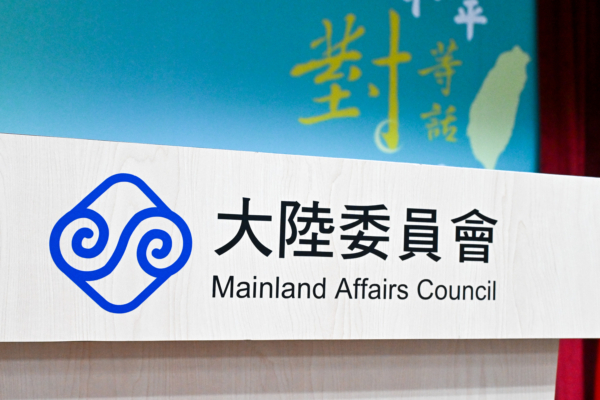
Taiwan Mainland Affairs Council file photo. (Credit: Song Bilong /Dajiyuan)
[People News] On April 7 at 1:30 PM, the cabin door of Shanghai Airlines flight FM852 opened slowly. As Kuomintang Chairman Zheng Liwen stepped out, she was greeted not only by the spring breeze of Shanghai but also by a carefully orchestrated political event.
The standards set by Beijing were impressively high. Song Tao, the Director of the Taiwan Affairs Office of the State Council, personally welcomed her on the tarmac. His first words were significant: 'I am here on the instructions of the Central Committee of the Communist Party of China and General Secretary Xi Jinping to specially welcome Chairman Zheng.' This statement elevated the nature of the trip from a simple party exchange to a 'leader's directive.'
However, it is important to note that beside Song Tao stood another figure in a dark blue suit—Chen Tong, a member of the Shanghai Municipal Committee and the Minister of United Front Work. The term 'United Front Minister' is politically sensitive in Taiwan, but in Beijing, it reflects the true nature of this 'peaceful journey.' When the United Front Minister shook hands with Zheng Liwen, the title of this event in Beijing's narrative subtly shifted from 'peace' to 'submission.'
After the welcoming ceremony, the delegation was led onto a bus, heading directly to Hongqiao High-Speed Railway Station, where they transferred to the 'Fuxing' train to Nanjing.
In the business class cabin of the Fuxing train, Song Tao and Zheng Liwen sat across from each other, with the Jiangnan scenery whizzing by at 350 kilometres per hour outside the window. Beijing seeks a sense of closeness among 'family members.'
Song Tao might point to the towering buildings outside the window and say to Zheng Liwen: 'Look, this is the development of the mainland; Taiwan should not miss this opportunity.' This represents not only a physical acceleration but also a political pressure. Beijing is signalling to the Kuomintang that the pace of cross-strait relations must align with this 'Fuxing' train.
In the evening, the delegation arrived in Nanjing and checked into the politically significant Dongjiao State Guesthouse. The banquet officially began in the opulent 'Peace Hall.'
During the dinner, Song Tao reiterated the importance of the '1992 Consensus' and the need to oppose Taiwan independence. This was not merely a welcome gesture; it was a 'definition.' He was drawing a red line for Zheng Liwen and presenting her with a test. He wanted to ascertain whether the 'peace' she brought included the 'unification' core he sought. Zheng Liwen's response was quite nuanced; she emotionally remarked, 'While it is too late to prevent the tragedies of the past, it is certainly not too late to avert wars in the future.'
This meal was about peace, but what was ultimately consumed was unification. By the end of the banquet, Zheng Liwen received a ticket to enter the Great Hall of the People in Beijing on Friday. However, we must ask: what was this ticket obtained in exchange for?
The 'political repair' and endorsements from influential figures before departure
Zheng Liwen's trip, dubbed the '2026 Peace Journey,' lasted only six days, yet its rapid pace and high density made it feel like a political marathon.
She arrived in Shanghai on April 7 and quickly transferred to Nanjing; on the morning of the 8th, she planned to visit the Sun Yat-sen Mausoleum and return to Shanghai in the afternoon. Following that, on the morning of the 9th, she would engage in discussions with Taiwanese businessmen before flying directly to Beijing, returning to Taiwan on the 12th.
Each stop during these six days serves as a final pressure test for the upcoming 'Xi-Zheng Meeting' at the Great Hall of the People.
Zheng Liwen has been planning this ticket to Beijing for quite some time. In the week before her departure, her schedule was packed as she held intensive meetings with several influential figures within the Kuomintang, including former chairman Wu Boxiong and the office of Ma Ying-jeou.
Zheng Liwen needs to ensure that when she proclaims the '1992 Consensus' across the strait, she has the support of these influential figures behind her. She understands that if she cannot secure their backing within Taiwan, her trip to Beijing would merely be a 'personal showcase'; only with their approval can the package she brings back be regarded as 'the assets of the Kuomintang.'
However, on the very afternoon that Zheng Liwen arrived in Shanghai, the Republic of China President Lai Ching-te addressed her during a memorial ceremony for Zheng Nanrong, urging her to demand that Beijing cease military aircraft disturbances instead of going to 'pay tribute.' He asserted that 'peace cannot rely on the gifts of dictators,' directly criticising Zheng Liwen from across the strait.
In Lai Ching-te's view, peace must be founded on 'defence strength' and 'democratic sovereignty,' and any dialogue lacking a sovereign basis is merely 'paying tribute.' In contrast, Zheng Liwen believes that Taiwan is currently sitting on a geopolitical powder keg, and that only through communication and the so-called stabilising force of the '1992 Consensus' can Taiwan secure some breathing space.
The looming shadow of Beijing's 'big gift package' and the 'Xi-Chuan Meeting'
The highlight of Zheng Liwen's six-day itinerary is undoubtedly the upcoming 'Xi-Zheng Meeting' set for April 10 at the Great Hall of the People.
However, there are currently no official announcements regarding Zheng Liwen's visit to Beijing. Whether Xi Jinping will meet with her depends on whether her statements in Shanghai and Nanjing over the past few days align with the red line of 'opposing Taiwan independence and pursuing peace.' Every word Zheng Liwen spoke at the Sun Yat-sen Mausoleum serves as a ticket to the Great Hall of the People.
Why is Beijing inviting Zheng Liwen to visit at this particular time? It is crucial to consider the international context: next month, U.S. President Trump is scheduled to visit Beijing. At this sensitive juncture, Beijing's invitation to the Kuomintang (KMT) chairperson sends a powerful signal—Beijing wants to show Washington that it can stabilise the situation across the Taiwan Strait through 'civilian' and 'opposition' forces. Xi Jinping aims to communicate to Trump: 'The Taiwan issue is our internal matter, and we are capable of handling it ourselves.'
To this end, Beijing will allow Zheng Liwen to return with a 'big gift package.' But is this gift package truly easy to obtain? Every incentive offered by Beijing comes with a price tag. This approach is referred to as 'promoting unification through economic means.' Beijing seeks to create an environment where acknowledging the '1992 Consensus' leads to endless benefits; conversely, failure to acknowledge it results in missiles and sanctions. The incentives Zheng Liwen brings back are perceived as a 'lifesaving elixir' by the Kuomintang, while the Democratic Progressive Party (DPP) views them as 'united front bait.'
Looking deeper, what Xi Jinping needs most right now is to ensure that the DPP cannot continue to leverage the 'anti-China, protect Taiwan' narrative in the upcoming local elections in Taiwan in 2026, as they have done in the past.
Through the "Xi-Zheng Meeting", Beijing is strategically engaging in "public opinion disintegration". Xi Jinping aims to convey to Taiwan's small and medium-sized business owners, tourism operators, and farmers that aligning with the Kuomintang (KMT) will secure their livelihoods, while following the Democratic Progressive Party (DPP) only leads to preparations for war. Although he does not mark your ballot, he has a direct impact on the money in your pocket. This is why the Mainland Affairs Council consistently warns Zheng Liwen against becoming a "pawn in Beijing's united front strategy".
At the Great Hall, Xi Jinping has rolled out the red carpet and presented an economic gift package, but the wrapping bears the watermark of "one country, two systems". What Zheng Liwen may bring back could be a fleeting economic boom, but what concerns the Taiwanese people more is whether we are trading our long-term sovereignty and dignity for this temporary peace dictated by Beijing.
Freedom of speech and the collective anxiety of "Hong Kongization"
In reality, the Taiwanese public has a strong instinctive aversion to the notion of "reunification" or "one country, two systems", with the core reason being not economic, but the "survival of our way of life".
Consider the current situation in Hong Kong. Once, it was a place where the familiar phrase "dance and horse racing" applied, a free port with a vibrant media landscape where people could openly criticise the government in the streets; however, now, many Taiwanese see Hong Kong as a cautionary tale. As we witness the deterioration of the rule of law, the shrinking space for free speech, and the pervasive "self-censorship" infiltrating daily life, the sense of crisis among the Taiwanese people has been profoundly awakened.
The primary concern for the people of Taiwan is whether, after unification and reintegration, they will be subjected to the same authoritarian governance. Will they lose their rights to freely create online content, express their opinions, and even criticise their leaders? If the ultimate goal of peace means sacrificing the 'democratic oxygen' essential for their existence, then no matter how fast this revival train travels, the people of Taiwan will not want to board it.
Thus, the greatest challenge for Zheng Liwen during this trip has never been about convincing Xi Jinping (Xí Jìnpíng), but rather persuading the 23 million Taiwanese who are fearful of losing their freedoms.
'Only with peace can we lie flat'?
Lastly, we need to examine the Kuomintang's (KMT) release of a controversial AI promotional video just before Zheng Liwen's departure. The video conveys a warm message: 'Because it is peaceful here, we can lie flat with peace of mind.'
In mainland China, the concept of 'lying flat' initially described a passive form of resistance adopted by young people facing social pressures like high housing prices and low wages—choosing not to buy homes, marry, or have children, thereby reducing demand to push back against the system. In the eyes of the Chinese Communist Party (CCP), 'lying flat' essentially means not resisting and being vulnerable to exploitation.
When the KMT asserts that 'only with peace can we lie flat,' have they considered how this phrase is perceived in Beijing?
What Beijing interprets is not the Taiwanese people's yearning for peace, but rather that they have already surrendered their will to resist, waiting to be exploited, and are prepared to 'enter the cage of Taiwan without resistance.'
Guan Bilin, the chairperson of the Ocean Affairs Council, shared a sea situation map for April 6 on Facebook, revealing that just before Zheng Liwen's arrival in Shanghai, Taiwan was encircled by eight Chinese military ships, destroyers, and coast guard vessels. She questioned, 'Is this what it means to lie flat in Taiwan's cage?' This remark underscores the stark reality of cross-strait relations. Zheng Liwen had previously asserted that the Chinese military aircraft surrounding Taiwan were there to 'defend Taiwan.'
Beijing's strategy is now quite clear: on one hand, they roll out the red carpet and host high-profile banquets to present the Kuomintang delegation visiting the mainland as a group of 'tamed rabbits' bringing peace; on the other hand, their military aircraft and ships are consistently working to create a 'cage for Taiwan.'
Polls indicate that over 80% of the public wishes to 'maintain the status quo.' Why is that? Because the 'status quo' signifies a modern lifestyle while safeguarding the most valued freedom of choice. If the benefits brought back by Zheng Liwen are wrapped in paper marked with the watermark of 'authoritarian rule,' would you accept such a gift? If the smiles and handshakes in the Great Hall of the People in Beijing lack the word 'freedom,' would you agree to that?
Peace is the aspiration of the Taiwanese people, but freedom is their lifeblood. Genuine peace should not be established on a foundation of 'lying flat' under the threat of force, but rather on 'equality' grounded in dignity and strength. What temptations will Beijing present, and what decisions will the 23 million people of Taiwan make as they stand at the crossroads between freedom and confinement?
(People News first published)
△



News magazine bootstrap themes!
I like this themes, fast loading and look profesional
Thank you Carlos!
You're welcome!
Please support me with give positive rating!
Yes Sure!