
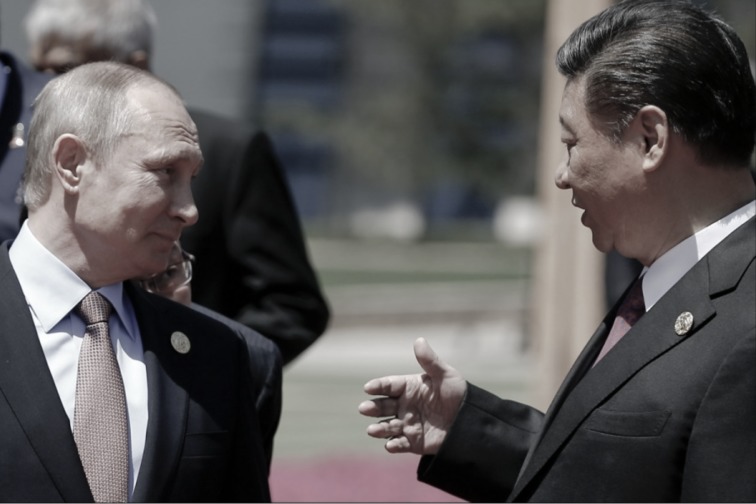
File Photo: Putin and Xi Jinping Posing for a Photograph
[People News] Just after U.S. President Trump left Beijing, Russian President Putin arrived with a large delegation that included five deputy prime ministers, eight ministers, and business leaders. In a brief two-day visit, the two sides signed and reached 42 bilateral cooperation agreements covering energy, industry, artificial intelligence, and more. The Chinese Communist Party also gave Putin a high-level reception.
In response, both Chinese state media and Russian news agencies claimed that China-Russia relations had reached an unprecedented height, as if ties had advanced another step. However, as outside observers have noted, Putin and Xi Jinping are simply each taking what they need, and the foundation of their political mutual trust is not solid.
On one hand, the Russia-Ukraine war has led to massive consumption of materials and military personnel, along with international sanctions and no clear prospect of victory. This has resulted in a sluggish Russian economy, soaring prices, and growing public dissatisfaction, all of which threaten Putin’s position. Therefore, Putin urgently hopes to obtain more support from Xi in areas such as the economy, military, and high technology. Russia’s current situation also places it in a relatively weaker position.
On the other hand, Xi, facing both domestic and external pressures, is using Russia as leverage against the U.S. and Europe, while also ensuring that China does not rely solely on Russia for energy imports, in order to avoid being strategically constrained in the future. This is also why the “Power of Siberia 2” gas pipeline project that Putin hoped to advance during this visit failed to reach an agreement.
“Power of Siberia 2” is a cross-border pipeline project that would transport natural gas from Russia to China via Mongolia. It is designed to deliver 50 billion cubic meters annually, with a total length of about 2,600 kilometres. In September 2025, China, Russia, and Mongolia signed a legally binding memorandum covering the construction of this pipeline and the “Eastern Alliance” pipeline passing through Mongolia, with a supply duration of 30 years and pricing to be negotiated separately. As of now, negotiations are ongoing, and construction has not yet begun.
Perhaps sensing Xi’s “coolness” and more pragmatic considerations, Putin’s language in this year’s seemingly high-profile meeting was more diplomatic. Notably, during the official talks, he did not praise Xi or express “respect” as he had in the previous three years.
In this year’s formal meeting, Putin stated: “Through joint efforts, Russia-China relations have reached an unprecedented high level. High-level exchanges are close, and political mutual trust is firm. … Russia-China relations have withstood tests, grown stronger over time, and have become a model of comprehensive strategic coordination. … Russia is willing to work with China to uphold the spirit of the treaty, strengthen strategic coordination and practical cooperation, and push bilateral relations to a higher level. … Russia is also willing to strengthen multilateral coordination with China, support China in hosting the APEC leaders’ informal meeting … and promote a more just and reasonable international order.” His remarks were largely diplomatic in tone, with not a single mention of Xi, instead using “both sides.”
However, what did Putin say during official meetings with Xi in 2025, 2024, and 2023?
On September 2, 2025, Xi met Putin at the SCO summit. At that time, Putin stated: “Under the leadership of President Xi Jinping and myself, Russia-China relations have demonstrated a high level of strategic nature and reached a historic peak. President Xi Jinping’s state visit to Russia in May and his participation in the 80th anniversary of the victory of the Great Patriotic War … The global governance initiatives proposed by President Xi Jinping are timely and necessary, and will play an important role in addressing global governance deficits. Russia is willing to maintain strategic coordination with China, strengthen high-level exchanges, expand practical cooperation in various fields, and promote the continued high-level development of bilateral relations.” In this statement, Xi was mentioned three times, with clear expressions of praise and respect.
On May 16, 2024, Xi met visiting Putin. Putin said: “I am very pleased to visit China again after being re-elected as President of Russia. Last March, President Xi Jinping also paid a state visit to Russia shortly after his re-election. This is a friendly tradition between our two countries, demonstrating the high importance both sides attach to strengthening comprehensive strategic coordination in the new era. … Russia is willing to continue expanding bilateral cooperation … and promote a more just and reasonable international order.” He also said, “Russia appreciates China’s objective and fair stance on major international and regional affairs.” Xi was mentioned once, with words of appreciation.
On October 18, 2023, Xi met Putin, who was attending the Third Belt and Road Forum. At that time, Putin said: “The Belt and Road Initiative proposed by President Xi Jinping ten years ago has achieved great success and has become an important international public good recognised worldwide. I highly evaluate President Xi Jinping’s keynote speech at the forum’s opening ceremony, appreciate his foresight, and believe and wish that this great endeavour will achieve even greater success.” He added: “Developments in the international situation fully confirm President Xi Jinping’s strategic judgment of profound changes unseen in a century. Russia firmly adheres to the one-China policy and strongly supports China in safeguarding its sovereignty and territorial integrity.” In this speech, Xi was mentioned five times, with abundant praise, including statements on Taiwan that catered to Xi’s preferences.
As a leader who emerged from a communist system, Putin understands very well what Xi likes to hear and how Communist Party officials enjoy flattery. Thus, during his visits from 2023 to 2025, although there were diplomatic phrases, some remarks were clearly tailored specifically for Xi.
Putin’s failure to mention or praise Xi in the latest official meeting, unlike in the previous three years, reflects a sense of distance. Does this reveal some dissatisfaction in his mind? Although Putin mentioned Xi once during the subsequent tea session, it came only after Xi had mentioned Putin once in his own remarks, and Putin’s tone still appeared largely diplomatic.
Interestingly, in reporting on the signing of documents, Russian media used a rather unusual photograph: after exchanging documents and shaking hands, Putin continued facing the reporters, while Xi tilted his head and looked downward toward Putin. This is unusual because news outlets could have used a standard image of both leaders facing the cameras or exchanging documents. How should this image be interpreted? Does Xi look down on Putin, while Putin ignores it? What do you think?
(First published by People News)





News magazine bootstrap themes!
I like this themes, fast loading and look profesional
Thank you Carlos!
You're welcome!
Please support me with give positive rating!
Yes Sure!