
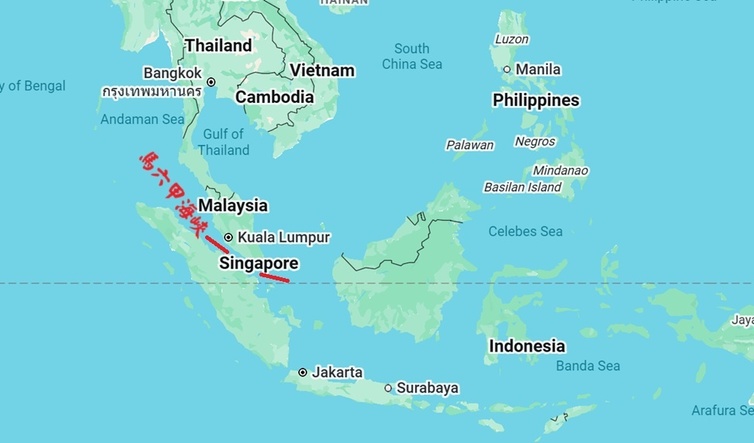
The Malacca Strait. (Screenshot from Google Maps)
[People News] The United States and Indonesia have recently announced the formation of a 'significant defence cooperation partnership.' Analysts suggest that Indonesia, which controls the vital energy chokepoint of the Strait of Malacca, will enhance its collaboration with the U.S. This partnership is expected to further limit the Chinese Communist Party's (CCP) expansion in the South China Sea, effectively thwarting its strategic ambition to transform the South China Sea into an 'internal lake' and exacerbating Beijing's energy shortfall crisis.
On April 13, U.S. Secretary of Defence Lloyd Austin and Indonesian Defence Minister Prabowo Subianto announced the official establishment of this partnership at the Pentagon. The aim is to deepen bilateral defence cooperation and uphold peace and stability in the Indo-Pacific region.
The new cooperation agreement encompasses 'joint development of advanced asymmetric warfare capabilities and exploration of next-generation defence technologies in surface, underwater, and unmanned systems.'
While both officials smiled and claimed during the press conference that this initiative is not directed at any third party, the focus of the military exercises and the nature of the weaponry tell a different story. Numerous military experts believe that the primary goal of this partnership is to prevent any single power (specifically, the CCP) from achieving absolute military dominance in the Indo-Pacific region, thereby ensuring freedom of navigation and the sovereignty of Indonesia. By forging significant defence ties with Southeast Asia's largest nation, the United States has effectively disrupted the CCP's strategic efforts to turn the South China Sea into an 'internal lake.'
The United States and Indonesia have formed a "Major Defence Cooperation Partnership" (MDCP), effectively inserting a strategic element into the heart of Southeast Asia. This arrangement provides the U.S. with a form of "strategic depth" in collaboration with Indonesia, extending beyond the first island chain (which includes Japan, Taiwan, and the Philippines). Should a conflict arise in the South China Sea, Indonesia's cooperation would place significant flanking pressure on the Chinese Communist Party (CCP).
The enhancement of U.S.-Indonesia defence ties has sparked alarm in Beijing, particularly due to Indonesia's strategic location, which controls the global energy choke point—the Strait of Malacca. This strait, approximately 900 kilometres long, serves as a crucial "choke point" linking the Pacific and Indian Oceans and is vital for the economies of East Asian nations. According to the U.S. Energy Information Administration (EIA) data for 2025, the Strait of Malacca accounts for about 30% of the world's maritime crude oil trade on a daily basis.
As reported by Xintangren, military channel host Mark on the program "Mark's Space" stated: "If Indonesia fully aligns with the U.S., blocking the Strait of Malacca could happen in a matter of minutes, which would be like a thorn in the side for the CCP."
Mark emphasised that Beijing is heavily dependent on energy imports, primarily sourced from the Middle East and transported through the Strait of Malacca. To alleviate this dependency, the CCP has constructed pipelines to import oil and natural gas from Russia and Central Asian countries; however, these pipelines have limited capacity, and the majority of energy still needs to be shipped through the Strait of Malacca. Recent shifts in the international landscape have left Beijing feeling increasingly anxious.
Mark stated, "In just a few months, the Chinese Communist Party has lost access to Venezuela's cheap oil, and concurrently, due to the ongoing conflict in Iran, a significant portion of Middle Eastern oil has been cut off. This has resulted in severe energy anxiety for the Chinese Communist Party."
Earlier this year, the Chinese Communist Party's longtime ally, Venezuelan dictator Maduro, was captured by U.S. forces.
At the end of February, the U.S. military conducted an airstrike that eliminated another ally of the Chinese Communist Party, Iranian Supreme Leader Khamenei. Subsequently, Iran announced a blockade of the Strait of Hormuz, while the United States intensified its maritime blockade against Iran in the surrounding waters, effectively choking off Iran's economic lifeline. The crude oil that the Chinese Communist Party has depended on from Iran is also facing supply disruptions.
Taiwanese military strategist Su Ziyun noted, "The current international landscape is shifting, with Iran at the centre of attention. In Northeast Asia, we have the first island chain, which includes Japan, Taiwan, and the Philippines as a defensive line, and now Venezuela in South America has also been neutralised by the United States. Therefore, with the closure of this outlet in Iran, the future encirclement of the Chinese Communist Party will be even more comprehensive," adding, "In the future, when necessary, U.S. military aircraft can traverse Indonesian airspace, facilitating access to the South China Sea or the Strait of Malacca. This is an enhancement for the U.S. military. If U.S. forces in Australia reinforce to the north, they can utilise Indonesian airspace, significantly shortening their travel distance. This reflects the broader geopolitical strategy at play."
As the U.S.-Iran conflict continues, the United States has swiftly moved to establish a higher level of defence cooperation with Indonesia, focusing on the Strait of Malacca and the South China Sea, thereby creating a stronger deterrent against Beijing.
For many years, the Chinese Communist Party has been expanding its influence and engaging in bullying tactics in the South China Sea. Consequently, an increasing number of neighbouring countries are enhancing their defence cooperation with the United States to secure safety guarantees.
In a joint statement issued by the US and India, there is a strong emphasis on maintaining a 'free and open Indo-Pacific region' and a 'rules-based international order.' The implicit message is clear: 'Opposition to the Chinese Communist Party's expansion in the South China Sea.' Experts believe that this collaboration particularly highlights 'surface and underwater autonomous systems (unmanned vessels)' and 'special forces training,' which directly addresses the requirements for asymmetric warfare in the South China Sea. This aims to bolster Indonesia's capacity to handle 'grey zone conflicts,' such as incursions by Chinese Coast Guard vessels or maritime militia into Indonesia's exclusive economic zone.
Mark remarked: 'The closer the military cooperation between the countries surrounding the South China Sea and the United States becomes, the greater the threat to the Chinese Communist Party. The more the Chinese Communist Party attempts to transform the South China Sea into an internal sea and assert its hegemony, the less effective it will be. The pressure it faces will only intensify.'
For Indonesia, the Chinese Communist Party's assertion of the 'nine-dash line' also encompasses the exclusive economic zone of the Natuna Islands, resulting in frequent disputes over sovereignty and fishing rights between the two nations in that maritime region.
Earlier this month, Indonesia detected a suspected underwater drone in the waters near the strategically important Lombok Strait, which prominently displayed the logo of the China Shipbuilding Industry Corporation (CSIC) along with simplified Chinese characters. △







News magazine bootstrap themes!
I like this themes, fast loading and look profesional
Thank you Carlos!
You're welcome!
Please support me with give positive rating!
Yes Sure!