
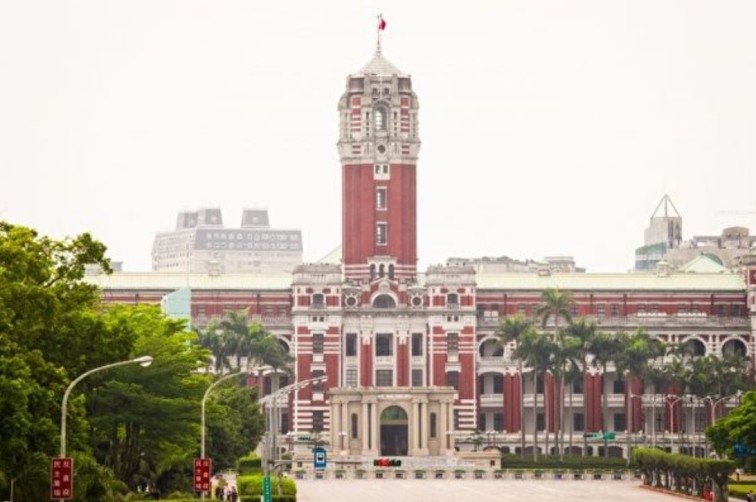
Taiwan Presidential Office. (Chen Bozhou / Dajiyuan)
[People News] Xi Jinping's confidence in his system has been challenged! Taiwan's GDP surged to 13.69% in the first quarter, directly overshadowing the CCP's self-proclaimed figure of 5%.
Nurtured by a free and democratic system, Taiwan has leveraged the ongoing momentum of its AI and semiconductor industries to create an economic growth narrative that has persisted for nearly 40 years. In contrast, mainland China is engulfed in a repressive authoritarian regime, grappling with political instability, economic downturn, and rampant social unrest, leading to a concentrated eruption of chaos, with society caught in a desperate cycle of 'lying flat' and 'offering loyalty'.
This remarkable figure is not only a shining report card for Taiwan's economy but also a striking rebuttal that completely dismantles the CCP's false narrative of national ascendance and common prosperity.
The 13.69% growth is not just an economic miracle; it also highlights systemic advantages.
According to the latest data released by Taiwan's Directorate-General of Budget, Accounting and Statistics on April 30, Taiwan's GDP achieved an astonishing year-on-year growth rate of 13.69% in the first quarter of 2026, significantly surpassing the market expectation of 11.3%, and setting a new record for the highest quarterly growth in nearly 39 years. For an island nation that has already joined the ranks of developed economies with a population of only 23 million, such double-digit growth is indeed miraculous. In comparison, established G7 countries like the UK and Canada are lauded for maintaining an annual growth rate of 2%-4%.
Taiwan stands at the forefront of the global AI industry chain, firmly establishing its core advantages in semiconductors and advanced manufacturing processes. The three key drivers of export, investment, and private consumption are all experiencing robust growth, particularly with the explosive demand for artificial intelligence, high-performance computing, and cloud infrastructure. This surge has led to a remarkable increase in the export of electronic and information communication products, with dollar-denominated exports in the first quarter soaring by 51.1% year-on-year. TSMC (Taiwan Semiconductor Manufacturing Company), often referred to as the national treasure, has played a crucial role in this growth, contributing around 11% of Taiwan's GDP in added value.
Taiwan's capital market has also shown exceptional performance. Since 2026, the Taiwan stock index has surged by over 35%, with total market capitalisation exceeding $4.47 trillion, surpassing major economies like the UK, Canada, Germany, and France, and becoming the sixth-largest stock market globally. This small island has outperformed several G7 nations in terms of total stock market capitalisation, marking a rare 'plug-in level integrated' achievement in the history of the global economy. This not only highlights the global competitiveness of Taiwanese companies but also reflects investors' confidence in Taiwan's institutional environment and innovation ecosystem.
The true engines of growth are the rule of law, democracy, and free markets.
Why has Taiwan managed to achieve such impressive growth, while mainland China, which claims to be the 'world's second-largest economy,' finds itself in a deep crisis? The key to economic growth lies in social systems, which encompass political, legal, and economic frameworks. All developed economies are built on a market economy system grounded in democracy and the rule of law. Without a robust legal framework to protect property rights, markets struggle to function effectively, innovation is stifled, and ultimately, escaping the 'middle-income trap' becomes nearly impossible.
Under Xi Jinping's centralised rule, contemporary China is gradually retracing the decline of the Qing Dynasty in the late 19th century. The totalitarian regime of the Communist Party of China fundamentally suppresses freedom of speech and denies universal values, which severely restricts genuine innovative potential. For instance, AI technology requires substantial computing power (chips), vast amounts of high-quality data, and an open environment for algorithmic iteration. While China's lag in the chip sector may seem like a technical issue, the underlying cause is institutional shortcomings; an environment devoid of freedom, rule of law, and trust is unlikely to nurture breakthroughs in advanced technology.
During the initial phase of reform and opening up, China’s growth was bolstered by its integration into the international order and the expansion of the private economy. However, the current Communist Party is reversing this progress. In the global race for AI, the United States has explicitly excluded China from the core supply chain, as totalitarian regimes tend to leverage technology for zero-sum games and surveillance, rather than for mutual benefit and the welfare of humanity.
From the absurd accusations of 'lying flat' to the violent outbursts of 'loyalty offerings.'
While the people of Taiwan bask in a sense of overwhelming happiness, the social landscape in mainland China is increasingly teetering on the edge of collapse. Under the combined pressures of economic decline and stringent control, Chinese society under Xi Jinping is experiencing unprecedented chaos and distortion.
The concept of "lying flat" has emerged as a form of passive resistance among countless young people who are grappling with despair in the face of reality. The rapid withdrawal of foreign investment, the severe devaluation of educational credentials, and the extreme scarcity of job opportunities have made it nearly impossible for many young individuals to sustain a basic standard of living, regardless of their efforts. Ironically, at the end of April, the Ministry of State Security of the Communist Party of China published an article absurdly accusing the "lying flat" phenomenon of being a conspiracy funded by foreign forces. They claimed that foreign organisations are financing "lying flat internet celebrities" to produce short videos aimed at "brainwashing" the youth into adopting this mindset. This attempt to blame the spontaneous helplessness of young people on external dark forces quickly became a source of ridicule online. It not only reveals the authorities' profound fear and disregard for social realities but also underscores the absurd blame-shifting logic inherent in totalitarian thinking, where the dissatisfaction of the populace is never viewed as a problem of the system or those in power, but rather as a consequence of foreign infiltration and the relentless anti-China forces that seek to undermine the nation.
More alarming and frightening than the 'lying flat' phenomenon is the ongoing surge of the loyalty phenomenon. On the afternoon of May 1, 2026, a typical indiscriminate vehicle attack took place at the intersection of Tianfu Fourth Street and Jiannan Avenue in Chengdu High-tech Zone. A small car suddenly accelerated and made a right turn, crashing into pedestrians waiting to cross the street. During its escape, the vehicle repeatedly collided indiscriminately with both pedestrians and other vehicles. Witnesses described the scene as horrific, with many people being thrown into the air, and the driver, after being forced to stop, brandished a sharp knife. The official report indicated 1 death and 11 injuries, but numerous witnesses questioned this figure, suggesting that the actual casualties were significantly higher and that the incident was clearly retaliatory in nature.
Incomplete statistics show that such indiscriminate violent incidents in China have been on a notable rise: from an average of 3-5 incidents per year in 2019, the number surged to 19 incidents in 2024 and exceeded 20 incidents in 2025. The Chengdu incident on May 1, 2026, is simply the latest example in this upward trend.
The rapid economic growth over the past 30 years has generally created an illusion of upward mobility for the Chinese populace. However, with the real estate market experiencing a sharp decline, a wave of unemployment sweeping through, and many highly leveraged middle-class individuals falling below the survival line, combined with China's lack of a comprehensive unemployment relief and housing security system, unemployed individuals burdened with mortgages are facing a swift collapse of their lives, leaving them with no way out. Under the conditions of grid-based surveillance, strict speech control, and high-pressure stability maintenance, the public is unable to express dissatisfaction or engage in public affairs through legal channels. As a result, long-standing grievances can only erupt in extreme ways.
As many commentators have noted, the weak do not dare to directly confront the towering system in the iron jungle of power. Instead, they turn their aggression towards the equally vulnerable ordinary citizens, seeking to be 'seen' and to feel a sense of 'revenge' by instilling maximum panic. This distortion of human nature is an inevitable pathological outcome of the long-standing totalitarian rule of the Chinese Communist Party (CCP), which has internalised a fear of power and eroded social trust.
In Taiwan, the sense of happiness starkly contrasts with the suffering in mainland China, highlighting a cruel and vivid institutional comparison.
In Taiwan, the government has implemented widespread cash distributions, the wealth effect from the stock market is significant, and per capita GDP is expected to reach $39,000 by 2025, surpassing traditional powers like Spain. The public genuinely experiences the benefits of economic growth. Taiwan ranks among the 'least painful' countries in the global 'misery index,' even eliciting envy from netizens in Canada and the UK, who are struggling with high inflation. The people enjoy real dignity and hope within a framework of freedom, rule of law, and prosperity.
Conversely, in mainland China, there is systematic falsification from top to bottom, evident in state-owned enterprise financial statements, stock market candlestick charts, and statistical bureau data. The entire incentive mechanism of the system has completely failed and become distorted under the high pressure of Xi Jinping's so-called correct view of political achievements. The CCP system does not encourage truth-telling; it only rewards deception. When mainland netizens exclaim, 'Isn't Taiwan in dire straits?', the lies constructed by the CCP's internal propaganda over the years have completely collapsed in light of the 13.69% data.
Institutions determine destiny; Taiwan reflects the future.
Taiwan, with a population of 23 million, has demonstrated through undeniable facts that human wisdom, courage, and innovative spirit, along with the moral qualities of kindness, politeness, tolerance, and peace, can generate immense value under an inclusive and open democratic rule of law. In the 21st century, the core soft power of a nation lies in its systems, civilisation, and independent technological innovation; in contrast, totalitarianism, barbarism, conflict, deceit, and violence pose significant barriers to national prosperity and the well-being of its citizens.
In the ongoing long-term confrontation between the systems and civilisations across the Taiwan Strait, it is already clear who represents the future and who is on the path to decline. Under Xi Jinping's leadership, the Chinese Communist Party is trying to sustain its precarious legitimacy through increasingly severe repression and ideological indoctrination. However, as economic growth stagnates, hope fades among the populace, and society becomes rife with violent sentiments, the internal contradictions and risks of collapse within this system have become inevitable. Taiwan's ongoing progress serves as a stark contrast to the sharp decline of the CCP system.
(First published in People News)△






News magazine bootstrap themes!
I like this themes, fast loading and look profesional
Thank you Carlos!
You're welcome!
Please support me with give positive rating!
Yes Sure!