

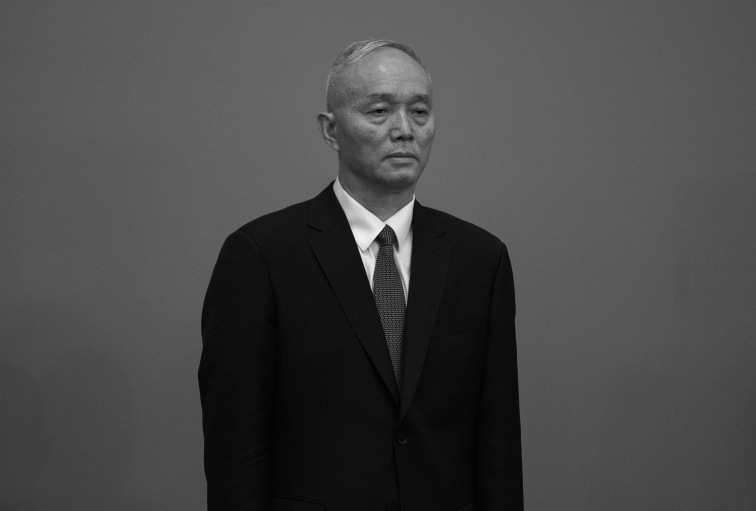
Zhang Youxia, Vice Chairman of the Central Military Commission of the Communist Party of China, remarked that Xi&9;s faction has been entirely apprehended. (Video screenshot)
[People News] It has been three months since January 24, when Zhang Youxia and Liu Zhenli were officially announced to be under investigation. The investigation into these cases has progressed at an extremely slow pace, exceeding 120 days. Analysts indicate that the resistance from within the Chinese Communist Party (CCP) military is significant and may have developed into a systemic confrontation with the highest levels of the CCP leadership.
The 'Collective Silence' of Theatre Commanders
In the political culture of the CCP military, it is customary for all military units to quickly and prominently 'declare loyalty' after the investigation of a 'military giant' at the level of vice chairman. Following the downfall of Guo Boxiong and Xu Caihou, the former seven military regions and various military branches launched a 'loyalty competition' within 24 hours, with party committees at all levels convening 'thematic democratic life meetings.' These meetings required all standing committee members to speak individually, not only to 'declare support' but also to 'dig deep into the ideological roots' to ensure that everyone passes the scrutiny. The 'Liberation Army Daily' also dedicated several consecutive days to a special column featuring signed articles from commanders and political commissars of various theatres. The slogan at that time was 'We must not allow the toxic influence of Guo and Xu to linger.'
Even after the recent downfall of senior generals He Weidong and Miao Hua, the major military regions and functional departments of the Military Commission managed to complete notifications and collective learning within a few days following the official announcements. In the Eastern Theatre Command, where He Weidong had a long tenure, the official social media platform reposted the Ministry of Defence's notification at a coordinated time. However, there were no personally signed comments from the main officials; a collective statement asserting that 'the officers and soldiers of the Eastern Theatre Command resolutely listen to the Party's command' was prominently displayed in a timely manner.
Since Zhang Liu was officially announced to be under investigation on January 24, more than a hundred days have passed, yet none of the main officials (commanders and political commissars) from the five major military regions have published signed supportive articles in the PLA Daily or on their respective official platforms. Only the official platforms of the Eastern Theatre Command and the Western Theatre Command have shared brief notifications related to the case, while the Northern Theatre Command, Southern Theatre Command, Central Theatre Command, People's Armed Police, China Military Account, and Rocket Force's official accounts have not issued any supportive statements or editorials regarding the Zhang Liu case.
This 'collective silence' among senior military leaders breaks the norm that typically follows the investigation of high-ranking officials, which usually sees a surge of loyalty expressions. It also highlights significant divisions within the military concerning the characterisation and handling of the ongoing Zhang Liu case.
Daring not to enter the barracks, Xi Jinping extends 'video condolences' to grassroots officers and soldiers.
Traditionally, on the eve of the Chinese Lunar New Year, Xi Jinping, as the Chairman of the Central Military Commission, is expected to inspect grassroots troops and offer condolences to the officers and soldiers. In January 2025, he is set to visit the Northern Theatre Command, accompanied by then Vice Chairman of the Military Commission Zhang Youxia and Northern Theatre Command Commander Huang Ming, among others.
However, by 2026, Xi Jinping broke the long-standing tradition of personally inspecting military camps during the "Spring Festival grassroots visits." On the afternoon of February 10, the Little New Year, he expressed his condolences to the military via video from the Bayi Building in Beijing, accompanied by Zhang Shengmin, Vice Chairman of the Central Military Commission, and Defence Minister Dong Jun. He unusually emphasised that "the entire military must strengthen combat readiness duty, maintain the prescribed state of alert, and timely and effectively handle various possible emergencies."
Analysts noted that this marks the first time Xi Jinping has called for the entire military to "maintain the prescribed state of alert" on the eve of the Chinese New Year, a statement not seen in previous years. This comes in light of Xi's recent arrest of Zhang Liu and the subsequent changes within the military, raising suspicions among observers that the Chinese Communist Party's military may be harbouring dissent against Xi. If Xi were to rashly enter a military camp at this time, he could face sudden incidents such as "hostage-taking," "assassination," or "military admonition." Thus, in order to "preserve his life" and to project an image of still "firmly holding military power," Xi had no choice but to retreat behind high walls for a "video condolence."
Repeated political purges have led to Xi losing the support of the military.
Since taking office in 2012, Xi Jinping has initiated multiple rounds of high-intensity purges within the military under the pretext of "anti-corruption" and "military reform." While he has formally completed the reorganisation of power, this prolonged political pressure has resulted in abnormal signals within the military, indicating a "desire for change among the ranks, waiting for action."
Public data indicates that in the past 14 years, more than 15 generals and over 200 officers at the deputy military rank and above have been dismissed, surpassing the total number of generals investigated by the Communist Party since its founding during both wartime and peacetime. In the 14th Central Military Commission established in 2023, only Xi Jinping and Zhang Shengmin remain, while the rest of the military leadership has been completely replaced. Initially, the purges of Guo, Xu, and their associates could be justified as efforts to 'clear out toxic influences.' However, the recent dismissals of Li Shangfu, senior officials from the Rocket Force, as well as Zhang Youxia and Liu Zhenli, have predominantly targeted those who are part of Xi's 'personal appointments and promotions,' often referred to as the 'Xi family army.'
This approach of 'personally promoting and personally capturing' sends a chilling and clear message to the entire military: in the eyes of Xi Jinping, 'absolute loyalty' does not equate to 'absolute security.' Any senior general is essentially a political pawn that can be discarded or purged at any moment. If falling from grace has become an unavoidable fate, then it is increasingly plausible for powerful generals to instigate a coup using the military forces at their disposal, directly confronting the regime in a bid for political survival and retaliation.
Analysts indicate that Xi Jinping's arrests of Zhang Youxia and Liu Zhenli represent not just a crackdown on specific senior generals, but also fundamentally shake the Communist Party's foundational control over the military. This action has entirely eroded the political trust that the professional officer corps had in the Communist Party's highest leadership, leading to a shift in the military's loyalty from a soldier's sense of honour to a mere 'fear of survival.' The mutual trust between the Communist Party's top leadership and the military has reached a state of complete 'zero trust.' The military, which serves as the 'gun barrel' upon which the Communist Party depends to sustain its regime, is now at risk of structural 'breakdown.' △




News magazine bootstrap themes!
I like this themes, fast loading and look profesional
Thank you Carlos!
You're welcome!
Please support me with give positive rating!
Yes Sure!