
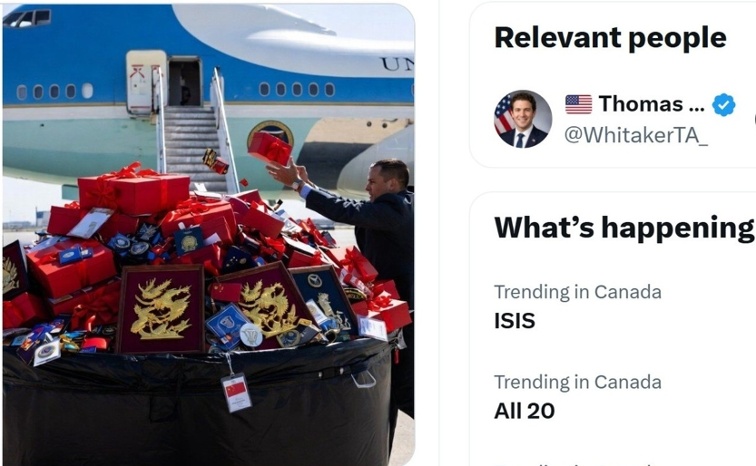
U.S. officials disposed of all gifts from China in the trash before departing the country. (Reproduced from X platform)
[People News] During the opening remarks of a meeting with Xi Jinping in Beijing, U.S. President Trump, who has had a long-standing and amicable relationship with Xi, remarked, 'You are a great leader.' He further explained, 'Some people may not appreciate me saying this, but I must say it because it is the truth; I always speak the truth.' This statement took many by surprise, as it is unusual for a democratically elected president to commend the leader of the CCP as a 'great leader.' Has Trump been misled by the CCP?
Effectively utilising 'flattery' against the CCP
In response, Peter Navarro, senior trade and manufacturing advisor at the White House, commented in a CNBC interview on May 19 that President Trump is often ridiculed by the CCP's 'wolf warrior' faction, yet he understands how to navigate this dynamic better than anyone else.
He pointed out that the CCP has historically dealt with the U.S. through 'flattery, exaggerated commitments, but failing to deliver.' However, Trump is more adept at countering this strategy than any previous president and can even play along. Nevertheless, the accomplishments of President Trump have not been fully revealed, which is why they have not yet entered the mainstream media's discourse.
Navarro had a reason for his statement, as Trump's visit to Beijing successfully secured what the United States sought from Xi Jinping, including contracts for the export of American beef, soybeans, and Boeing aircraft. Trump brought all of these back to the U.S. and also addressed the 'rare earth' supply issue that had been a headache for the Western tech community.
Additionally, Navarro revealed, 'We received a commitment from Xi Jinping to no longer provide any weapons to Iran.'
It appears that Trump has numerous strategies to engage with the Chinese Communist Party.
Trump returned with a wealth of achievements.
According to a report by Voice of America, the Chinese government agreed to collaborate with U.S. regulatory agencies to lift the suspension on certain U.S. beef processing facilities and re-approve export licenses for over 400 plants. They also resumed imports of poultry from the U.S., provided there were no concerns about avian influenza.
Moreover, the fact sheet released by the White House indicates that China committed to purchasing at least $17 billion worth of U.S. agricultural products annually for three consecutive years from 2026 to 2028, although this agreement does not include the previously promised soybean purchases.
Regarding Boeing aircraft, Trump explicitly stated that Xi Jinping had agreed to purchase 200 Boeing planes.
Trump also publicly highlighted soybeans, energy, and Boeing as key achievements from his dealings with China.
Additionally, observers have noted that Trump has frequently mentioned his invitation to Xi Jinping to visit the United States on September 24. This date coincides with the expiration of the one-year trade truce agreement previously signed between China and the U.S. More significantly, it is close to the upcoming U.S. midterm elections, making it advantageous for Trump to showcase 'major deals with China' to bolster his electoral chances domestically.
This clearly demonstrates that Trump is not only a successful businessman but also a political leader adept at managing the Chinese Communist Party's rogue tactics.
Trump Challenges the 'East Rising, West Falling' Myth
Trump's visit to Beijing proved to be highly productive. While Moscow featured a front-page photo of Trump alone on 'Air Force One,' Trump boldly instructed all his aides at Beijing Airport to discard the gifts presented to him by the Chinese Communist Party into a trash can in front of the cameras before boarding 'Air Force One.'
Would a true friend treat gifts from a friend in such a way?
Xie Jinhai, chairman of Taiwan's Caixin Media, expressed on Facebook that Trump's trip to Beijing is essentially dismantling the Chinese Communist Party's 'East Rising, West Falling' narrative.
Xie Jinhai remarked that this was a meticulously crafted scheme by Trump, a calculated performance art where Trump is the central figure surrounded by many, while Xi Jinping plays the role of the host, merely a supporting character in this performance. This grand event resembles the United States showcasing its national strength.
Xie Jinhe highlighted two notable incidents involving Trump. The first occurred before Trump's visit when the U.S. C-17 Globemaster transported thousands of tons of supplies, including electronic warfare vehicles, communication systems, and the presidential limousine known as The Beast, a mobile steel fortress weighing 14 tons. This impressive display seemed more like a demonstration of American national power, with Trump proclaiming to a global audience: America is great again!
The second incident took place at the end of Trump's trip, just before Air Force One departed Beijing. The U.S. disposed of all gifts from China, along with accessories and a secure mobile phone that had been in use, treating them as trash and not permitting them to be brought back to the U.S.
Xie Jinhe pointed out that this underscores a significant implication: the U.S. and China are still in a state of hostility. While Trump claims that the Chinese leader is a good friend, the act of discarding gifts from a friend as garbage is a striking image.
Xie Jinhe further noted that throughout the trip, Trump's primary focus was on making America great again, which is particularly important in the context of the shifting dynamics between the East and the West!
In an interview with the program "Xiao Jun Taiwan PLUS," Xie Jinhe stated that the United States still holds significantly more power in leading the global order. The notion of the East rising and the West declining is simply unfounded. Firstly, the national strength of China is vastly different from that of the United States. For instance, among the top 100 companies globally, very few are from China. Currently, Tencent is the largest company in China, with a market value of approximately 570 billion USD, ranking in the 50s. Alibaba, on the other hand, has a market value of just over 300 billion USD, placing it even lower. The total market capitalisation of the U.S. stock market is 76 trillion USD, while China's stands at 14 trillion 460 billion USD; including Hong Kong, it is around 22 trillion USD. This means China is only one-third the size of the United States in this regard. All original technological innovations originate from the U.S.; China primarily either steals or gradually imitates these under the specifications and standards set by the U.S., leveraging its large market to create a distinctive market of its own.
Xie Jinhe emphasised that in this context, technological leadership is more crucial than market leadership. Trump's visit to China was essentially driven by China's need for Trump, while Trump had no such need for China. Therefore, we need not overly concern ourselves with future changes.
(First published by People News) △




News magazine bootstrap themes!
I like this themes, fast loading and look profesional
Thank you Carlos!
You're welcome!
Please support me with give positive rating!
Yes Sure!