
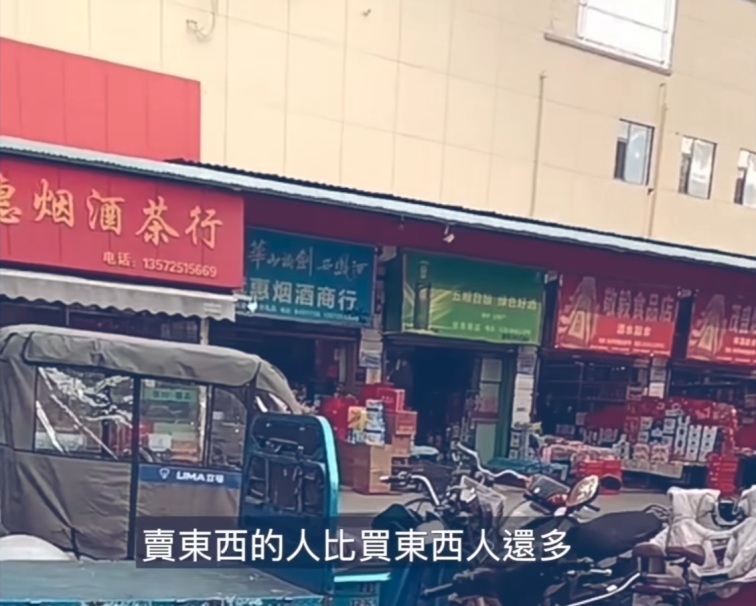
China’s economic downturn has left both major cities and remote towns struggling, with malls and markets facing a wave of closures and street vendors outnumbering customers. Many people have fallen into despair as a result. (Video screenshot)
[People News] The WeChat public account "Catering Business Insider" published an article on June 4 titled "Street Vendor Equipment Prices Skyrocket by 600%! The Night Market Stall Army is Back". The article highlights an increase in foot traffic at night markets in cities such as Ningbo, Zibo, and Xishuangbanna, with night markets and outdoor stalls also emerging in major cities like Beijing and Shanghai. It cites a second-hand equipment dealer who noted that in the two to three months leading up to last year's Spring Festival, sales of street vendor cart equipment around Beijing surged by 600%.
According to Radio Free Asia, the article mentions that the Ningbo Sanguantang Night Market, which was previously concentrated in the intersection square area, has recently expanded to fill the sidewalks with stalls. The Zibo Liuquan Road Night Market, located under an overpass, features a variety of snacks including snail noodles, spicy hot pot, sauce-flavoured pancakes, ice dumplings, and street barbecues. A netizen commented on social media, "With the evening breeze, the streets are filled with the aroma of delicious food; this is the perfect way to enjoy summer nightlife."
Mr Liu, a micro-business owner from Jiangsu, told reporters that the recent rise in sales of street vendor equipment and carts indicates that many people are seeking new ways to earn a living. He stated, "It's tough for physical stores; it's really challenging right now, and many people are aware of that. Everyone is trying their own solutions; some are looking for small carts to start catering or street-side dining, but that is relatively more difficult. For those who have never done it, it may seem easy, but once you actually start, these low-threshold ventures can be even harder to manage."
Mr Liu stated that the individuals attempting to set up stalls or engage in street-side dining come from a diverse range of backgrounds, not solely those who previously operated physical stores. He remarked, 'Regardless of whether they are employees in companies or from physical stores, it’s the same across all sectors; nothing is working. Everyone is looking for a way out, but changing the method still leads to no solution.'
Zhang Haoran, a restaurant industry worker focused on urban consumption, told reporters that the resurgence of night markets reflects the rising employment pressures. He explained, 'In the past, some cities had long-term crackdowns on street vendors and mobile stalls. Now, authorities are witnessing many people losing their income and are concerned that the public will face food shortages and cause disturbances, prompting them to re-establish night markets and outdoor dining areas. I believe night markets are not a new concept; Li Keqiang proposed the street stall economy years ago, which is quite similar to the current night market economy. It caters to ordinary consumers and has a low entry barrier. For instance, if you purchase small items from Taobao and sell them at the night market, that also represents a low-threshold opportunity for making a living.'
Regarding the trend of many individuals turning to night markets and street stalls, Zhao Zhi informed reporters that numerous online videos are discussing the decline of physical retail, the drop in foot traffic in department stores, and the rising number of closures. He stated, 'Many people online are saying that physical stores are now empty; just look at the large department stores, there are no customers, and they are all shutting down. It’s unfortunate; who is responsible for this situation? There are many complaints online.'
Zhao Zhi also shared that he previously sold clothing online, but it has become increasingly difficult to sustain the business. He noted, 'This has essentially come to a halt; selling clothing is even more challenging. In the past, a piece of clothing would last for six months, but now many people wear a piece of clothing until it’s completely worn out. This year, it’s even tougher to run a clothing business.'
He mentioned that many people around him are also seeking temporary jobs or gig work: "There are a lot of people doing odd jobs in the factory now. A few days ago, I ran into a friend who works at a state-owned enterprise. He currently has no work and is looking for temporary jobs, earning money day by day, working whenever there is work available, and taking time off otherwise."
First-tier cities embrace outdoor dining
An article from 'Restaurant Owners' Insider' indicates that the Longfu Market in Beijing will launch a summer night market, set to begin on June 18 and expected to last for three months, with a focus on night market consumption. Night markets such as the Shenghuatun Night Market, Lishuiqiao Night Market, and Moon River Night Market in Beijing have also expanded options for citizens' nighttime spending. This year, districts like Hongkou, Huangpu, and Xuhui in Shanghai have rolled out outdoor dining policies, categorising outdoor dining spaces into 'city image display areas' and 'vibrant functional expansion areas,' implementing differentiated guidance and management that benefits over 500 outdoor dining areas and more than 4,000 merchants across the city.
The article cites a second-hand equipment recycler known as 'Dog Ge,' who stated that in the first two or three months leading up to last year's Spring Festival, there were an average of about 20 inquiries per day regarding street vendor equipment, primarily about street vendor carts, display cabinets, steam bun ovens, and noodle cooking pots, with sales of street vendor cart equipment surging by 600%.
Night markets say goodbye to the low-threshold era
Some professionals in the catering industry assert that night markets are not as 'easy to profit from' as outsiders might think. Stall owners contend with stall fees, equipment costs, food waste, competition from similar vendors, and weather fluctuations, resulting in unstable income.
In 2020, Li Keqiang, who was then the Premier of the State Council of the Communist Party of China, introduced the concept of the street stall economy, describing it as an important source of employment and referring to it as 'the smoke and fire of human life, the vitality of China.' However, this idea has not been consistently advanced in the governance of many cities since then. In June 2020, the Beijing Daily published a commentary asserting that the street stall economy is unsuitable for Beijing.
Recently, cities like Beijing and Shanghai have reopened night markets and outdoor spaces. Mr Wang, a scholar from Beijing, explained to reporters that when Li Keqiang proposed the street stall economy, it was in response to the economic downturn and rising unemployment in China, aiming to alleviate the situation through low-barrier employment options. However, this approach was not genuinely embraced within the Communist Party system. He noted that it has been demonstrated that the street stall economy offers an alternative means of livelihood for the unemployed or those experiencing reduced incomes. The reopening of night markets and outdoor spaces across various regions indicates that employment and consumption pressures have once again come to the forefront for local governments.
△



News magazine bootstrap themes!
I like this themes, fast loading and look profesional
Thank you Carlos!
You're welcome!
Please support me with give positive rating!
Yes Sure!