

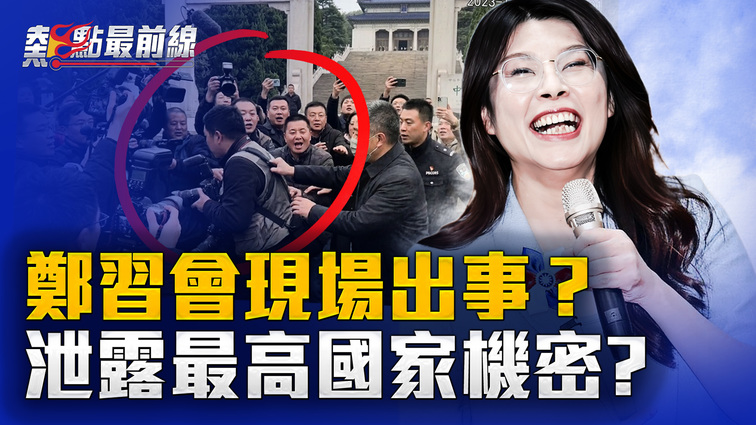
The height of Xi Jinping, the leader of the Chinese Communist Party, is considered a state secret. (Video screenshot)
[People News] Recently, Zheng Liwen, the Chairman of the Kuomintang, delivered a speech in San Francisco, where she mentioned several 'miracles': Taiwan's democratic miracle and the economic miracle resulting from China's reform and opening up. In just a few words, she laid bare the dual dilemmas facing the Kuomintang's cross-strait discourse today—one is termed 'wishful thinking,' and the other 'a dream of Nanke.' Zheng Liwen's wishful acknowledgement of the mainland's economic miracle stands in stark contrast to the Kuomintang's abandonment of democracy in favour of peace, which will ultimately amount to a mere dream of Nanke.
1. Wishful Thinking: A Monologue Without Echo
Zheng Liwen affirmed the economic miracle of the mainland, which is not inherently wrong—after forty years of reform and opening up, the material achievements of the mainland are indeed remarkable. However, the issue lies in the fact that this 'acknowledgement' is one-sided and lacks any reciprocal recognition. The Chinese Communist Party has never acknowledged, nor is it willing to acknowledge, Taiwan's democratic miracle.
This reflects the inequality in 'acknowledgement' and highlights the true crux of cross-strait relations. While Beijing is eager to showcase its economic achievements to the world, the political progress—specifically, the democratic miracle achieved by 23 million people through voting, party alternation, and press freedom—is deliberately overlooked, belittled, and even stigmatised as 'chaos.' One side is willing to recognise the other's strengths, while the other side is reluctant to offer any acknowledgement. Thus, Zheng Liwen's goodwill becomes a wishful thinking monologue: she bows to her own reflection, mistakenly believing that there is someone on the other side returning the gesture.
The danger of unilateral goodwill does not stem from the goodwill itself, but from the tendency to misinterpret an opponent's silence as tacit approval and to see their denial as an opportunity for negotiation. When you are willing to acknowledge the achievements of others, yet they refuse to even recognise your legitimacy, what is presented as dialogue is, in fact, submission.
2. A Dream of Nanke: Peace Achieved at the Expense of Democracy
Zheng Liwen advocates for 'peace to save the country', expressing a desire for peace across the Taiwan Strait. The pursuit of peace is fundamentally a noble intention and deserves respect. However, it is crucial to distinguish between genuine and false peace: peace that lacks a democratic foundation is not peace at all, but rather surrender.
Let us reflect on a historical moment. In 1949, Beijing did indeed 'avoid war and achieve peace'. However, this was not the peace of victors; it was the peace that came about when the garrison commander Fu Zuoyi laid down his arms and surrendered the city. The city remained intact, and the people were safe, but from that point onward, whose flag was hoisted over the city? Whose will governed that ancient capital? In the guise of disarmament, the reality was one of surrender; even in the absence of gunfire, it was already a treaty of submission. If today someone demands that Taiwan make concessions and deliver before receiving equal democratic commitments, how is such 'peace' any different from the situation in Beijing in 1949?
In the Tangren Legend "The Tale of the South Kē Governor", Chún Yú Fén drunkenly falls asleep under an ancient locust tree and dreams of entering the "Great Locust Peaceful Nation", where he enjoys twenty years of glory and wealth as a prince, a governor of South Kē, and a general. However, upon waking from this dream, he realises that the so-called nation is merely an ant nest beneath the locust tree. Today, if the Kuomintang believes that simply abandoning the banner of democracy will lead to equal, dignified, and lasting peaceful unification, it is no different from Chún Yú Fén's dream of locust peace: in the dream, there are princesses, glory, and the dignity of “one China, each with its own interpretation”, but upon waking, it is just an ant nest, and the banner on the city wall has long since changed. The true horror of the South Kē dream is that the dreamer is completely unaware that they are dreaming.
3. Democracy is the Premise of Peace
To break free from "wishful thinking" and "the South Kē dream", the Kuomintang has only one path: to recognise that democracy is the premise of peace, not its price. I would like to propose three points.
First, the Kuomintang must uphold its core value—Three Principles of the People. The principle of civil rights itself indicates that democracy is the premise of peace. Without the banner of the Three Principles of the People, the Kuomintang loses its fundamental basis for existence and its moral standing to challenge the Communist Party on equal terms, becoming merely a passive responder in the context set by the other side.
Second, the Kuomintang has an undeniable historical responsibility: to bring Taiwan's democratic miracle back to mainland China. It must help the Chinese Communist Party understand that to integrate into global unification, it cannot only do so economically and in trade, but must also politically embrace universal values. Taiwan's democracy should not be "unified" under the mainland's authoritarianism; rather, Taiwan's democratic experience serves as the spark and signpost for the entire Chinese nation to advance towards civilisation.
Thirdly, regarding cross-strait issues, the Kuomintang (Guomindang) should revert to its traditional stance of 'unifying China under the Three Principles of the People' and proactively present democratic demands and slogans to the other side. Only then can all Chinese people clearly recognise who is truly hindering genuine unification for the sake of one party's private interests. By placing 'democracy' on the table, the initiative shifts to the side that champions democracy; if it is avoided, the initiative will remain firmly in the hands of those who monopolise power.
Conclusion
The century-long conflicts between the Kuomintang and the Communist Party are intricate and multifaceted. However, history will ultimately remember not who made temporary concessions for a few years of stability, but who stood with the people and freedom at critical junctures. Wishful thinking cannot achieve equality, and a dream in the South cannot awaken without dignity. We sincerely hope that the Kuomintang will not seek its own South County in someone else's ant nest, but will instead become the guardian of Taiwan's democracy and the guide for 1.4 billion compatriots on the mainland towards democracy. This is the true 'peaceful salvation of the country.'
(Author: Chairman of the China Democratic Party Alliance)
June 6, 2026
(First published in the People News)
△





News magazine bootstrap themes!
I like this themes, fast loading and look profesional
Thank you Carlos!
You're welcome!
Please support me with give positive rating!
Yes Sure!