
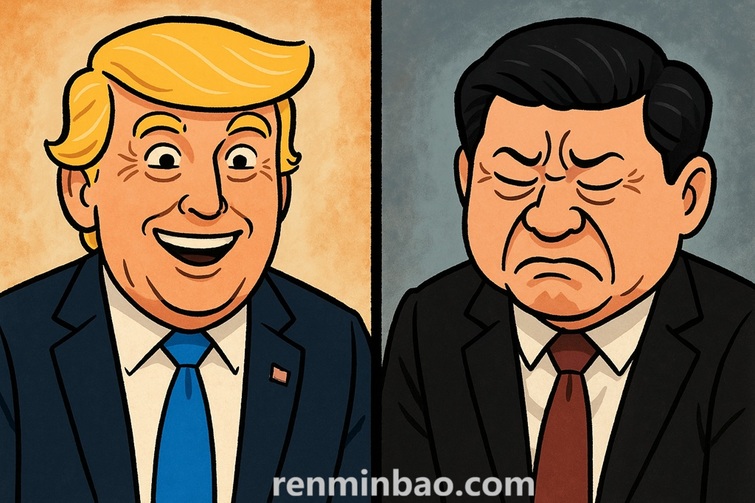
Thinking about taking action against Taiwan? Trump: You are free to think about it, but what are you actually going to do? (People News/AI-generated image)
[People News] Just one day after Xi Jinping's birthday, the U.S. Senate unanimously passed a notable resolution condemning Xi Jinping for fifteen crimes. Senator Scott, who introduced the resolution, openly expressed his disdain for Xi Jinping, stating, 'We should treat Xi Jinping as we would a tyrant,' and even wryly added, 'This serves as a way to celebrate Xi Jinping's birthday.'
Scott listed Xi Jinping's alleged offenses, which include concealing the COVID-19 pandemic, exporting fentanyl, engaging in trade fraud, manipulating exchange rates, stealing intellectual property, discharging toxic waste, coercing the signing of confidentiality agreements, committing genocide in Xinjiang, organ harvesting, perpetrating atrocities in Tibet, dismantling Hong Kong's 'one country, two systems,' suppressing dissent, military incursions into the Taiwan Strait, illegal fishing, and supporting terrorist organizations and dictatorial regimes.
In a detailed and thorough manner, he nearly covered all the common perceptions regarding the Chinese Communist Party's abuses. According to reports from Pursuer News, it turns out that Scott had visited Hong Kong during the anti-extradition movement, where he observed and supported the struggles of the Hong Kong people firsthand. In his recent speech, he candidly remarked, 'Six years have passed, and they still unjustly imprison my friend Jimmy Lai.' It appears that Scott has long been an 'old friend' of the Hong Kong people, and notably, the bill he proposed received unanimous approval from all Senate members.
The U.S. Congress has a history of passing various resolutions that condemn the leaders of foreign dictatorial regimes, including Russia's Vladimir Putin, Iraq's Saddam Hussein, and Serbia's Slobodan Milošević. These figures are infamous dictators and tyrants in contemporary history, and now Xi Jinping can be regarded in the same light as these notorious figures.
The Senate's unanimous passage of this resolution condemning Xi Jinping illustrates a bipartisan consensus in Congress regarding the Chinese Communist Party (CCP) and Xi Jinping himself. The CCP has committed numerous crimes during its over seventy years of rule, adopting values that starkly contrast with those of the United States and other democratic nations. Regardless of the CCP's fortunes or their rhetoric, they remain America's foremost adversary.
In the U.S. political system, Congress holds the highest authority over both domestic and foreign affairs, while the President and the government are tasked with implementing Congress's positions. Although Congress does not mandate specific actions from the government, the government must always consider Congress's stance in its decisions. The Senate's resolution condemning Xi Jinping, while largely symbolic and lacking legal force, will nonetheless influence the tone of U.S.-China relations due to the authority of Congress.
Trump, reflecting his background as a businessman, has at times embraced Xi Jinping and at other times engaged in minor political maneuvers. Nevertheless, as President of the United States, he could not escape the inherent American aversion to communism and openly recognized the CCP as a primary adversary in strategic terms. This Senate resolution acts as a declaration against communism, setting a foundational tone for U.S.-China relations for any future administration.
The Senate's bill offers another significant advantage: it provides a detailed account of the Chinese Communist Party's (CCP) crimes against humanity to the entire world. This marks the first time that international public opinion has produced such a thorough and unyielding condemnation of the CCP, which will facilitate other countries in having a complete record of these crimes when discussing the CCP in the future. Should there be a need to hold the CCP accountable, there is now an almost comprehensive ledger of their wrongdoings.
Additionally, this resolution sends the record of the CCP's crimes back to mainland China, effectively printing this record on Chinese soil. Some compatriots are aware of parts of this record, while others remain completely uninformed. When Chinese citizens reflect on their own experiences of suffering in contrast to the absurd propaganda of the CCP, they can achieve a deeper understanding of the CCP's true nature. Moving forward, whenever any events occur in China's domestic or foreign affairs, the Chinese people can use this as a reference point to critically analyze the CCP.
For years, Xi Jinping has been advocating for global governance, seeking to reshape the world according to the CCP's values and compete for dominance with the United States. The passage of this resolution by the U.S. Senate clearly establishes a boundary with the CCP, indicating that the U.S. and the CCP are irreconcilable political entities. The world cannot accommodate both nations in governance; where the U.S. holds sway, there is no room for the CCP, and the same applies in reverse.
This condemnation of the CCP is set to become the foundational document for the collective China policy of Western democratic nations. European countries are swiftly clarifying their positions against the CCP, and since Fumio Kishida took office in Japan, there has been a marked increase in proactive defense and foreign policy initiatives. As the United States' primary ally in the Asia-Pacific region, Japan is playing a supportive role in countering the CCP.
In the current international climate of anti-communism, this resolution emerges with a strong sense of shared animosity and is notably timely. As the U.S. and Iran are on the verge of concluding an unexpected conflict, it identifies the Chinese Communist Party (CCP) as America's true adversary. This shift allows the American public to disengage from the Middle East and refocus on U.S. interests and influence in the Asia-Pacific region.
At the time of writing, there was no specific response from the CCP regarding this resolution. While Xi Jinping undoubtedly harbors resentment, a public response would only draw more attention to the issue. It is likely that the CCP will choose to overlook it, allowing it to fade without comment. Regardless of the flattering rhetoric from Trump, the relationship between the U.S. and China remains fraught with deception, mutual sabotage, intermittent conflicts, and efforts to prevent escalation; this dynamic is unlikely to change in the near future.
You are defined by your enemies, and thus the U.S. stands as the arch-enemy of the CCP, a situation brought about by the CCP's own misdeeds. The CCP will not express regret, and the U.S. can only remain steadfast. Ultimately, when the conditions are right, both sides will confront each other on the battlefield, facing life and death. Both the U.S. and China are preparing for that inevitable day, and both nations are determined to fight to the bitter end; that day will surely arrive.
Source: (author's Facebook) △





News magazine bootstrap themes!
I like this themes, fast loading and look profesional
Thank you Carlos!
You're welcome!
Please support me with give positive rating!
Yes Sure!